

A new qualification for swim teachers is making a real splash after being added to the Scottish Credit and Qualifications Framework (SCQF).

Designed by the Swim Teachers’ Association (STA), the SCQF level 7 Swimming Teacher Qualification comes with eight credit points, which equates to 80 hours of learning.
The benefits of the qualification being on the SCQF
The qualification was put on the SCQF after completing the rigorous credit rating process by Qualifications Scotland Accreditation. This assures learners that the qualification is an official, properly recognised way into the profession.
At SCQF level 7, it is the same level of learning as Advanced Higher or an HNC, which tells helps you understand the knowledge and practical skill the course asks for.
The new qualification has been delivered to learners from April 2026.
Designed for how people learn now
This qualification was built with today’s learners in mind. Its aim is to help people build the skills, confidence and competence to teach safe, inclusive, effective lessons across the learn-to-swim pathway.
STA designed the course to reflect how people learn in today’s world. It begins with theory and then moves into practical, blended learning, so it fits the way learners process information.
The training is hands-on and face-to-face. Every learner gets assessed while teaching lessons, with real participants in the pool, in a safe and supportive environment. It’s competency-based, meaning it’s built around what the sector genuinely needs.
Learners are judged on their lesson planning and time management , alongside their teaching practice. The programme also uses AI-assisted marking to give an initial grade, but a human always reviews it before anything is final.
STA estimates 3,500 learners will become certified through the programme every year.

Why it matters
Jodie Davis, aquatics qualification development officer at STA, believes the SCQF recognition reflects the strength of the qualification and all the work that has gone into building it.
She explained: “Achieving SCQF Level 7 … provides clear assurance to employers, operators and learners in Scotland that this is a robust and professionally aligned route into the profession of swimming teaching. It also supports greater clarity and consistency across the sector, helping to strengthen workforce development and raise standards across aquatic education.”
What’s next
STA is rolling the qualification out across its network, working with training centres and tutors to make sure delivery stays consistent and of a high-quality.
Useful links
Find out more about the qualification at www.sta.co.uk.
Discover how a learning programme is placed on the SCQF.
Get to know the people behind the SCQF Partnership (SCQFP). In this new blog series, we shine a spotlight on our Board members and the valuable experience, perspectives and leadership they bring to the organisation. This week, it’s the turn of Rob Stroud.

Rob is the Executive Director of Quality Assurance and Enhancement at the Quality Assurance Agency for Higher Education (QAA), and was previously been Director of Assessment Services and Access to Higher Education.
Prior to this, Rob held senior roles at the Office for Students and Higher Education Funding Council for England.
As we celebrate the 25th anniversary of the SCQF, we caught up with Rob to learn more about his vision for the Framework’s future.
What’s been the most rewarding aspect of serving on the Board?
For QAA, membership of the SCQF Partnership is more than a governance responsibility – it reflects our commitment to Scotland’s qualifications landscape and our standing as a global leader in quality assurance and academic standards.
That expertise is what we bring to the Board: a view across multiple national systems and international contexts that allows us to consider how Scotland’s approach to qualifications and credit transfer compares with best practice elsewhere.
The Partnership gives us a direct channel through which to contribute meaningfully to a system that matters to Scottish learners, and to ensure that quality assurance thinking remains at the heart of how the SCQF continues to develop.
What do you see as the SCQF’s most important contribution to Scottish education and skills development in the past 25 years?
The SCQF’s most important contribution has been establishing a single, coherent framework that spans all levels of learning in Scotland – from the earliest stages of formal education through to doctoral level, and across schools, colleges, universities, workplaces, and communities. That breadth, captured across 12 levels, means that every qualification and every learning pathway sits within a common structure, giving learners, providers, and employers a consistent way to understand and navigate their achievements.
The alignment with the Framework for Higher Education Qualifications (FHEQ) has been particularly significant, enabling Scottish qualifications in higher education to be understood and recognised across the rest of the UK.
The referencing to the European Qualifications Framework extends that recognition further still, connecting Scottish learners and institutions to an international context.
How do you see the SCQF evolving over the next 25 years?
I think the next 25 years will be defined by the challenge and opportunity of lifelong learning.
The world of work is changing rapidly, and people will increasingly need to reskill and upskill throughout their careers, not just at the beginning of them.
The SCQF has an important role to play in supporting that – providing the common structure within which diverse learning, at any stage of life, can be recognised and valued.
Recognition of Prior Learning is one area where I hope to see continued progress. The SCQF Partnership has worked with the Scottish Government and made a contribution here, and there is a growing body of work across Scotland and beyond – from employers, professional bodies, colleges, and universities – that is helping to make RPL a more accessible and understandable concept.
The Partnership is one voice in that broader conversation, and the SCQF can continue to provide a valuable framework within which that work gains coherence and credibility.
There is also scope for the SCQF’s international influence to grow further.
Can you share an example of how you’ve seen the SCQF make a real difference to learners, training providers & employers?
Perhaps the most tangible difference the SCQF makes is in supporting learner progression across different parts of the education and skills system.
Being able to understand and compare qualifications using a common level and credit structure opens up pathways that might otherwise be unclear – whether that is credit transfer between a college and a university, or a learner returning to education understanding where their prior study sits.
For training providers, the SCQF Register helps learners do exactly that – providing a transparent, consistent way to understand and contextualise what is on offer.
What has struck me as a Board member, however, is the breadth of organisations beyond colleges and universities that are coming forward to have their qualifications credit rated on the SCQF. This is the Framework reaching into parts of the learning landscape that sit well outside the traditional education ecosystem.
Why should learners, training providers and employers care about the SCQF?
Because it is, at its heart, a tool for making learning count. People’s time and resources are precious, and when someone commits to a period of learning they deserve to understand clearly what that qualification means, what level it represents, and how it compares to others in the landscape.
For learners, the SCQF provides exactly that clarity – a consistent way to understand where a qualification sits and what pathways it opens up.
For training providers, having their programmes on the SCQF Register means that learners can make that informed comparison, understanding the level and credit associated with what is on offer.
For employers, it provides a reliable common currency for understanding and comparing the qualifications of the people they are recruiting or developing. In a labour market where skills are increasingly what matters, having a shared framework to express and understand those skills is not a nice-to-have – it is essential.
What makes the Partnership model effective for Scotland’s qualifications landscape?
The Partnership model draws together organisations with distinct but complementary roles across Scotland’s education and skills landscape. That breadth means the Framework has representation from across the full range of learning contexts it serves, which is an important structural feature.
The presence of bodies such as QAA on the Board brings an external and independent perspective – one grounded in experience of quality assurance systems across the UK and internationally – and that kind of external input has a valuable role to play in any governance structure.
What’s one thing you’d like more people to understand about the SCQF?
That it has been specifically developed to reflect Scotland’s particular needs and context. The SCQF is not a generic framework – it was built to make sense of the particular range of qualifications and learning opportunities that exist in Scotland, and the work of the SCQF Partnership is to ensure it remains relevant to that context as Scotland’s economy, society, and education system evolve.
Keeping a framework current and meaningful over time is a significant undertaking, and that is a core part of what the Partnership exists to do.
Get to know the people behind the SCQF Partnership (SCQFP). In this new blog series, we shine a spotlight on our Board members and the valuable experience, perspectives and leadership they bring to the organisation. First up, it’s Gillian Brydson.

Gillian is Executive Director of Education, Skills and Community Wellbeing for Dumfries and Galloway Council, having previously been Director of Education and a local authority chief officer for many years.
Before moving to local government, she was a lecturer in the college and university sectors.
Her current role has responsibility for overarching functions that have relevance to the work of the SCQFP, including schools, early years, adult and community learning and employability and skill.
Through this, she also brings her experience of the wider learning system to the SCQFP’s Quality Committee.
As we celebrate the 25th anniversary of the SCQF, we caught up with Gillian to learn more about her vision for the Framework’s future.
Tell us about your role:
My role at Dumfries and Galloway Council encapsulates lifelong learning, from our early years provision, through schools and our community learning and development.
We have been supporting many New Scots with skills for work and progression through the SCQF levels of English for Speakers for Other Languages (ESOL).
What’s been the most rewarding aspect of serving on the Board?
Having a structured national qualifications framework, and one which is mapped to other systems, helps shared understanding of achievement.
It has also been rewarding to see the re-emergence of policy intent around the Recognition of Prior Learning, and the pivotal role of the SCQFP in this.
What do you see as the SCQF’s most important contribution to Scottish education and skills development in the past 25 years?
The transparency and stability offered by the SCQF has given the system a constant frame of reference during times of much discussion about the need for education and skills reform.
It has recently been reported that the government’s Post-School Education and Skills Reform programme aims to create a simpler system, more responsive to Scotland’s economic and social needs and I will be promoting the importance of the SCQF and the Recognition of Prior Learning as part of this work.
Duplicating or repeating learning is not economically sensible – for learners, providers or employers but the landscape can be fragmented and confusing.
I promote the SCQF as the tool to help people understand the levels and values of qualifications, recognise their prior learning to meet their ambitions, which may include increasing their family income, while helping meet the needs of a changing economy and society.
How do you see the SCQF evolving over the next 25 years?
I see the SCQF evolving over the next 25 years as the partnership establishes the basis for a revised education and skills system which is trusted and respected.
There will need to be balances struck to ensure rigour and quality, while being agile and responsive; this can be best managed through a well governed partnership.
Can you share an example of how you have seen the SCQF make a real difference to learners, training providers or employers?
Reflecting back to my work with New Scots, I can see daily examples of where ESOL learners have used clear learning pathways towards qualifications which recognise and validate their learning.
Understanding the rungs of the ladder needed to access specific college courses or meet the specifications of particular jobs gives direction towards the world of work, increasing feelings of belonging and purpose often supporting their wider community and increasing their family income.
I have many individual examples of where learners and employers have used the SCQF has a frame of reference to help make expectations clear, particularly when people are coming from different education and training systems.
We have rich seams of talent across our country; we can use the SCQF as the groundwork to support people into good jobs. If we collaborate to keep it simple and clear and well governed, we can use the Framework to improve economic prosperity in our communities.
Useful links
Learn more about the SCQFP board and its members
Watching football is one thing. Actually analysing it? That’s a whole different ball game and Glasgow Clyde College is now giving students the chance to learn exactly how it’s done.
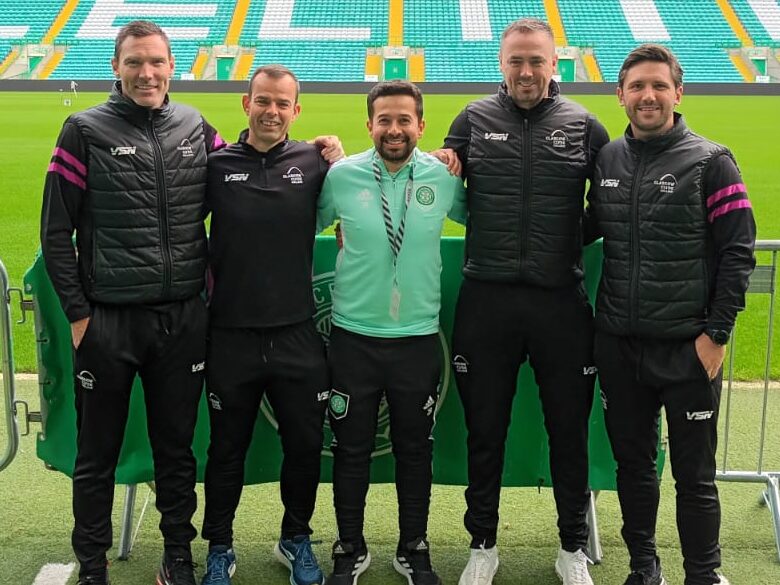
The college, a recent winner of the Herald Further and Higher Education Awards FE Institution of the Year, is the first in Scotland to launch a dedicated Applied Performance Analysis in Football unit.
Whether you’re dreaming of a career as a coach, an analyst or a scout, this could be the foot in the door you’ve been looking for.
What’s football analysis all about?
The SCQF level 6 unit sits within Glasgow Clyde College’s NQ Football Performance course at the Cardonald campus and was built from scratch by sports lecturer Grant Cassidy and curriculum manager David McGurn – two guys who love both football and finding new ways to teach it.
The idea is simple but powerful: there’s a massive difference between watching a match and truly understanding what’s happening on the pitch. This unit gives you the tools, the software and the analytical mindset that professional clubs use every single day.
We’re talking real industry software – NAC Sport, Hudl, Coach Paint – plus live match analysis, consultancy projects with local clubs and building your own professional scouting reports. It’s hands-on, career-focused and built around what the game actually looks like at the top level.
Football analysis is a ‘fast-growing role’
Grant explained: “We wanted to create something bespoke, unique and career-focused – a programme that gives students a real taste of what performance analysis jobs in football look like. There’s a real difference between simply watching football and actually analysing it and this unit gives our students the building blocks to become future analysts, coaches and scouts.”
David, himself a former professional goalkeeper, added: “Performance analysis is one of the fastest-growing roles in football, but it’s also one of the least understood. By embedding this into the curriculum and working closely with clubs, we’re helping to create a new pathway into the sport that could put Scotland on the map as a leader in football analysis education.”
Don’t like writing? Don’t worry
What stands out about this course is how it’s been designed with inclusion front and centre. Following Universal Design for Learning principles, students can show what they know through written work, visuals or oral presentations. No one-size-fits-all approach here, just a genuine focus on making sure every student can succeed and walk away with a portfolio that reflects real-world experience.
And the results are already speaking for themselves. One former student has gone on to work at Queen’s Park FC, and their experience directly helped shape the structure of this unit. The course can also be adapted for clubs at any level – from grassroots all the way up to the Scottish Premier League and Scottish Women’s Premier League.
What’s next?
The long-term ambition goes well beyond the classroom. Glasgow Clyde College wants to work directly with football clubs across Scotland to shape coaching strategies and player development.
For now though, if you’re a football obsessive who’s always wanted to go deeper than the highlights reel, this might just be the course that changes everything.
Useful links
Discover how this SCQF level 6 qualification compares on our interactive framework.
With football capturing global attention during the World Cup, there has never been a better time to develop your coaching knowledge and skills.
As fans watch the world’s best players and coaches compete on the biggest stage, many are inspired to take a closer look at what happens behind the scenes to create successful teams.
The Applied Principles and Practices of Football Coaching unit – available as part of Glasgow Clyde College’s NQ Football Performance and Coaching course at SCQF level 6 – offers the opportunity to do exactly that.
Learn about effective football coaching
Written by curriculum manager David McGurn and sports lecturer Shaun Gallagher, the unit has been designed for aspiring coaches, current practitioners, players and football enthusiasts.
It provides a practical and engaging introduction to the key principles that underpin effective coaching.
Learners explore how to plan and deliver football sessions, analyse technical and tactical performance and create learning environments that help players develop.
By combining theory with practical coaching experiences, participants gain the confidence to apply modern coaching methods in real-world situations.
Delivered with Celtic Soccer Academy
The 18-week NQ course, which includes the coaching unit, is delivered in partnership with Celtic Soccer Academy.
Learners develop their technical abilities and tactical game via weekly coaching sessions from the Celtic Soccer Academy and earn a range of SFA Awards along the way.
As this is a pathway course, it can also lead to further studies or even possible opportunities with Celtic Football Club, Celtic Soccer Academy or the Celtic Foundation.
Sports lecturer Shaun is proud of the learning and career progression offered to the students at Glasgow Clyde. He said “Over the years it’s progressed from an SCQF level 4 programme, to level 6, now level 7 and potentially onto level 8, going from NQ through to HNC and possibly HND. The way the students have developed under the stewardship of the coaches at Celtic has been incredible.”
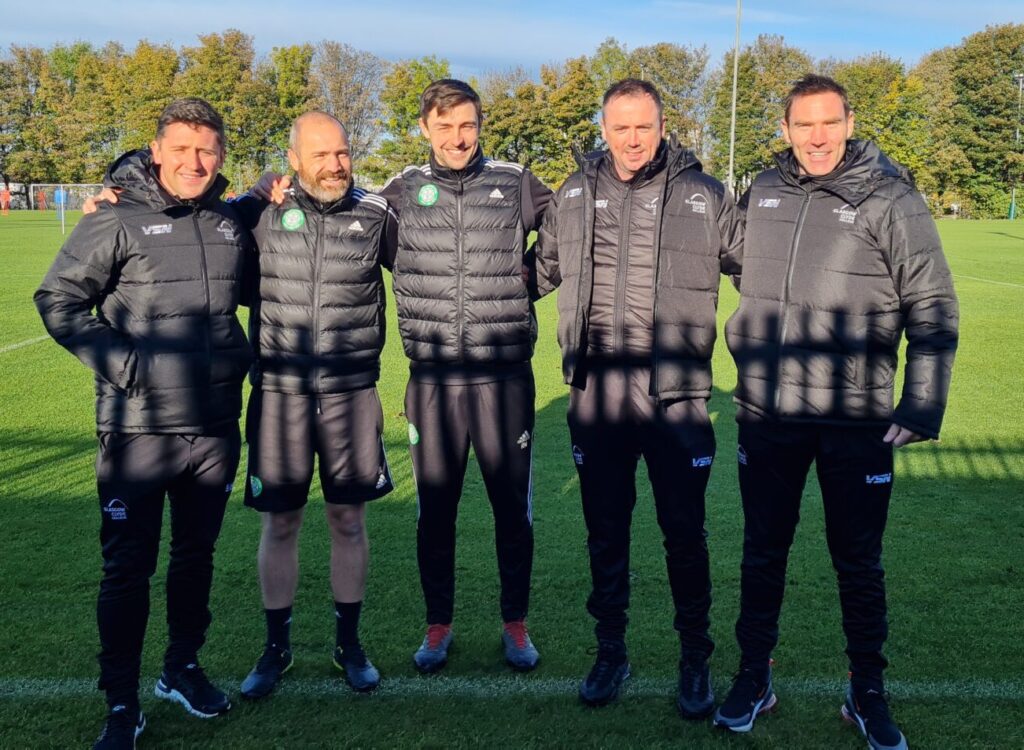
To date, 30 graduates from the course have progressed into employment with Celtic FC.
NQ student Barry Templeton praised the course. He said: “I want to be a head coach and possibly start my own football academy. Since being on the course, the number of experienced coaches we’ve met has been great. The amount of experience, the amount of tactical knowledge, the everyday workings of a football club. So … it’s been great to get to know all that.”
Award-winning
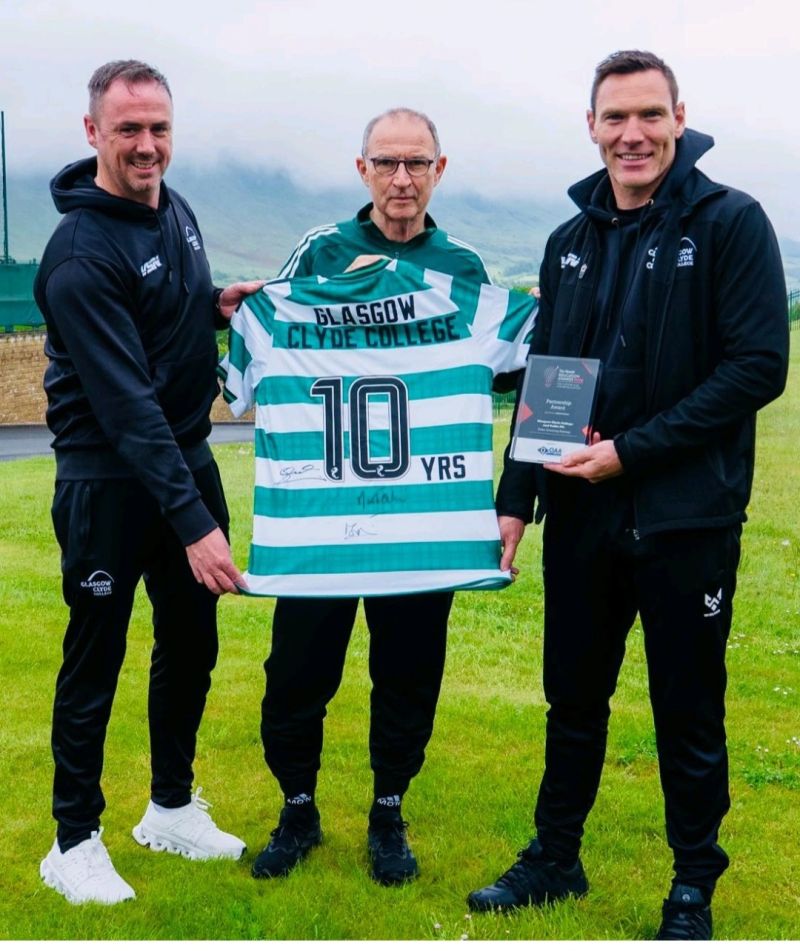
The Soccer Academy has been partnered with Glasgow Clyde College for the past 10 years and the collaboration has scooped the Partnership Award at the recent Herald Education awards.
As the World Cup inspires the next generation of footballers, it can also inspire the next generation of coaches. This course offers a fantastic opportunity to turn that inspiration into meaningful learning and professional development.
Whether you’re hoping to begin a career in football coaching, enhance your current practice, or simply deepen your understanding of the game, this programme provides the knowledge and practical skills needed to support players at every level.
Useful links
Find out more and submit your application now ahead of the course start date in August 2026.
Discover how the SCQF level 6 qualification compares on our interactive framework.
Over three rare hot days of Scottish sunshine in May, experts in qualifications, training and vocational education from across the world came together for our international study visit, delivered in partnership with British Council Scotland.
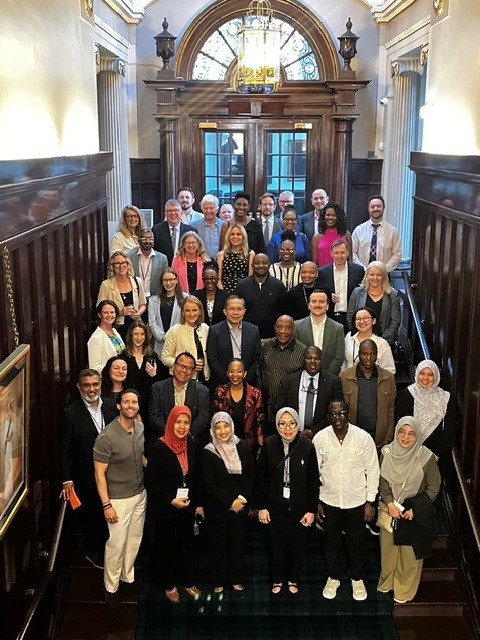
Our guests, representing countries across Africa, Asia and the Caribbean, wanted to learn about the Scottish Credit and Qualifications Framework (SCQF), and importantly, how it has endured for 25 years and continues to enable a thriving lifelong learning landscape.
Over the three days, spanning visits and talks with universities, colleges, employers, training providers, qualification owners and more, we explored the SCQF in practice. But one theme surfaced repeatedly – the importance of partnership working to the success of the SCQF.
Building trust through partnership
While the SCQF was intentionally designed to map the existing Scottish education landscape and enable future innovations, it is trusted for more that its design. It is trusted because of long-standing, open collaboration between organisations that shape and deliver education and training in Scotland.
The SCQF was created after years of discussion about how to better connect Scotland’s education system through a shared framework based on credit and levels.
What made its implementation successful is that the Framework was, and still is, governed collectively by our partners and, by extension, the whole Scottish education system. Our founding partners, the Quality Assurance Agency for Higher Education, the Scottish Executive (now the Scottish Government), the Scottish Qualifications Authority (now Qualifications Scotland) and Universities Scotland, remain central to the partnership today, and have grown to include many other key agencies.
These relationships have not been transactional or short term. They have been transparent and grounded in shared purpose, allowing the SCQF to act not as a mechanism of control, but as an enabler across Scotland’s education and skills system.
A founding principle that endures
The SCQF’s partnership model was created in a large part thanks to Sir Andrew Cubie, who went on to become the first Chair of the SCQF Partnership.
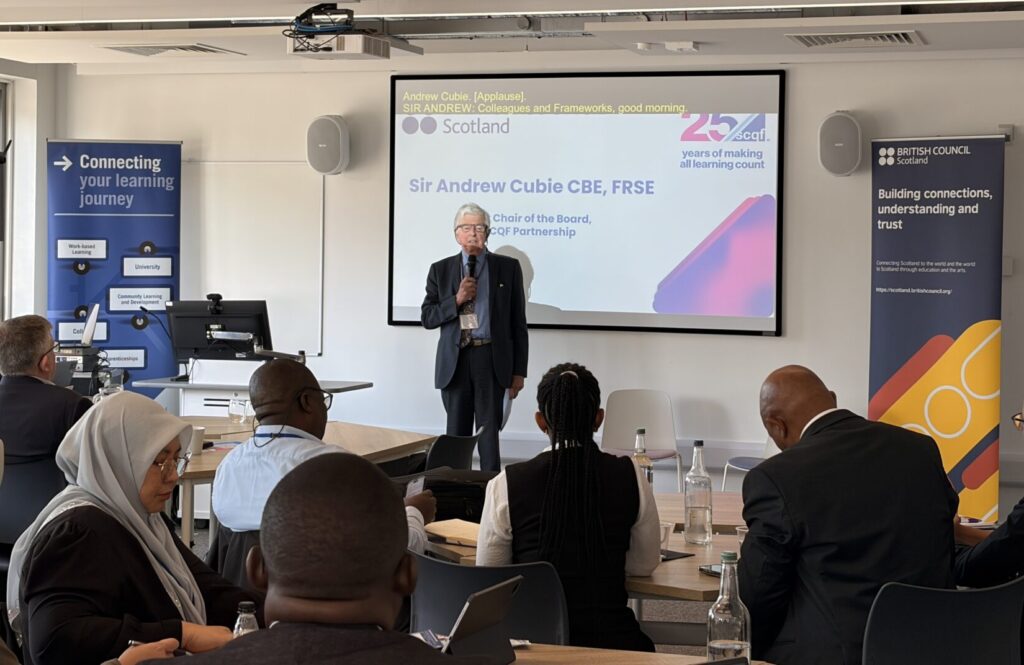
As a special guest speaker on day one of the study visit, Andrew (pictured right) reflected to our delegates that his passion for true lifelong learning goes back to his childhood. As a child, he failed his 11+, which sparked his later-life mission for the need for respect to be given both to vocational and academic qualifications. “Parity of esteem” remains one of his mantras. When he was approached to become involved in formalising a Scottish framework to blend academic and vocational qualifications, in his words, he could hardly say no.
In 2006, Andrew got all the SCQF partners round a table at a restaurant in Edinburgh, with him footing the bill. He urged the partners to establish a company limited by guarantee and the Scottish Credit and Qualifications Framework Partnership was incorporated on 7 November 2006.

Partnership in practice
Our international colleagues saw the true collaborative nature of the Scottish education system in action throughout their visit.
It was fitting that the visit itself was delivered in partnership with British Council Scotland, with whom we share an ambition to showcase the very best of Scottish education on the world stage.
From our fantastic hosts at Glasgow Caledonian University – where discussions explored the foundations of the SCQF and approaches to Recognition of Prior Learning – to Celtic Renewables and Forth Valley College, delegates saw how the framework is applied across different settings. Whether through employer engagement with apprenticeships and work-based learning or innovative qualification delivery aligned with local industry needs, the common language of the SCQF and its flexible principles remained consistently tangible.
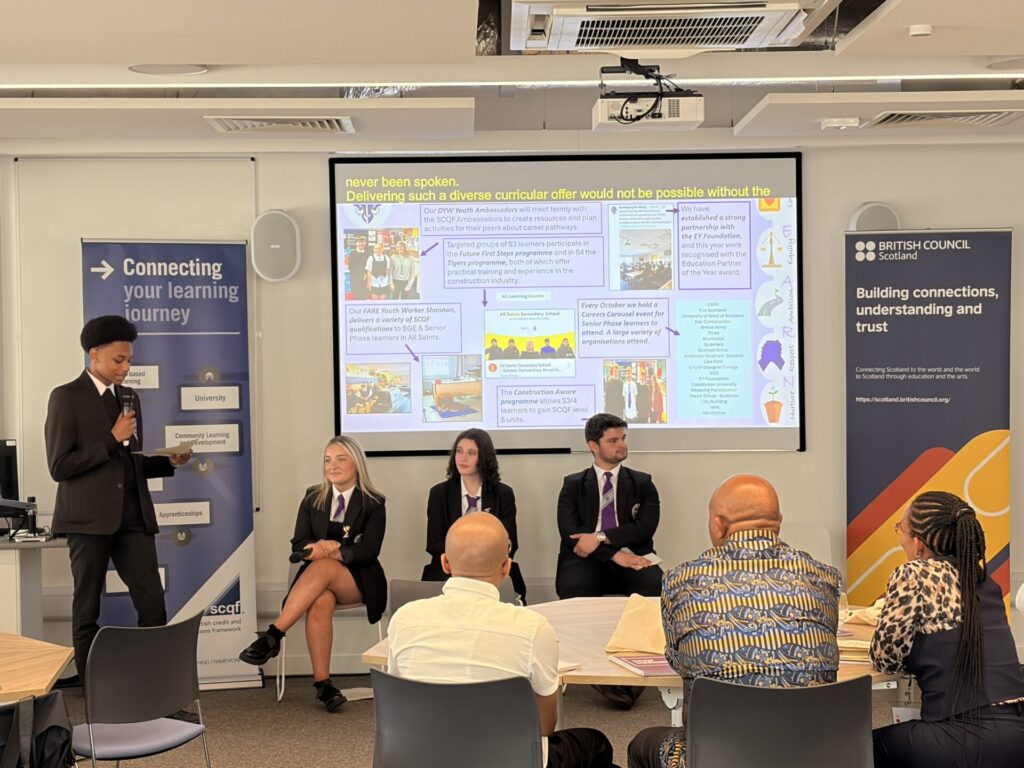
And, in hearing first-hand from SCQF School Ambassadors at All Saints Secondary School (pictured right) they saw how the Framework expands the understanding of the opportunities available for young people in meaningful and digestible ways.
Trust is not built into a framework. It is built around it.
There is no single blueprint that can be lifted from one country to another. But one lesson resonated strongly across our discussions: Qualifications frameworks are not just technical systems, they are social agreements that depend on trust, and that trust is built on partnership.
As we mark 25 years of the SCQF, this remains our most important insight. The ongoing success of the SCQF will rely on how we continue to invest in the relationships that sustain it.
Because, ultimately, a national qualifications framework’s value is not defined solely by how it is written, but by how widely it is trusted and used.
Continuing the conversation at SCQF@25
The themes explored during our international study visit – partnership, trust and shared purpose – remain as relevant today as they were when the SCQF was first established.
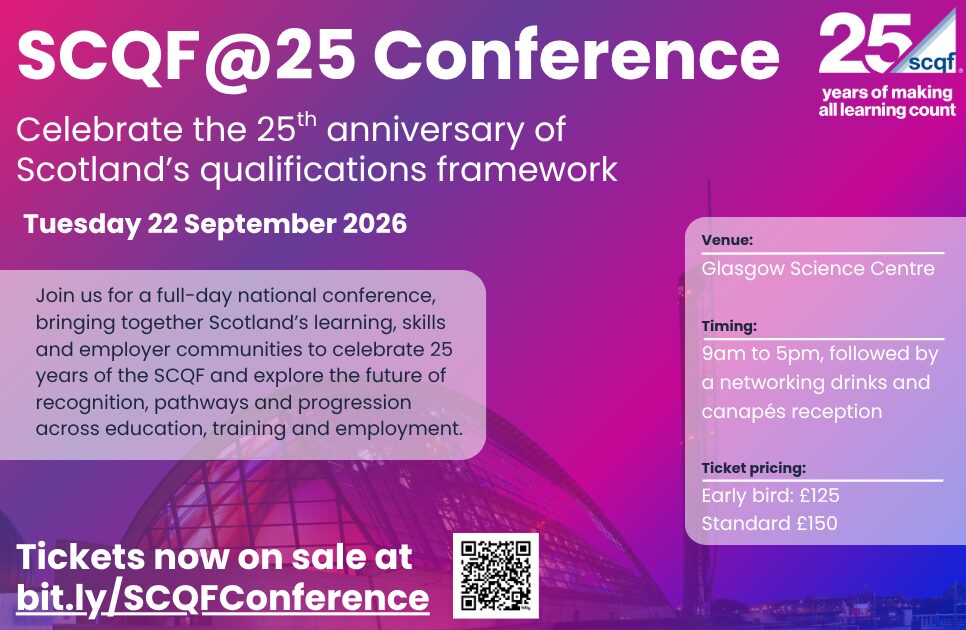
As we celebrate 25 years of the Framework, these ideas will take centre stage at a major milestone event in our anniversary year – the SCQF@25 Conference, taking place on 22 September at Glasgow Science Centre.
Bringing together voices from across Scotland’s learning, skills and employment landscape, the conference will provide an opportunity to reflect on the partnerships that have shaped the SCQF’s success, explore current challenges and opportunities, and consider how we can work together to support learners, employers and educators in the years ahead.
Please join us in the celebrations. Tickets are now on sale at bit.ly/SCQFConference
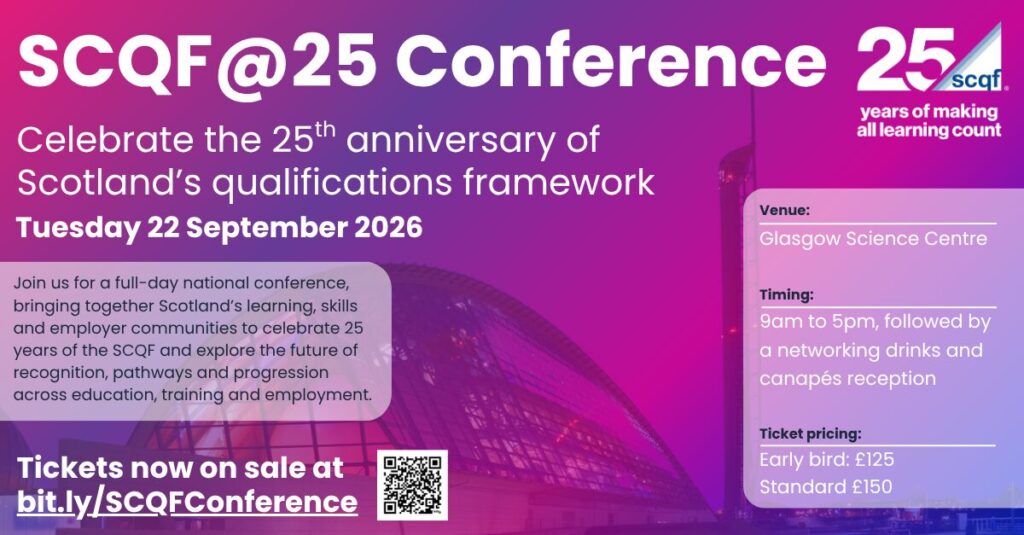
In 2026, Scotland celebrates a significant milestone — 25 years of the Scottish Credit and Qualifications Framework (SCQF). To mark this achievement, we are delighted to host the SCQF@25 Conference, a national event bringing together voices from across Scotland’s learning, skills and employment landscape.
A milestone worth celebrating
For a quarter of a century, SCQF has played a vital role in helping people understand qualifications, build pathways, and progress in learning and work. The Framework has supported individuals, educators and employers alike by creating clearer connections across education, training and employment.
The SCQF@25 Conference offers a unique opportunity to reflect on this journey – and, importantly, to look ahead to the future.
Event details
- Date: Tuesday 22 September 2026
- Venue: Glasgow Science Centre, 50 Pacific Quay, Glasgow, G51 1EA
- Time: 9am to 5pm
- Networking: Drinks and canapés reception to follow
This full-day conference will provide a vibrant and engaging space to explore the evolution of SCQF and its impact across Scotland.
What to expect
The conference will bring together a diverse mix of attendees from across:
- Education
- Skills and training
- Industry and employers
- Policy and public sector organisations
Throughout the day, participants can expect:
- Insightful keynote sessions
- Thought-provoking panel discussions
- Opportunities to share best practice
- Meaningful networking with peers and partners
Tickets now on sale
Tickets for the SCQF@25 Conference are now available:
- Early bird (closing Friday 21 August): £125
- Standard: £150
Book your place at bit.ly/SCQFConference
Early booking is strongly encouraged to secure your place.
For more information, email conference@scqf.org.uk
Qualifications Scotland (formerly SQA) results are due on Tuesday, 4 August, 2026.
If you have signed up to My Qualifications Scotland, you will receive your results by text or email. Everyone will also receive their results certificate by post.
SCQF levels and credit points are included in all Scottish qualifications certificates, so understanding what these mean can help when making decisions about your future learning or career options.
Watch our video below to learn more.
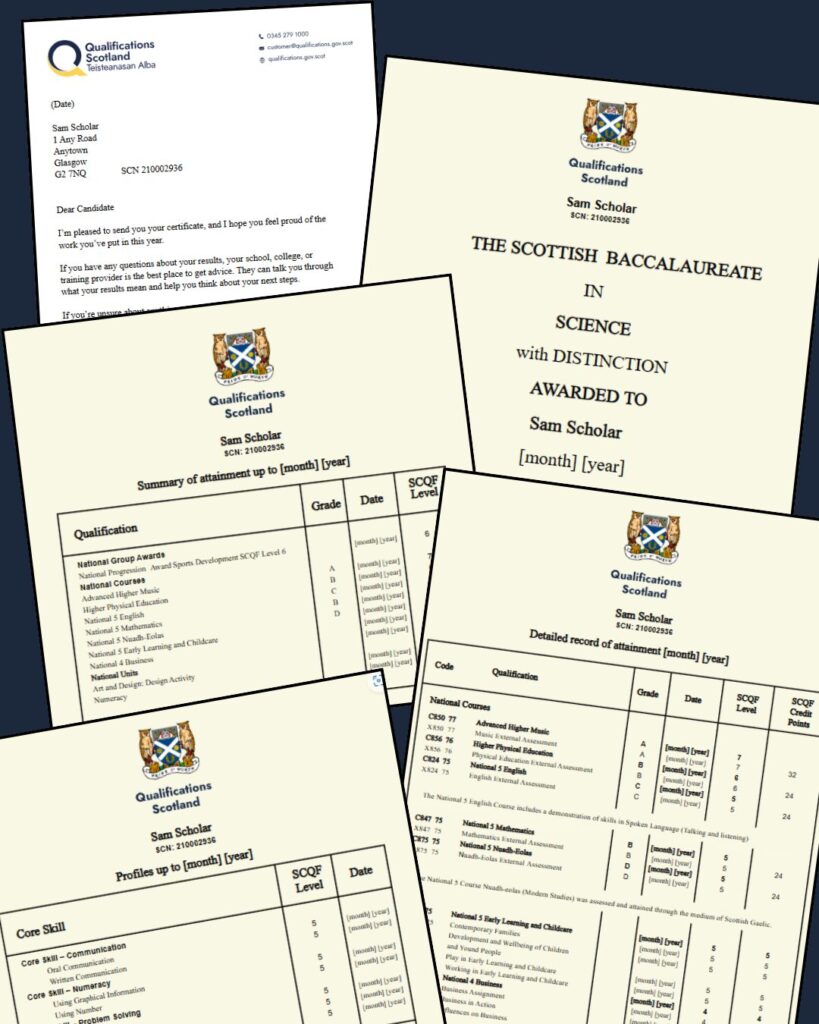
Your Scottish Qualifications certificate
Inside the envelope, you will receive:
- A letter, which has a short message and it may also state that you have not passed the subjects/courses listed.
- A commemorative certificate if you have passed a certain qualification – the full list is on the Qualifications Scotland website here.
- A summary of attainment, which shows all the SQA/Qualifications Scotland qualifications you’ve passed since 1995, including their SCQF level.
- A detailed record of attainment, which features the SCQF level and credit points for each qualification listed.
- A profiles page, which outlines the core skills you’ve gained while completing the qualifications, and their SCQF level. It also outlines the total number of credit points you’ve gained at each SCQF level. An explanation of SCQF levels and credit points is featured below.
What is the SCQF?
The SCQF is the Scottish Credit and Qualifications Framework and it provides a way of comparing Scottish qualifications. The Framework features the qualifications you will achieve at school, college, university and many other qualifications you may go on to achieve at work or in the community. Each qualification has an SCQF level and credit points.
What are SCQF levels?
The Scottish Credit and Qualifications Framework has 12 levels. The different levels indicate the level of difficulty of a particular qualification, with 12 being the most challenging.
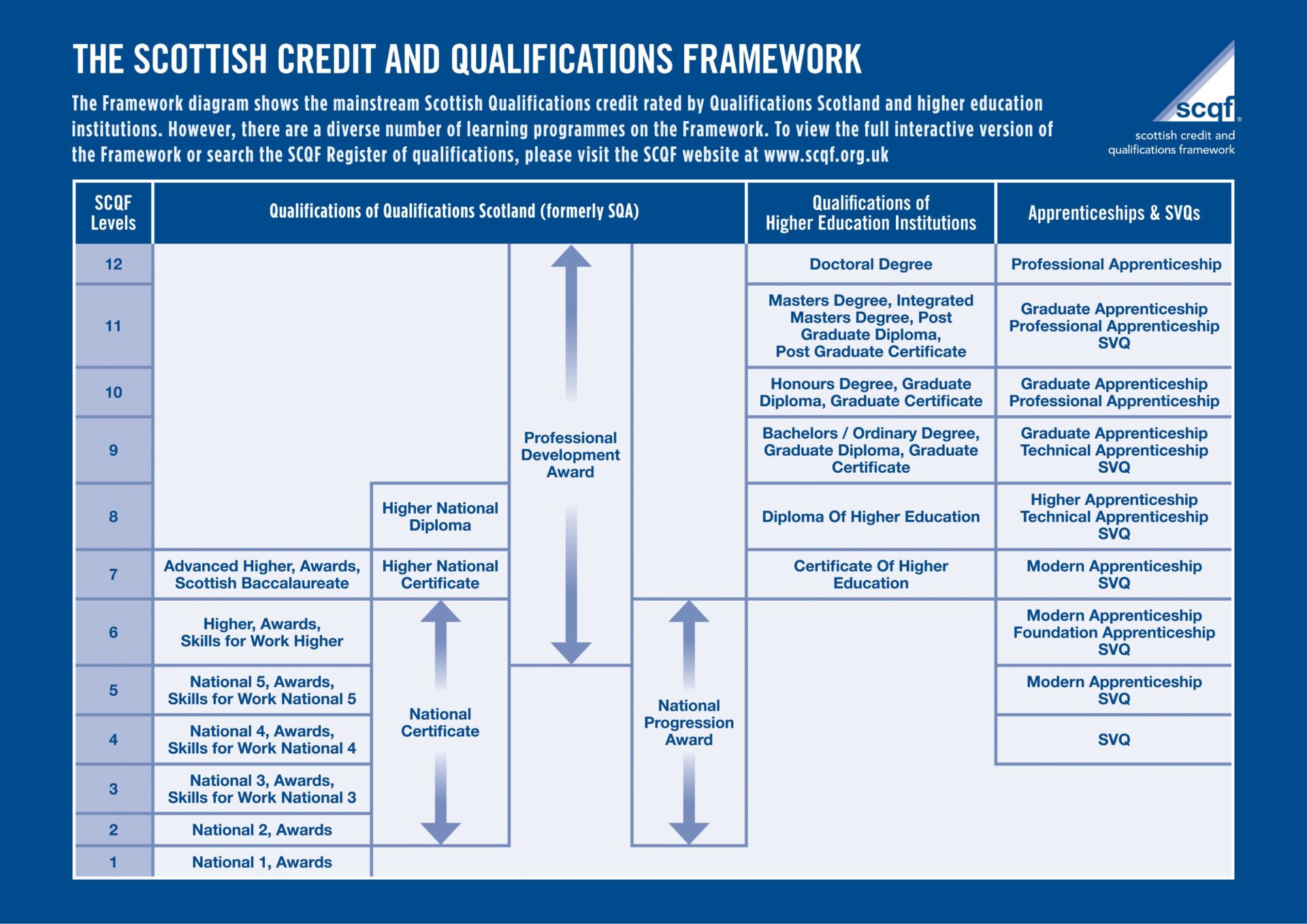
Find your level of learning and compare qualifications on our interactive framework diagram
What are SCQF credit points?
Credit points are a way of showing how much time it takes, on average, to complete a qualification or learning programme. They allow learners, learning providers and employers to compare different qualifications at the same or even different levels.
One credit point is approximately 10 hours of learning. For example, 15 credits involves 150 hours of learning.
What is the SCQF for?
The SCQF makes it easier to describe, compare and understand qualifications. Before the SCQF, there was no easy way to compare different qualifications. Now it is easy to see that, for example, a National Progression Award (NPA) at SCQF Level 5 is at the same level as a National 5. Most Scottish universities and colleges now use SCQF levels and credit points to describe their courses.
The SCQF can:
- help you plan your learning and make the right choices;
- help employers understand your qualifications;
- help universities or colleges identify the level you have studied at in a particular subject, and make it easier to transfer credits between different learning programmes;
- increase your confidence by showing you the level of learning you have achieved; and
- recognise other areas of formal and informal learning or skills that may help you to develop and achieve your goals.
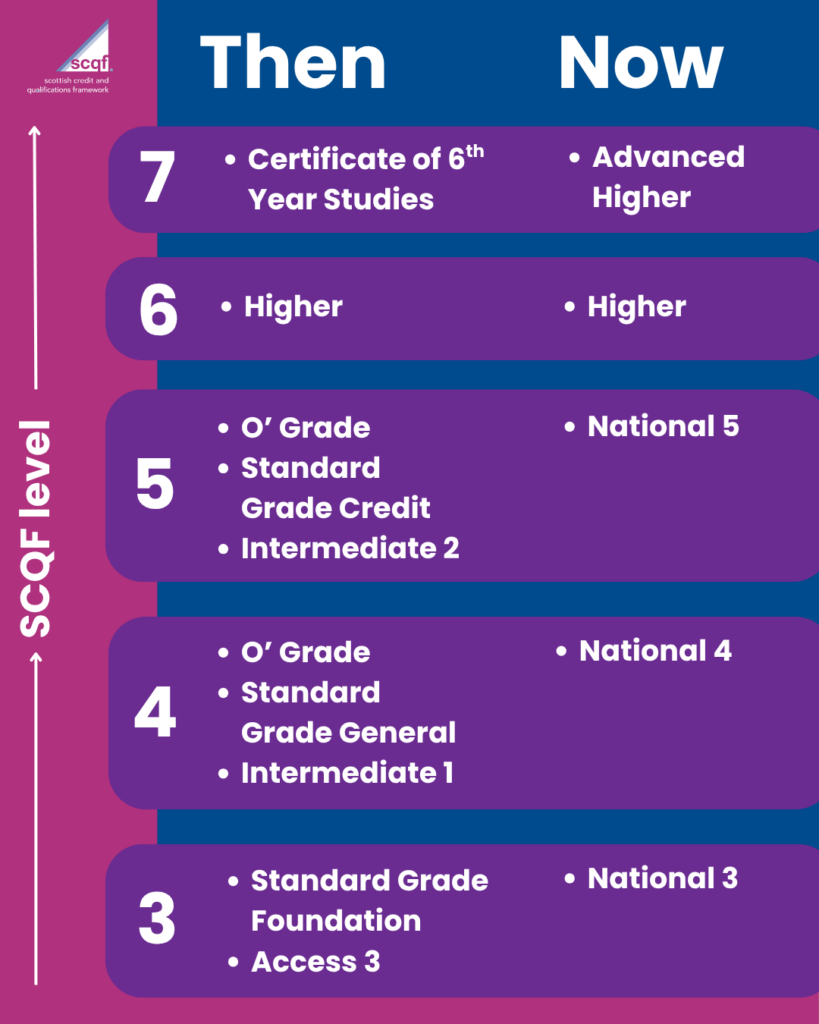
Comparing old vs new qualifications
The names of qualifications have changed over the years, but that doesn’t mean they’re harder, easier or less valuable – they’re just different. To help you make sense of all it, we’ve created a handy guide to help you understand how older qualifications relate to today’s.
View the simplified version, right, or download the more detailed Old V New, which contains more qualifications, such as Skills For Work, National Progression Awards and Foundation Apprenticeships.
By understanding how your qualifications relate to your child’s, you’ll be able to support them with confidence on results day.
Frequently asked questions
Are SCQF credit points the same as UCAS tariff points?
SCQF credit points are not the same as UCAS tariff points. UCAS tariff points relate to the grades you have achieved. SCQF credits are a measure of how long it takes to achieve a qualification, no matter what grade you get.
Why does an ‘A’ at Higher get the same number of SCQF credit points as a ‘C’ at Higher?
The number of SCQF credit points you’ve gained doesn’t change depending on your grade at any particular level. SCQF credits reflect how many hours of learning you’ve done, not how well you’ve learned a subject.
Will my qualifications be recognised if I move abroad?
SCQF levels are referenced against the European Qualifications Framework (EQF), so learning institutions and employers in Europe can easily compare your qualifications against their own country’s qualifications framework.
If I build up SCQF credit points, will I get into college or university?
Not directly, although SCQF credit points help admissions officers in colleges and universities know exactly how much learning you have done and at what level. The admissions officers still have other factors to consider, such as the subjects you studied and grades you achieved.
Will the SCQF help me to get a job?
Not directly, but it will help employers understand the level of difficulty of each qualification, as well as the number of credit points you have achieved as part of your personal development. As your career develops, any work-based qualifications you achieve may add to the number of credits you already have.
What if don’t get the results I expected?
There is more than one path to get you to where you want to go. You can use our interactive framework to help you plan your learning journey. For example, if you want to go to university, but don’t have the grades, you can apply to study an HNC or HND at college. Many colleges have articulation agreements with universities so that students can gain entry into the second or third year of a university course upon completion of their college qualification. Contact your local college for more information. An apprenticeship is also a valuable option that could bring you a step closer to your ideal career.
Results Helpline
Skills Development Scotland’s Results Helpline goes live at 8am on results day.
- Tuesday and Wednesday: 8am to 8pm
- Thursday and Friday: 9am to 5pm
The SDS Results Helpline number is 0808 100 8000.
You can talk to SDS’s expert careers advisers about course vacancies at UK colleges and universities, Confirmation and Clearing, advice about Foundation, Modern, and Graduate Apprenticeships, jobs, volunteering, or staying on at school.
SDS careers advisers are at the end of the phone to help young people and their parents and carers.
There’s also lots of results support on Scotland’s career website, My World of Work – it’s packed with advice, information and resources.
If you would prefer to speak to someone in person, you can visit an SDS centre or community venue to talk to a careers adviser about your results and next steps. No appointment is necessary. Find your nearest centre at Contact us – Skills Development Scotland
BSL users
BSL users can use Contact Scotland BSL for support in speaking to an adviser. You can use their app to sign up with an interpreter who will make the phone call for you. Visit contactscotland-bsl.org
**Before 4 August you can still speak to an adviser by calling 0800 917 8000, Monday to Friday, 9am to 5pm.
Qualifications Scotland support
If something is wrong or missing from your certificate, call your school/college who will contact Qualifications Scotland Support on 0345 279 1000.
For other queries, email mailto:customer@qualifications.gov.scot or phone 0345 279 1000.
Learner support for National Qualifications – Qualifications Scotland
Information on Qualifications Scotland Appeals
Useful links
We offer support for learners and their parents/carers at Support for Learners.
You can also visit Qualifications Scotland, Young Scot and My World of Work and for parents there’s NPFS and Connect.
If you have any further questions relating to SCQF credits or levels, please get in touch via email on info@scqf.org.uk, or connect with us on Facebook or Instagram.