

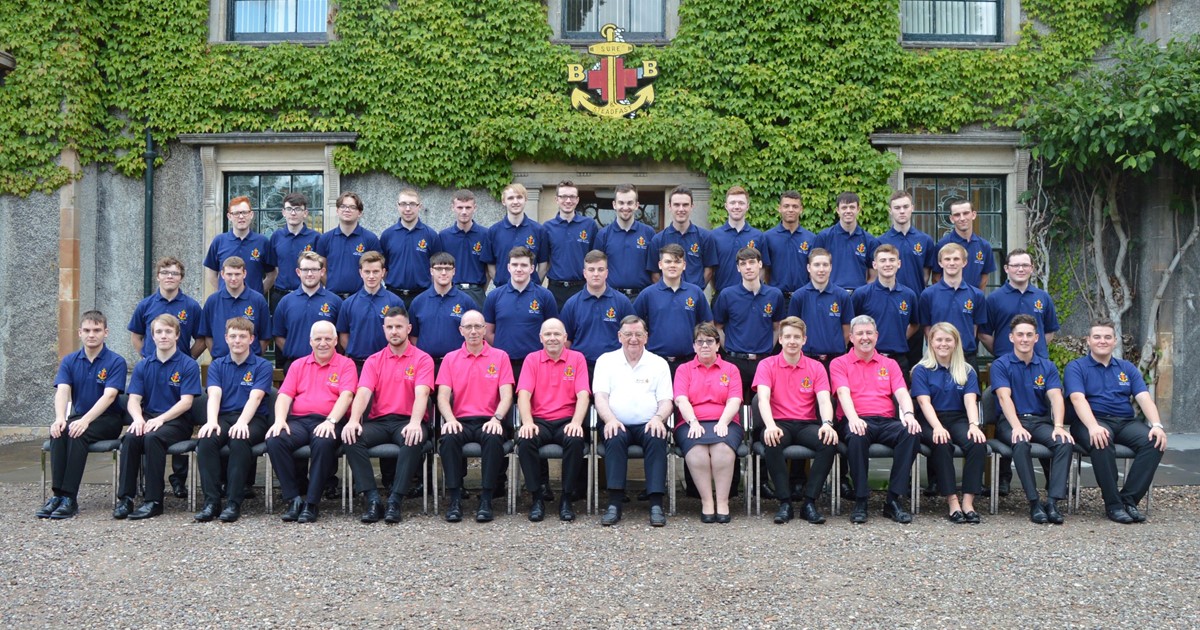
Is that on the SCQF…? is a series of blogs, where we look at some of the more unusual programmes that are on the SCQF. Read on to find out more about the King George VI Youth leadership Programme from Alan Hunter, Training & Development Officer with the Boys’ Brigade.
For a couple of weeks during the summer, Alan Hunter, The Boys’ Brigade in Scotland’s Training Officer’s focus is firmly on supporting BB young leaders, in the KGVI Youth Leadership Programme, at their national training centre at Carronvale House. The programme is credit rated by the Scottish Qualifications Authority (SQA) on to the Scottish Credit and Qualifications Framework (SCQF) at level 7, with 13 credit points.
The KGVI Youth Leadership Training Course (KGVI) is a programme of learning for young people, aged between 17 and 22, wishing to become Leaders in The Boys’ Brigade, comprising 2 one-week residential courses, one year apart, with supervised practical application back in the local group in the interim.
KGVI helps develop knowledge, skills and attitudes, required by effective youth workers, through practical and theoretical application, making use of a range of leadership, teamwork and life skills in a variety of contexts.
The programme comprises a series of three Modules in first year:
- Leadership, Communication and Relationships;
- Youth Leader Training – the Brigade’s leader training programme, incorporating a series of generic youth work modules;
- BB programme – training in specific BB related programme activities;
with a continuation of the first and last modules in second year.
Part one is mainly tutor-led interactive sessions, whilst Part two is an opportunity for the young leaders to demonstrate what they have learned and implemented back in the local group between the two courses.
The programme explores the important impact volunteers have on everyday life, giving learners experiences which are topical, and developing skills for learning, life and work, that will be of instant use when working with children and young people. Learners are involved in activities which are challenging, motivating and inspiring.
Josh, a young leader from Polmont said, “Membership of the BB has been a huge part of my life. Growing through the sections I developed a love and passion for the BB and I am proud to be a part of such a great organisation. KGVI has been a great help for my personal development as I have met like–minded young people and built good relationships with them. Skills learned at KGVI also helped me in interview, as a task we did at KGVI came up in the interview.”
Whilst the majority of participants will have come through all the sections as a young person, some will have come along to help as a young leader, like Heather from Paisley, who commented, “Throughout my six years in the BB as an Anchors leader, I have gained so much – from growing in confidence to meeting new friends. The relationships and connections I have made have been brilliant. Meeting everyone from all ages and walks of life, it has encouraged me to do the best I can do. Completing KGVI has enabled me to grow as a person, as I now have a lot more confidence, being able to chat to an audience of people listening to me, or voice what I feel is right and not be embarrassed or scared.”
For young people like Josh and Heather, being able to complete KGVI, a fun and life-changing experience, is great. To be able to achieve a widely recognised SCQF credit rated qualification in the process provides the icing on the cake.
For more information on the KGVI visit the website.
For more information on learning programmes on the SCQF, have a look at the SCQF register.
by Lynne Allison, PT Raising Attainment and Achievement, Clydebank High School
The SCQF has provided Clydebank High School (CHS) with many opportunities not only for our young people but also for staff and parents. Getting involved in SCQF competitions has allowed pupils to take on leadership roles within the school as well as raising awareness of the Framework; the young people have worked hard to promote the importance of qualifications at all levels and to dismiss the stigma attached to SCQF level 4 qualifications and Modern Apprenticeships. These leadership opportunities have given our young people a platform and a voice to talk in real terms about their qualifications and aspirations.
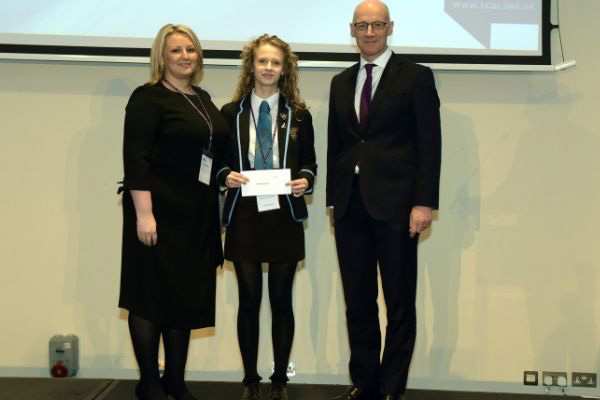
Paige Dunlop, Head Girl and pupil ambassador (2017-18), said, “Being an SCQF Ambassador has opened my eyes to many the different pathways available in Scottish education. I have learned the value of all qualifications and destinations, which previously I would not have considered. This knowledge has helped me support my peers. Furthermore I have had some unforgettable experiences such as attending the SCQF conference to collect our award for recognition of our hard work and meeting Deputy First Minister John Swinney.”
CHS has been able to successfully implement wider achievement programmes as pupils and staff can see the value in these courses as they can use the Framework to compare qualification levels.
Furthermore the SCQF Partnership has provided us with invaluable resources. The leaflets and posters facilitate parents’ evenings and options events as they allow young people to map their journey beyond school. Additionally we have embedded the Framework into our ‘BGE Curriculum Rationale’ document which shows the progression pathway from BGE to the Senior Phase.
Within the senior phase we have been able to adapt choices and widen the curriculum to suit the needs of all pupils. At CHS we have implemented a number of National Progression Awards (NPAs) across the school that can be gained within subjects without pupils undertaking more work.
Furthermore, teaching staff are comfortable to deliver these units as they are able to deliver material already in the department, therefore very little development is required. For example, Business pupils are able to gain the Higher award as well as two NPAs with no extra work involved, as a result maximising the credit and tariff points young people will gain on their final award.
For staff within CHS, feedback from SCQF training and events has been highly praised. As a result pupils are leaving with more qualifications. Staff reported feeling more confident and adequately equipped to talk about future destinations with the young people.
During this year’s session the SCQF Ambassadors worked alongside Young Scot and the Scottish Government on the Co-design Learner Journey Review Project.
Eva Lane (SCQF Pupil Ambassador) said, “The SCQF Ambassadors were approached to work on a ‘co-design learner journey review’. I was apprehensive as I had never heard of it before. However after meeting with Rachel at Young Scot I realised that this was a good opportunity to get involved as it was about getting my opinion and experience of my learner journey heard. The experience helped me to develop my skills for the world of work and I was able to represent the school as an SCQF Ambassador, while it helped me to decide on my pathway of college before university as that best suits my needs at this stage in my learner journey. Also our school has been involved in designing the new SCQF leaflet for secondary pupils and it is great to see something that we have been involved in come to life.”
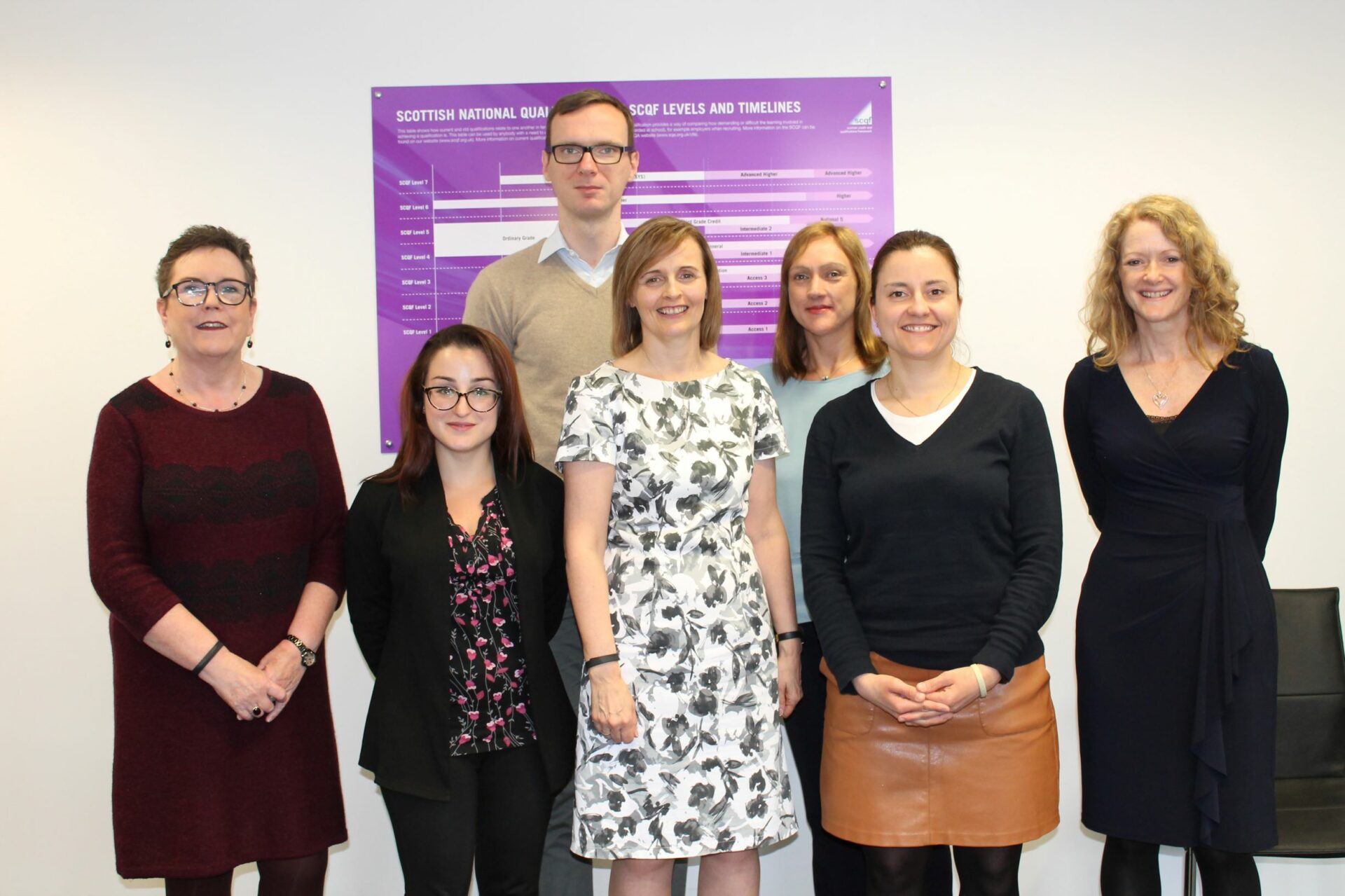
This week we have been hosting a study visit group from the National Commission for Further and Higher Education (NCFHE) in Malta.
The NCFHE was officially launched on the 14th September, 2012. Its mission statement is “to foster the development and achievement of excellence in further and higher education in Malta through research, effective licensing, accreditation, quality assurance and recognition of qualifications established under the Malta Qualifications Framework.”
As the European Qualifications Framework National Coordination Point in Malta, the NCFHE intends to ensure the quality of implementing the Malta Qualifications Framework and to help achieve this one of the proposed activities through an Erasmus+ project was to conduct a study visit to the Scottish Credit and Qualifications Framework Partnership.
The main aims of the visit were to explore the SCQF National Qualifications Database/ Register development and implementation; impact assessment of the SCQF; and the updating of the SCQF to EQF Referencing Report.
We regularly welcome study visit groups from all over the world and in addition to these we offer a range of international education development consultancy services. Find out more.

Is that on the SCQF…? is a series of blogs, where we look at some of the more unusual programmes that are on the SCQF. Read on to find out more about the Cycle Training Assistant programme from Dr Nina Saunders, Quality Improvement and Safeguarding Officer at Cycling Scotland.
Cycling Scotland is the nation’s cycling organisation. Working with others, we help create and deliver opportunities and an environment so anyone anywhere in Scotland can cycle easily and safely. This includes managing the Bikeability Scotland programme on behalf of the Bikeability Scotland Delivery Group.
Bikeability Scotland is a cycle training scheme designed to give children the skills and confidence they need both to cycle safely on the roads, and to encourage them to carry on cycling into adulthood. The training is usually delivered by either a member of staff at the school or a volunteer, to children in years P5-P7.
The support of Bikeability Scotland instructors is key to the creation of the next generation of confident and responsible cyclists. Without our instructors, many of whom are volunteers, cycle training would be beyond the reach of many primary schools, and pupils would miss out on learning a valuable life skill.
The Cycle Training Assistant (CTA) course at SCQF Level 5 with 1 credit point is a qualification for anyone wanting to volunteer to deliver Levels 1 and 2 Bikeability Scotland training to children in schools.
By completing the 10-hour course (3 hours of pre-course learning and 7 hours of contact time), a Cycle Training Assistant can plan and deliver cycle training sessions using Bikeability Scotland resources.
As the training provider, gaining the SCQF recognition for the CTA course was important for Cycling Scotland, as many of our volunteer instructors are teachers. This formal recognition enables teaching staff to put the qualification towards their own CLPL, and for other volunteers, it is a useful and recognised addition to CVs when applying for future jobs.
For some volunteers, this has also led them into a re-introduction to paid employment that they have then used to springboard into other posts.
“I was approached by my children’s school to help with their Bikeability Scotland sessions. I jumped at the chance as I enjoy seeing my twins in the school environment. However, it came to my attention it wasn’t their year that I would be helping with, it was the year below. I hesitated as I wasn’t a confident cyclist but decided to go ahead with it anyway as my children would be doing the same the following year. I was informed by the school that I would get some training before I got involved, which I did.
I’ve since been involved with Bikeability Scotland training for two years and it has made me confident on my bike. I get so much satisfaction from seeing the children gain their confidence in cycling and having fun at the same time.
I am glad I volunteered to help the school as I’ve met a wonderful team that I work alongside.”
Kiran Gallacher – Volunteer
For more information on the programme visit the Cycling Scotland website.
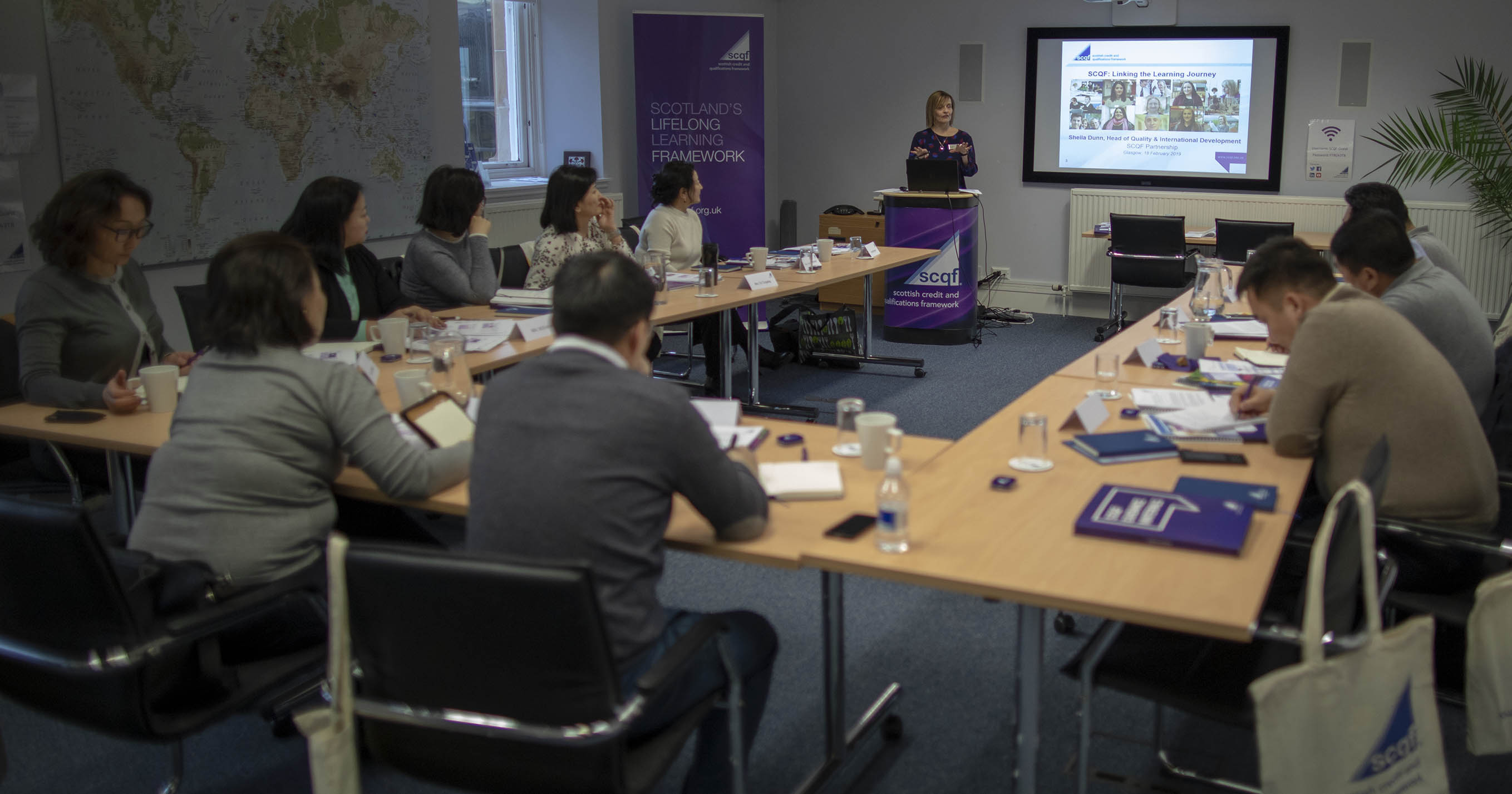
We recently hosted a delegation of 12 members of staff from a project team representing Mongolia’s Technical and Vocational Education and Training Sector.
The main aim of the visit was for the delegation to learn about the SCQF and how it relates to technical and vocational education and training in Scotland. The group were also interested in understanding a mature framework and quality assurance.
The SCQF Partnership provided a full day study visit programme to give the group an overall understanding of the SCQF and the quality assurance model in place. The team also heard about how the Framework can be used for capacity building within education and training institutions and organisations.
The Mongolian delegates also visited three SCQFP Credit Rating Bodies: Scottish Police College, City of Glasgow College and SQA.
For more information on SCQF Partnership international study visits please contact our International team.
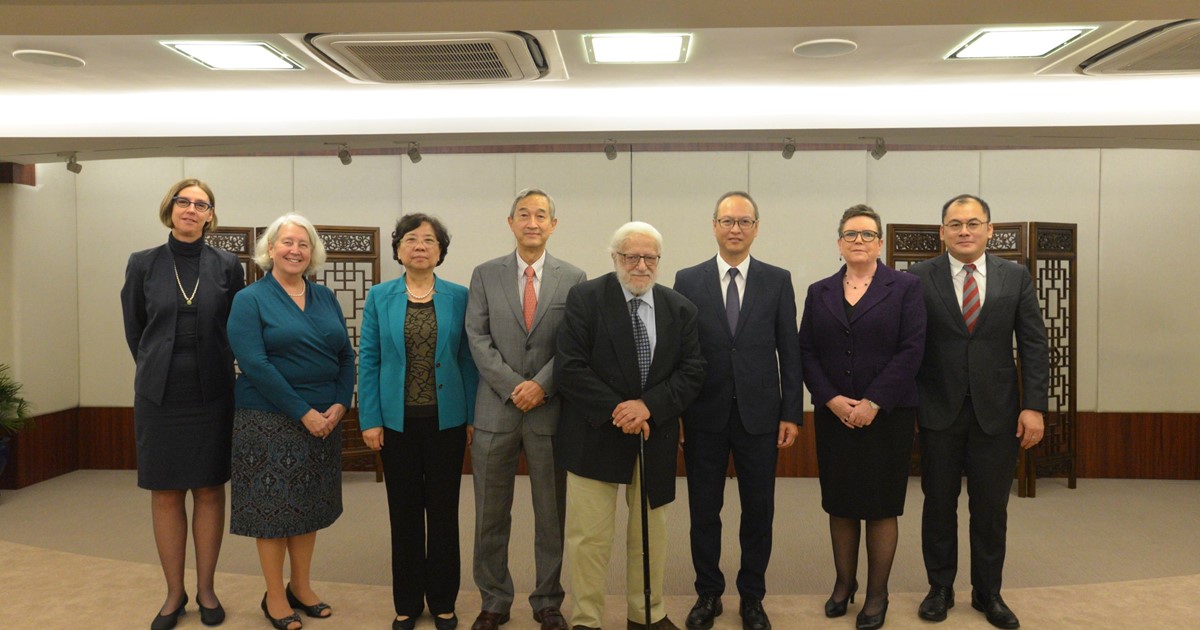
Our CEO, Aileen Ponton, has recently taken up a two-year term of office as Member of the Government of the Macao Special Administrative Region’s newly created Quality Evaluation Panel (QEP). Aileen is one of seven international members joining the panel with the others coming from China, Australia, Malaysia, USA and Portugal. The appointment will last until January 2021.
New legislation for Higher Education in Macao was introduced in August 2018 and the establishment of the panel forms part of that. The primary roles and responsibilities of the QEP are to:
• provide professional advice on higher education evaluation;
• make recommendations on the confirmation or otherwise of evaluation outcomes; and
• study evaluation-related cases and give advice.
Aileen attended the first meeting of the QEP in February and in addition to agreeing with other members and the Higher Education Bureau how the evaluation work would be handled, she was able to visit two higher education institutions to hear about the scope of their work.
The Bureau also organised a round table event for representatives from all 10 higher education institutions to share views on how the process would work.
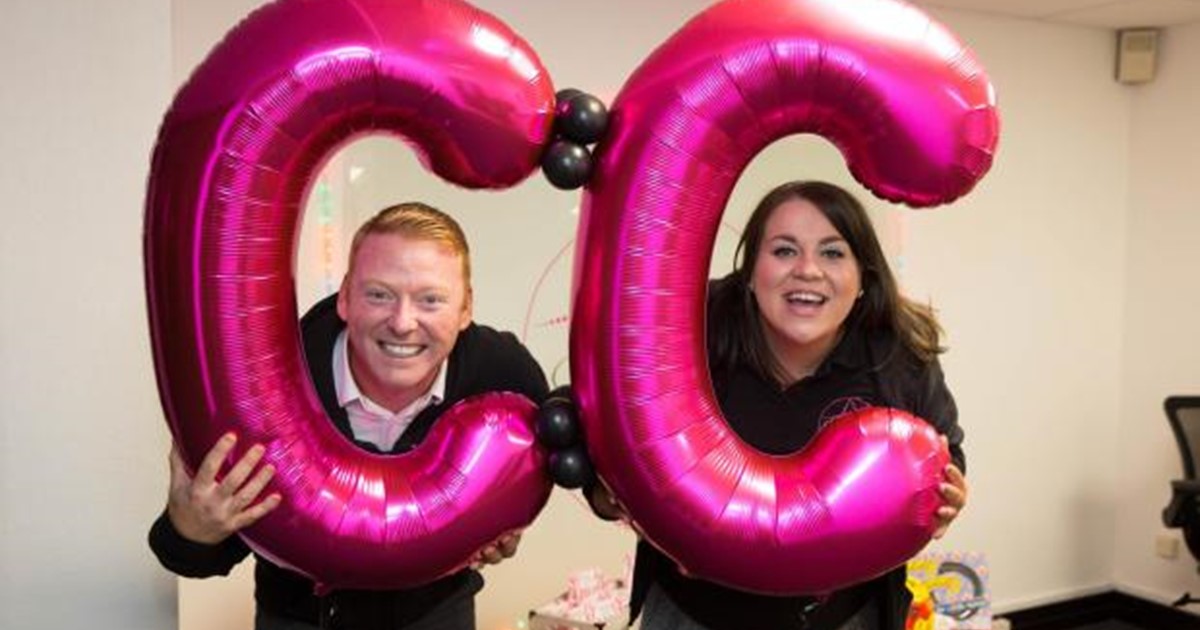
In the fifth of a new series of blogs, we look at some of the more unusual programmes that are on the SCQF. Read on to find out more about the Comedy & Confidence™ DirectDevitt Awards from Anna Devitt, CEO/Founder of Comedy & Confidence™. C&C™ is a community interest company, which was created by Anna Devitt (Most Ambitious Woman in Training & Education in Scotland 2018; Creative Edge Winner 2017) due to her own experiences within school and her career as a stand-up comedian.
Comedy & Confidence™ provides a creative, energetic, personal development programme for the most disadvantaged young people that helps them to “get the life they deserve and not the one they were dealt”. We make use of the power within laughter to develop emotional understanding and the medium of comedy as a tool to build confidence, resilience and communication skills.
The Comedy & Confidence ™ awards allow young people to grow their self-esteem and inner confidence by challenging themselves with new experiences and taking them out of their comfort zones. The medium of comedy is a “safe” and “creative” space. It is an inclusive experience for all young people without barriers to participation, showing them that their capabilities are not limited to a classroom.
Each stage of the Awards has been SCQF credit rated by SQA, meaning that young people will achieve formal recognition for any or all stages completed. We have also been in discussions with the Insight Team to include our Awards on Insight in future – a Scottish Government benchmarking tool used by schools.
We help young people gain the confidence, skills and qualifications they need to move on to further education, training or into the workplace with higher self-esteem.
Although our programme develops the skills and traits needed for work, we focus and aim to have the biggest impact on young people’s wellbeing and aspirations.
We work with young people, schools, social work and local authorities across Scotland. We concentrate on young people aged 12+ who lack the confidence to further their career or education.
The young people we worked with have complex lifestyles – many are care experienced, some are homeless, have learning difficulties, some are incarcerated, and mental health issues are commonplace.
Our young people ALWAYS create a piece at the end of their training and these have gone on to impact on policies for young people.
A DirectDevitt Comedy & Confidence Awards learner, Katie, says: “I left school early, due to various barriers and my disability. Most people said I wouldn’t be able to achieve – I don’t have a qualification in Maths – but I do have one in Comedy & Confidence ™ and that makes me want to keep going and take control of my own life – ‘cause I can.”
The Comedy & Confidence™ programme is made up of a number of awards at various SCQF Levels:
The DirectDevitt Confidence Award at SCQF levels 3, 4 & 5
The DirectDevitt Comedy Award at SCQF level 6
Comedy & Confidence The Direct Devitt Comedy Award at SCQF level 6
For more information on learning programmes on the SCQF, have a look at the SCQF register.
For more information on Anna Devitt and the Comedy & Confidence ™ awards, read the following press releases:
https://www.heraldscotland.com/business_hq/17221129.commercial-focus-why-staff-are-all-smiles-at-storage-vault/
https://glasgowcityofscienceandinnovation.com/alias1-124/
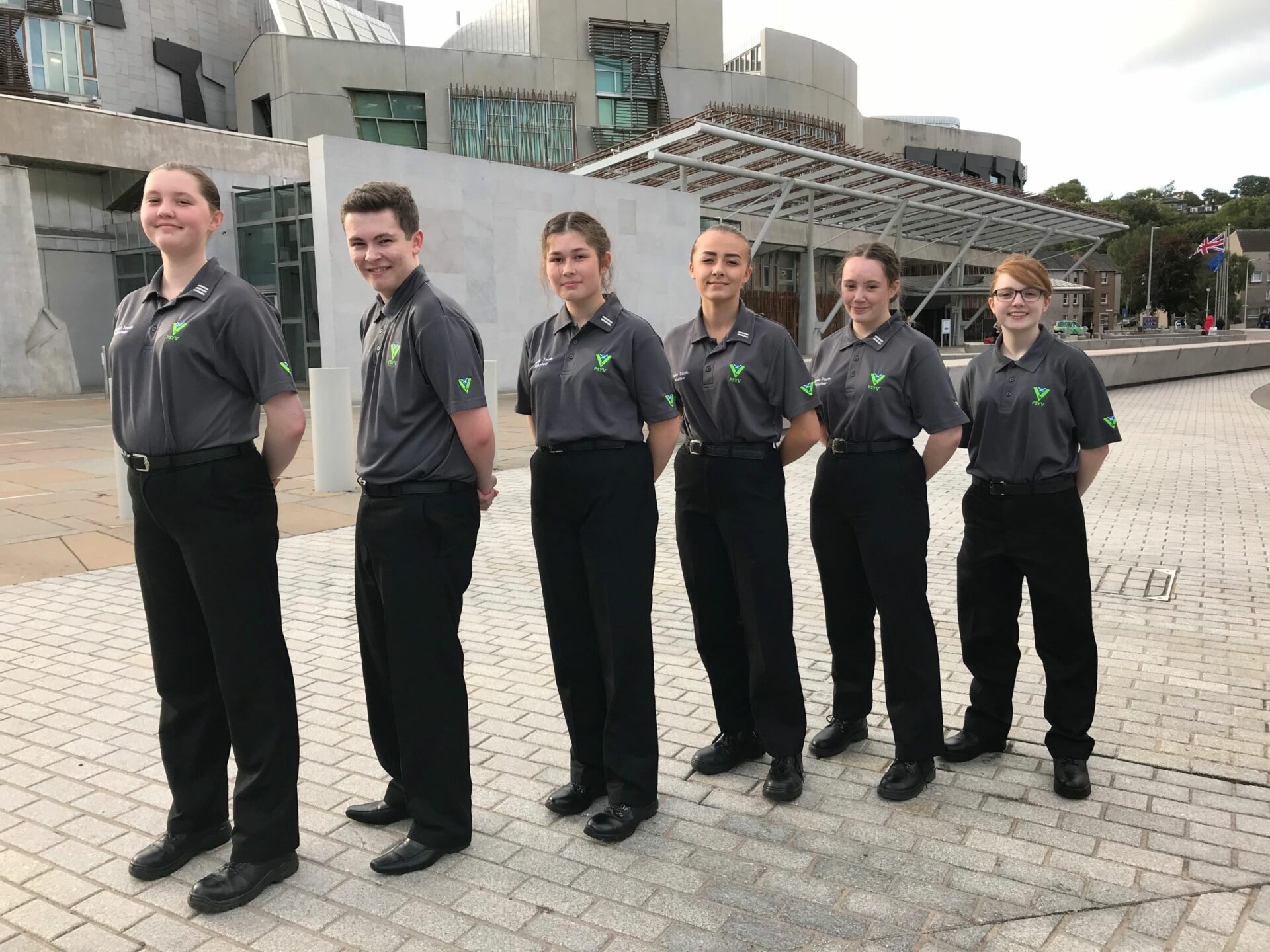
In the fourth of our popular series of blogs, we explore some of the more unusual programmes that are on the SCQF. Read on to find out more about the Police Scotland Youth Volunteering Award from Jan Holburn, Training Quality Assurance Coordinator at Scottish Police College – Tulliallan.
The overall aim of the Police Scotland Youth Volunteering Award is about developing Youth Volunteers to improve life skills, build confidence, and develop individual strengths while accessing real-life opportunities to work in supportive roles alongside Police Scotland Officers and their communities. The award sits at SCQF Level 4 with 20 credit points.
The Police Scotland Youth Volunteers (PSYV) are groups of up to 24 young people based across Scotland. Supported by adult volunteers and led by a police constable, the PSYV volunteer at community and national events across Scotland.
The programme aims to strengthen the relationship between the police and young people and is open to all Youth Volunteers aged 13 to 17. No prior qualifications or volunteering experience are required to enter this part of the programme.
PSYV promotes a practical way for young people to understand policing by supporting the Police in their local area through volunteering. As part of this, young people are given a chance for their voice to be heard and encouraged to promote good citizenship.
The programme consists of 2 modules:
Module 1: Initial Training Programme – the aim of this module is to ensure learners have basic knowledge of Police Scotland, the role of PSYV and to develop a working knowledge of the skills required in a volunteering role.
Module 2: Initial Volunteer Experience – to prepare learners to plan for a volunteering event and continues to provide face to face training which is relevant to learners when being deployed at events.
Read on for three testimonials from youth volunteers highlighting how they feel the training has benefited them in their life skills.
This is the story of a 15 year old whose family came to Scotland to escape war in Sierra Leone. She now lives in Glasgow and attends her local PSYV.
Our youth volunteer started life in Sierra Leone, and left with her family to escape the Liberian war. She and her family experienced serious trauma and loss during this time and ultimately fled to Scotland. She began to attend school once settled in Scotland and through this heard about PSYV. She had never volunteered before and wanted to be a part of something with young people her own age so applied for PSYV, and was successful at interview.
“PSYV has helped me be less judgemental about people. I used to judge people a lot and I was quite shy. It has helped build my confidence. It’s made me more outgoing with everyone. I didn’t like speaking to adults, especially authority figures. My mum told me that in her country police officers are looked on as being scary people, part of the government and corrupt.”
As a result of her involvement with PSYV, she is now a buddy/mentor in a project called Bridging the Gap, which is a project that supports children that are struggling with the transition from primary to secondary school. This involves her helping them find out information about the school that they are moving to and helping them build on their confidence so that they feel better equipped starting secondary school.
This is the story of a young woman who has gone from being involved in anti-social behaviour locally to working alongside the local police.
Prior to joining PSYV, this youth volunteer had social work involvement, was drinking alcohol regularly and was often coming to the attention of the police due to her anti-social conduct in the local community. Through contact with a local police officer who had at the time been dealing with the youth regarding an incident she had been involved in, they developed a good relationship and discussion was had regarding potential benefits to the youth of considering attending the local PSYV group. She subsequently applied for the group and her application was successful, it has turned her life around.
“Being part of the PSYV has changed my ways. I stopped misbehaving in the community and my behaviour changed. The police never come to my door any more. My attitude changed towards people and how I spoke to my mum was much better. I am a changed person. I go to college now and I’m doing a childcare course. School wasn’t a great experience for me, and the fact that the PSYV is run by the police was a challenge in the past as I didn’t like the police, but now my attitude has totally changed.”
This is the story of a young man who experienced bullying at school. His time at PSYV has led him to pursue a career in social Work.
This youth volunteer heard about PSYV through school and decided to apply to improve his self-confidence, and was delighted to be successful at interview.
“When I started I was really shy. Since I joined PSYV I have gained so much confidence. I have become more responsible. Before I wouldn’t care about how I acted or what I did. Now I give more thought to things. Because of the activities I’ve done through volunteering I am clear about what I want to do…..I want to go in to Social Work. My pals have seen a difference in me. Before I’d just open my mouth and say the first thing that came into my head. Now I think before I speak.”
He is certain that if he hadn’t joined the PSYV he would still be lacking in confidence and says that his involvement has made a difference to his family life; his parents are happy that he has joined and he believes that the work of the PSYV is worthwhile.
If you are interested in becoming a Youth or Adult Volunteer visit the PSYV Recruitment page for more information.
For more information on learning programmes on the SCQF, have a look at the SCQF register.