

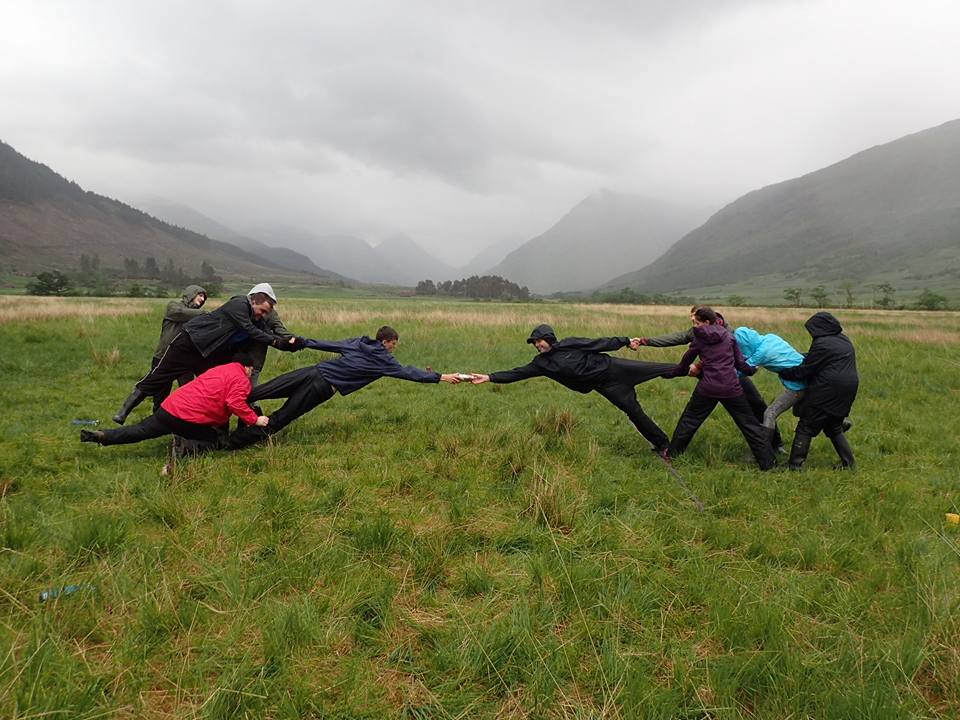
In the third of a new series of blogs, we look at some of the more unusual programmes that are on the SCQF. Read on to find out more about the Etive Awards from David Brackenridge, CEO at Venture Scotland.
Venture Scotland provides an outdoor-based personal development programme for the most disadvantaged young people that helps them to turn their own lives around. We make use of the hills and waterways across Scotland and at our Highland bothy in Glen Etive.
Together with our strong network of skilled volunteers, we help young people gain the confidence, skills and qualifications they need to:
• gain a qualification, job or training place;
• build a happier, healthier and more fulfilled life for themselves; and
• give something back to help others.
We work with approximately 160 young people per year across our two bases in Edinburgh and Glasgow. We focus on young people aged 16-30 from the most deprived areas who lack the confidence and motivation to further their career or education. Many of these young people are not surrounded by positive role models who provide encouragement and support. The presence and time provided by our outdoor youth workers make a huge difference to their sense of self-worth. Our programme develops the skills and traits needed for work, but it is young people’s wellbeing and aspirations that we make the biggest impact on.
The young people we work with have many complex issues – many are care experienced, some are homeless, have learning difficulties and mental health issues are commonplace.
The Etive Awards allow young people to grow their self-esteem by challenging themselves with new experiences. It is an inclusive experience for all young people without barriers to participation. The programme is delivered outdoors, showing young people that their capabilities are not limited to a classroom. Each stage of the Awards has been SCQF credit rated by SQA meaning that young people will achieve formal recognition for any or all stages completed.
As well as gaining a recognised Etive Awards qualification, young people will experience improved health and wellbeing and will have significantly reduced a key problem area (e.g. drugs, offending, mental health). Young people will graduate and move into a positive destination – either employment, further education or training.
An Etive Awards learner, Mark, says: “The team at Venture Scotland helped me a lot. Spending time outdoors gave me some time to myself to think about my goals and what I wanted for my life. Before coming to Venture Scotland I had a criminal history, took drugs and had been in prison. Now I’m focused on my job and my future.”
The Etive Awards programme is made up of a number of awards at various SCQF levels:
|
Name of Award |
SCQF Level |
SCQF Credits |
|
Etive Award – Challenge |
3 |
5 |
|
Etive Award – Discover |
4 |
10 |
|
Etive Award – Explore |
5 |
11 |
|
Etive Award – Leadership |
6 |
22 |
For more information on learning programmes on the SCQF, have a look at the SCQF register.
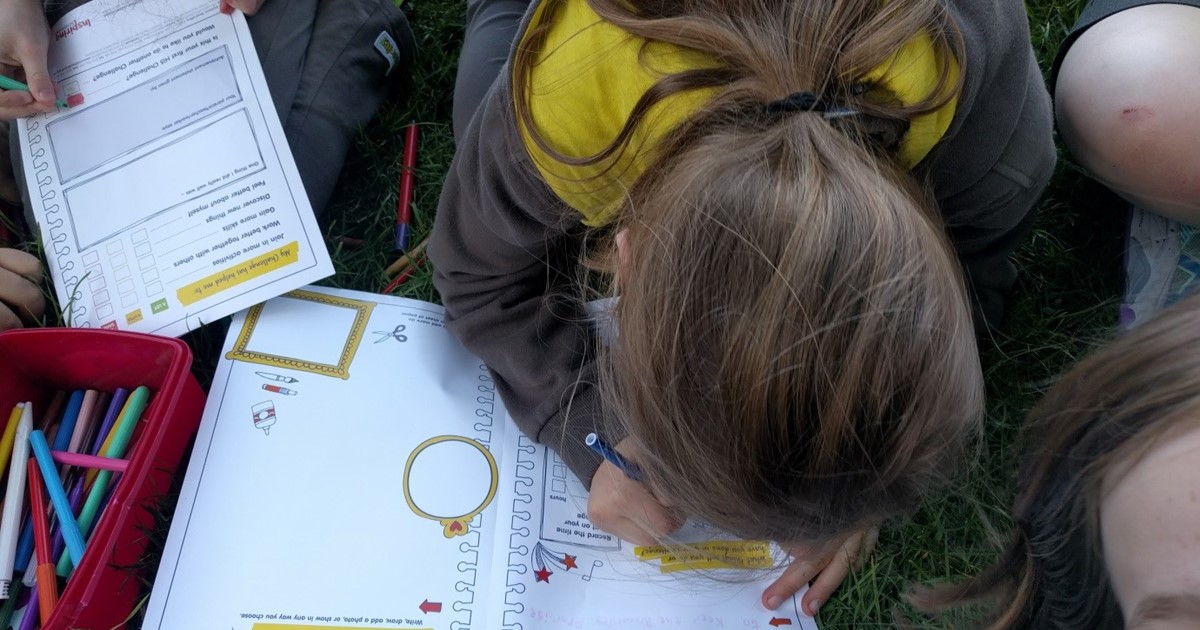
** UPDATE MARCH 2020** You can now access Hi5 Award resources electronically. The Hi5 Award at home offers young people the chance to gain an accredited award for wider achievement through a minimum of 5 hours spent on an activity from home. Click here for Details
Responding to the needs of its pre-high school audience, Youth Scotland recently developed and launched the Hi5 Award for ages 5+. The award provides a means of recording and recognising their learning and wider achievement.
Highly adaptable, the Hi5 Award does not come with a prescribed programme but instead is based on activities that the young people choose to be involved in, making it suitable for all interests and abilities.
The award has been credit rated by the Scottish Qualifications Authority (SQA) on the Scottish Credit and Qualifications Framework (SCQF) at level 2 with 1 to 3 SCQF credit points. This adds value and credibility to the award as it requires a quality assurance process to be in place to ensure that national standards are met.
Youth Scotland, the national charity for community based youth work, originally developed the award to formally recognise the achievements of young people within youth groups and clubs. Following a highly successful pilot and launch, the Hi5 Award is now finding use much more widely. It is being run within primary schools, sports clubs, with child minders, and even at home with parents looking to become involved in recognising their children’s learning and development.
One example in the education sector is Auldhouse Primary School in South Lanarkshire, a small rural school, which used the awards to engage with parents and helped their children to complete their awards out of school. This allowed the young people to share what they had learned with their parents and family in order to achieve their awards.
In the voluntary sector, 4th and 4thA City of Edinburgh Brownie Unit use the awards to formally recognise the activities they offer. Anna Thomas, Brownie Leader, said, “We used the award to help the girls record how they kept their Brownie Promise over the course of a week. The girls absolutely loved getting a certificate for their achievements.”
Youth Scotland was also contacted by a parent from Dundee who shared how completing a Hi5 Award and receiving a certificate had really helped her son. He was struggling in school and by completing his award at home with his family he gained in confidence and self-belief and this in turn impacted positively on his school learning.
These examples illustrate one of the key aims of Youth Scotland of supporting all young people in Scotland to reach their full potential. By offering an SCQF credit rated award that is accessible for all, caters for all interests and abilities and which builds confidence and a sense of self-worth, we hope to play our part in creating a culture of achievement in Scotland – beginning at age 5.
For more information on learning programmes on the SCQF, have a look at the SCQF register.
About Youth Scotland and the Hi5 Award:
We are Scotland’s network for community based youth work. We provide quality youth work programmes, youth awards, information, resources, training and support to local youth workers and groups.
The Hi5 Award launched a year ago and has enjoyed enormous popularity among a diverse audience. More recently, the award was featured at The Scottish Learning Festival where Youth Scotland launched the new Hi5 STEM Activity Toolkit to support STEM skills and learning.
More information on the Hi5 Award from Youth Scotland

In the first of a new series of blogs, we look at some of the more unusual programmes that are on the SCQF. First up from Sandy Riddell, Qualifications Manager at SQA.
SQA has introduced a new Award in Mentoring, which is aimed at those involved in organised mentoring programmes and was designed in consultation with representatives from various charities and training providers.
The Mentoring Award is made up of two units. The first unit covers the basic theory of mentoring and the second unit covers the practical skills used by mentors carrying out their role. It sits on the Scottish Credit and Qualifications Framework (SCQF) at level 4, ensuring accessibility to a wide range of learners. This qualification can be undertaken in many different environments, from rehabilitation or care settings, which may involve things like addiction recovery or coping strategies, to education, or career settings where specific learning goals or employment opportunities might be the main objectives.
It is important for the mentor and mentee to be carefully matched for their compatibility as some of the mentees may be going through difficult stages in their lives or they may be shy or reluctant participants. Trust, therefore, is a critical part of the relationship between the mentor and mentee and often mentees will appreciate simply having a mentor as someone who they can talk to and who will listen to them in a non-threatening and non-judgemental way.
The first requirement of the practical unit is that the mentor and mentee sign a confidentiality agreement to ensure the safety and support of all participants (mentees and mentors) in a mentoring programme. It is also vitally important that the mentoring programme is properly organised and managed by a trained co-ordinator.
In order to achieve the Mentoring Award, learners must complete a short on-screen assessment that features a range of questions on the basic theory and process of mentoring. The on-screen assessments are delivered using SQA’s on-screen assessment software, SOLAR. Learners should be given plenty of opportunities to become accustomed to the software before they undertake their assessment.
In addition, learners must be able to demonstrate other skills whilst undertaking a mentoring role. The assessment of these skills should occur naturally during the mentoring process, such as, introducing themselves to the mentee, holding meetings with their mentee, setting goals, and reviewing progress.
There may be scope for some simulation and role-play in the delivery of the Award but in most cases, learners will be assessed in real life mentoring situations.
This new qualification has been available since August 2018 and it is too early to say how many centres may deliver it but it is hoped that the Award will become established and provide the opportunity for learners to gain recognition for the skills and confidence they can develop through mentoring.
The Award is at SCQF level 4 with 12 SCQF credit points. For more information on learning programmes on the SCQF, have a look at the SCQF register.
From 2015 to 2018 the SCQF Partnership has been a project partner alongside France, Ireland, Croatia, Czech Republic, Hungary and Poland in a project funded by the Erasmus+ programme entitled Developing organisational and financial models for including non-formal sector qualifications in National Qualifications Frameworks (NQF-in for short).
This project involved the in-depth analysis of seven countries about the process of including qualifications outside of formal education in NQF-based systems, as well as discussions with experts and stakeholders to produce a final report Proposed Models of Including Non-formal Sector Qualifications in National Qualifications Frameworks.
The publication presents a proposed typology of qualifications that may be included in such systems, the characteristics of a qualifications system important in the context of including qualifications, a set of variants for each distinguished characteristic, as well as the impact of these variants on the properties of the system.
The theoretical work is preceded by an overview of the definitions of concepts and terms currently used in relationship to the presented work and a review of different approaches to qualifications frameworks. On this basis, four initial models are proposed for consideration by stakeholders and decision-makers involved in the implementation of NQF-based qualifications system in their countries.
In addition, a country report has been produced for each of the partner countries examining the experiences and solutions in each of the seven partner countries.
The final report may be downloaded from the NQF-in Project website together with each partner’s country report that served as the foundation for the analysis.
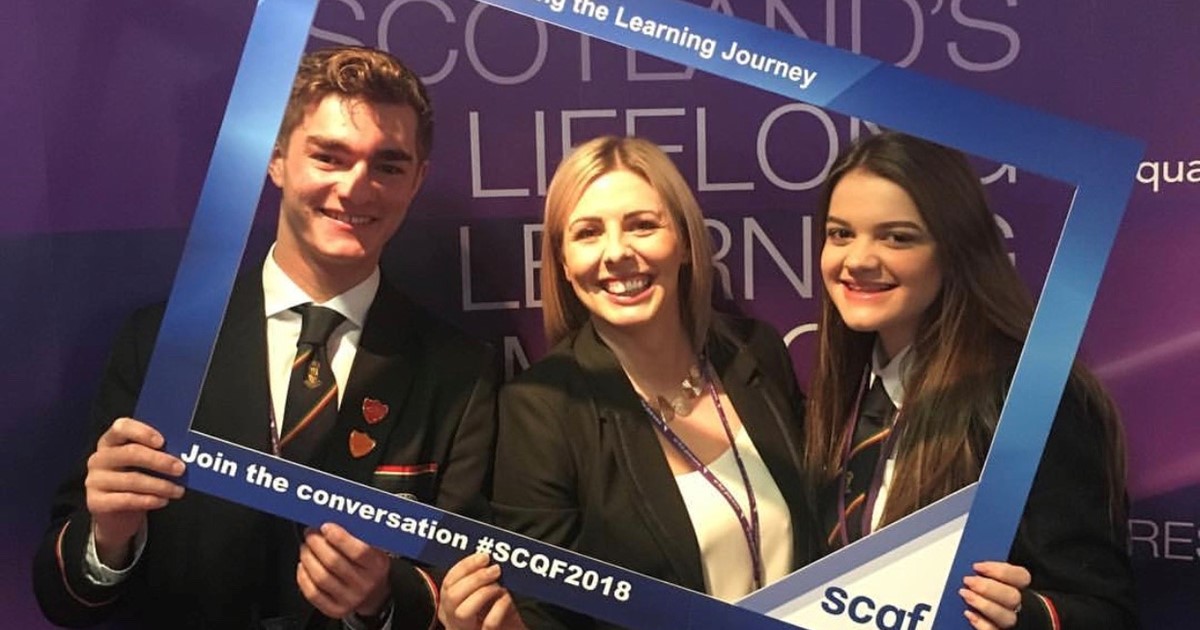
Understanding the SCQF
Our initial use for the SCQF Framework (prior to gaining SCQF Ambassador School status) was to share this with pupils and parents as a means to helping them understand the levels and ‘difficulty’ of learning. This was useful when, as a Guidance team, we supported young people to choose their subjects in the Senior Phase.
It also allowed us to help pupils understand their SQA qualifications on their certificates. With parents, we shared the Framework diagram to highlight the pathways from school and the connections between school qualifications and Further and Higher Education.
Our messages included asking parents if a jump to levels 8 and 9 at University was appropriate for their child or if an alternative pathway was more suitable. In a school where over 80% of our pupils apply to UCAS, it was important for us to highlight the many alternative options but ultimately make sure that the post school destinations are sustained and this is highly dependent on the suitability to the level of learning.
Becoming an SCQF School Ambassador
Following our SCQF Ambassador training the Guidance team had a clearer understanding that the number of points at each level is a good indication for progression to the next levels. This has proved very powerful in leading and directing young people and their parents through post-school destination decisions.
The materials provided by the SCQF Partnership have also been invaluable and these are made available to parents at all school events. We have also, through our school Twitter page (with almost 2000 followers), shared and posted content related to SCQF which we believe has gone a long way to helping parents understand their child’s qualifications.
Evidence so far includes:
-
- parents sharing that, given the qualifications vary so much to their own, they have a better understanding of what their child has achieved;
-
- all UCAS applicants are now including their skills profile as part of the qualifications section and they are referring to these in their personal statements;
-
- uptake in alternative courses in the Senior Phase (such as NPA courses) has increased as pupils and their parents feel less pressured to take subjects which will culminate in a ‘final grade’ as they previously thought that these carried more worth and relevance and short courses were useless;
-
- Understanding the SCQF has helped them to appreciate that all learning is valid and relevant and as more colleges and universities come on board to accepting SCQF credit points as part of their offers to students, I believe this will increase uptake further.
Staff Ambassadors
In February 2017 the SCQF Partnership trained 12 members of staff (including members of SLT, Principal teachers of Guidance and Curriculum and classroom teachers) as Ambassadors. Not only did this broaden their understanding of the Framework from a curricular point of view, but most were unaware of the formal recognition on offer for wider achievement. After the training took place teams were then formed to take forward specific projects which would ultimately benefit our pupils.
Three Principal Teachers of Curriculum formed a team to look at delivery of new units in S4 for Scottish Studies delivered through PE, Geography, Drama, Art and Social Subjects. In PE pupils completed a Social Dance unit. In Geography they will look at Scottish landscapes and in Drama they will be performing Scottish texts. We hope that going forward pupils can gain as many units as possible and, depending on their subject choices, they may be able to achieve 6 units which will give them an additional National 5 award.
Last session the Pupil Support Team delivered the Internet Safety award through PSE for all S4-S6 pupils. This not only raises awareness of social media issues that can affect young people which is already covered through the curriculum, but young people will receive formal credit for it. This session the team are delivering Leadership level 6 to all S6 pupils through PSE.
The PE department also delivered and presented all S4 pupils for a Well Being award, delivered through Core PE. Already we are finding that this is making core PE more valued by the pupils and giving them an aim, thus increasing pupil participation. In Hospitality, as this is a N4 course the Principal Teacher now believes that the young people can be presented for a Bakery qualification too, giving them further SCQF credit points. Lastly, within the Geography department in S3, all pupils can achieve the Travel + Tourism Destination Unit at SCQF level 4.
We have been delighted with the level of curriculum innovation the training has generated. Conversations are now taking place across the school about how to make courses meaningful but also look at areas where learning is taking place and pupils can gain credit points without too much additional workload for staff.
The Ambassador teachers have taken the lead on this and have already driven forward exciting new opportunities. The next step is to involve all staff and we plan to make this a feature at a future in-service day, giving staff time to see how they can maximise on pupil learning.
We already collate our pupils’ wider achievement from both in and out of school activities. We are pursuing how all young people can map these achievements using the SCQF. Those achievements, already recognised, are shared with pupils and this has increased motivation for participation in activities such as Duke Of Edinburgh. This has led our Ambassador team to research alternative personal development/ achievement awards which our pupils can be presented for as almost all pupils have a number of leadership roles and activities in and out of school.
Pupil Ambassadors
Last session we also appointed a team of S6 leaders as SCQF Ambassadors. This role involves the pupils becoming experts on the Framework to allow them to present on this at year group assemblies.
The pupil ambassadors were also visible at parents’ evenings and parent information evenings. They have an SCQF ‘stall’ which offers the SCQF leaflets and documentation to parents and they are ready to answer questions related to the SCQF. This team then built capacity in last year’s S5 pupils so that they can take on this leadership responsibility this year.
Our SCQF Ambassadors work closely with our My World of Work Ambassadors. This team of pupils from S1-6 have specific knowledge of the My WoW website and are also visible at events to encourage all pupils and their parents to create an account. We feel these teams’ work complements one another and we are excited to offer this as a further leadership opportunity for our S6 pupils.
Understanding the SCQF is a Benefit to Pupils
Overall, since initial training took place, we have embraced the SCQF and shared the information related to it with staff, pupils and parents.
The specialist knowledge of our staff ambassadors and the subsequent momentum gained in terms of new qualifications being offered is really promising.
Bearsden Academy pupils and their parents are far more knowledgeable about all qualifications and how these are linking to their post-school destination pathways.
I would recommend all schools to consider forming a partnership with the SCQF as this has been an invaluable learning experience for all involved for the benefit of our pupils. I have thoroughly enjoyed leading this project and working with the team at the SCQF Partnership.
Interested in joining the SCQF School Ambassador Programme? Get more information or make an enquiry.
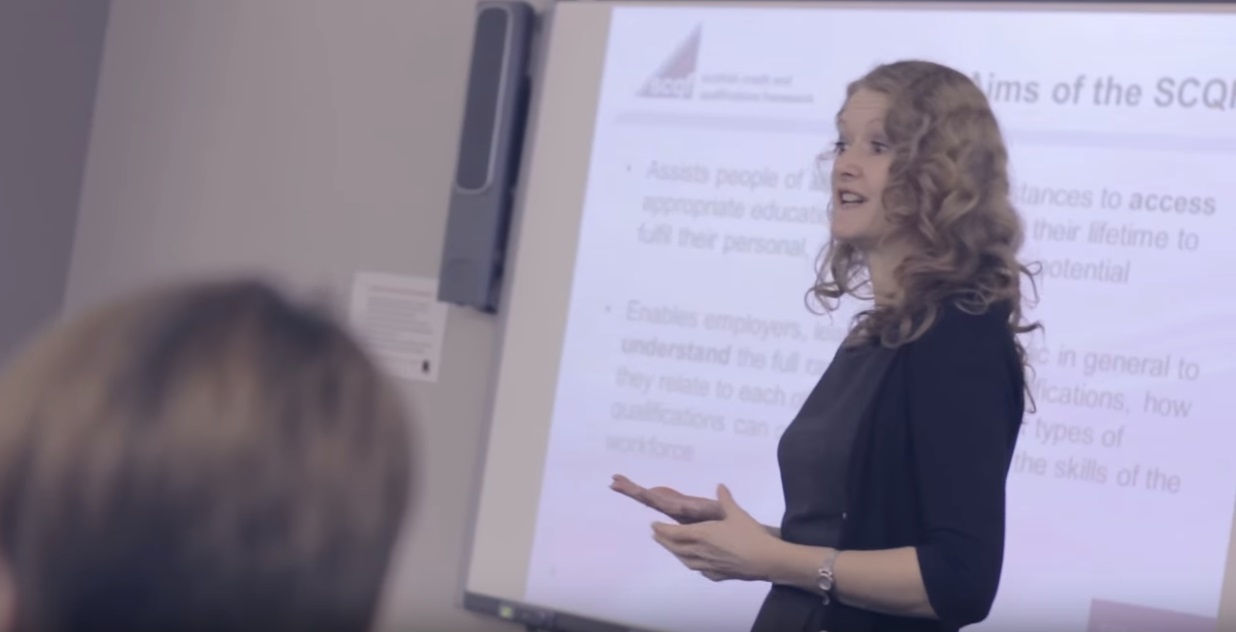
As another new academic session gets underway in Schools, Colleges and HEIs across Scotland, Julie Cavanagh, Head of Partnerships and Communication at the Scottish Credit and Qualifications Framework Partnership (SCQFP) gives some insight into how Educators and Advisers can use the Framework (SCQF) to help learners plan their journey, and advises how you can access some helpful SCQF resources.
The SCQF Partnership, plays an increasingly important role in supporting lifelong learning in Scotland, offering over 950 learning programmes in addition to those owned by the Scottish Qualifications Authority (SQA) and delivered by Scotland’s universities. These programmes recognise all aspects of work-based learning as well as young people’s wider achievements.
Educators and advisers can use the SCQF to help individuals understand the level of their learning and help them make a plan for their career through the development of individual pathways. In the period following exam results Careers Advisers from Skills Development Scotland use the SCQF to help young people make sense of their qualifications, whether things have gone better than expected or not according to plan.
The SCQF promotes equality of qualifications; meaning that there are different types of learning, but individuals still have to use the same level of skills to achieve them.
Many people aren’t aware that programmes such as the Youth Achievement Awards, Sports Leaders UK Awards and Powering Futures Award are all recognised on the SCQF, as well as programmes owned by the Police, Fire Service and the NHS. Knowing these programmes are on the SCQF and that they can be compared to other more formal qualifications helps build confidence in learners and can also help them into further learning.
Much has changed in the 10 years I have been with the SCQF Partnership, particularly within the Scottish education landscape, and educational policy has moved on significantly. However, the SCQF has always remained the underpinning support mechanism for lifelong learning in Scotland.
The latest review of the 15-24 Learner Journey clearly puts the SCQF at the heart of government policy in this area and 10 years on many more people across Scotland are aware of the SCQF and its benefits.
Some useful facts you may not know about the SCQF:
- There are over 11,400 programmes recognised on the Framework
- Over 290 different organisations own these programmes
- There are 55 organisations known as Credit Rating Bodies who have the authority to place learning onto the Framework
- 93% of programmes at SCQF level 6 are not Highers
The SCQF Partnership operates a register of credit rated learning which is easy to search and contains all programmes which have been recognised on the Framework.
The SCQF Partnership also offers useful resources for Educators and Advisers including:
- Postcards and posters of the Framework diagram – posters come in A3 and A0 sizes
- Old versus New – a timeline of school-based qualifications from the 1960s to the present day showing the levels of each qualification and offering a short explanation. This has been extremely popular with employers and parents
- Connecting your Learning Journey – a leaflet explaining the SCQF for young people in school
- Realising Your Potential – explains the SCQF to post-school learners
- Get to Know the SCQF – helps parents and carers understand the qualifications young people are undertaking
- Qualifications Can Cross Boundaries – shows the qualifications frameworks across the UK and Republic of Ireland as well as the European Qualifications Framework (EQF), and how they and their respective qualifications all relate to one another
- SCQF Employer guide and levelling tool – useful for those working within employer engagement, the guide and tool support employers in the area of effective recruitment and workforce development.
All of these resources can be downloaded, ordered by email info@scqf.org.uk, or requested by calling 0141 225 2922

The Scottish Credit and Qualifications Framework Partnership is currently undertaking a project to map the qualifications of veterans to the SCQF (Scotland’s Lifelong Learning Framework).
The project which is funded by the Scottish Funding Council has been established in response to the report from the Veterans Commissioner on Employability, Skills and Learning of veterans which was published in 2016.
The report recommended investigating whether the current system for translating and mapping skills could be simplified and how it might be better utilised and understood by both veterans themselves and Scottish employers.
The initial part of this project is a scoping exercise to identify the priority areas of armed forces qualifications that should be addressed in the first instance and we are currently gathering the thoughts of veterans, organisations that support veterans, educational partners and employers to gain their views and experiences.
We will then develop a scoping report outlining priorities for discussion at a number of focus groups in autumn 2018 and once priorities are agreed, the SCQFP will develop simple benchmarking materials for use by veterans in articulating their skills to prospective employers and for employers to understand the skills and qualifications gained by veterans which will hopefully lead to employment.
The project is due to complete in March 2019.
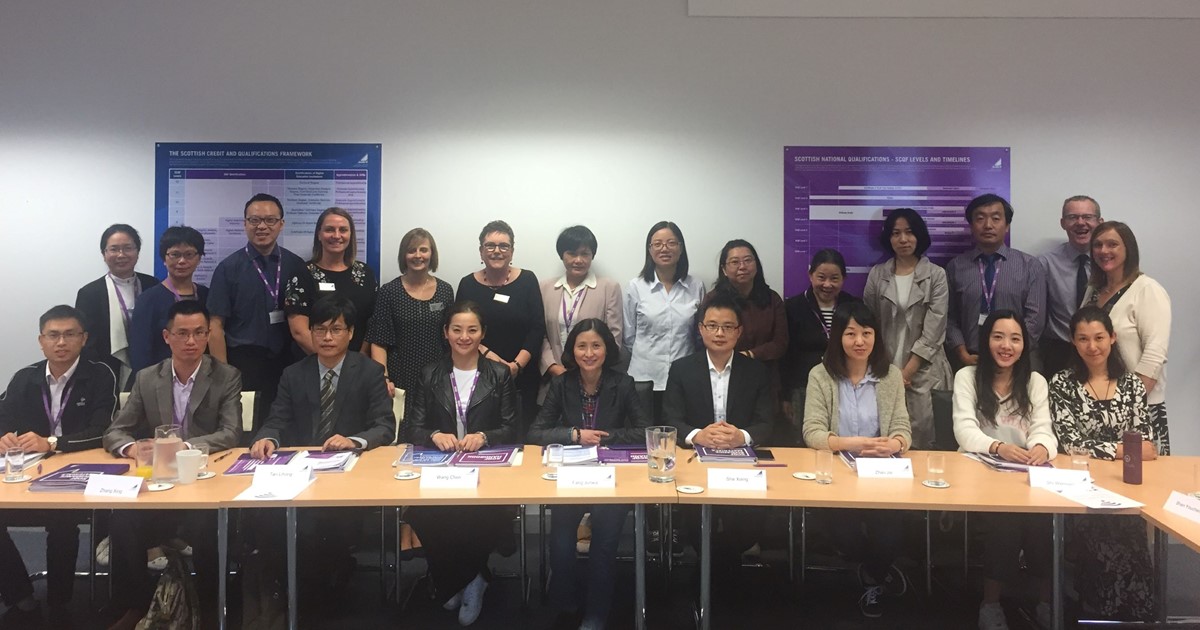
Working in partnership with City of Glasgow College, the SCQF Partnership was delighted to host a delegation of 18 members of staff from Zhejiang Technical Institute of Economics (ZJTIE) on Friday 17th August. The group were visiting Scotland to undertake a development programme on the apprenticeship system in Scotland arranged by the college.
Located in the Hangzhou economic development area, the public vocational college is currently working with City of Glasgow College on staff and student collaborations in supply chain management and teacher training. The group was selected by City of Glasgow College to spend 3 weeks taking workshops on all aspects of apprenticeships in Scotland, from developing, financing and promoting apprenticeships, to how they are supported by Scottish Government and Skills Development Scotland through the Developing the Young Workforce initiative. The group also attended sessions on how apprenticeships are managed operationally through various sectors.
The SCQF Partnership provided a full day study visit programme to give the group an overall understanding of the SCQF and how it supports the recognition and development of learning through apprenticeships. The group was particularly interested to hear about the SCQF Partnership’s approach to employer engagement and how the Framework can be used for capacity building within education and training institutions and organisations.
More information on SCQF Partnership international study visits