

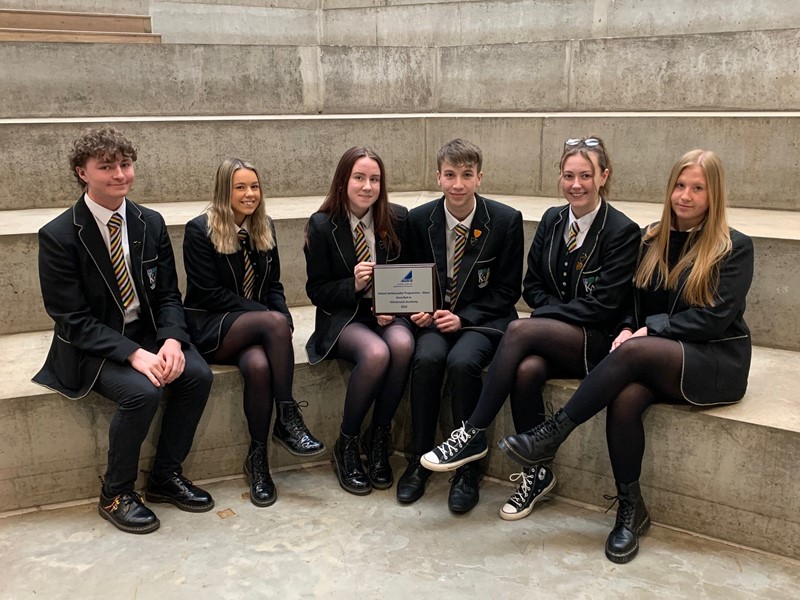
Pupils and staff at Kilmarnock Academy are celebrating after gaining Silver SCQF School Ambassador status.
The East Ayrshire secondary school has become only the third school in Scotland, and the first in the local authority area, to reach silver level since the recognition programme was introduced.
Originally launched in 2015, the SCQF School Ambassador programme offers secondary schools the opportunity to learn more about the benefits of the SCQF and the wider ways in which it supports learners. These include recognising wider achievement, developing senior phase learning pathways and demonstrating equality between vocational and academic qualifications.
The SCQF Partnership introduced the tiered recognition element of the programme in August 2020 to make sure that all the amazing work on enhancing learning pathways being done in secondary schools across Scotland is recognised, highlighted and celebrated.
There are now three levels (Bronze, Silver and Gold) in the process, with schools required to upload evidence to demonstrate how they are meeting the criteria of each level.
To recognise its fantastic achievement, Kilmarnock Academy has received a silver plaque to join the bronze plaque which the school received in February 2021.
David Rose, Kilmarnock Academy’s Head Teacher, said:
“We are absolutely delighted to receive the Silver SCQF Award. This recognises the work that has gone into raising awareness of the Framework and how it links with learning across a broad spectrum, ensuring our young people are fully informed as they progress in their education.
There has been a huge investment in our vocational pathways, which are supported by the Central Education Team who co-ordinate a range of external partners including Ayrshire College, Ayrshire Chamber and DYW Ayrshire. Key staff at Kilmarnock Academy have established superb relationships with these fantastic organisations to provide a sector leading, progressive experience for our young people across several stages. They are extremely popular and successful in our school, with young people achieving qualifications up to SCQF level 7. We currently have 85 pupils following our pathways.
These courses offer our young people a wide variety of industry-recognised qualifications and work experience, which are invaluable and link into further and higher education or employment which of course, has improved our leaver destinations.”
Councillor Fiona Campbell, Cabinet Member for Lifelong Learning, Education and Skills and Culture said:
“What a wonderful achievement by Kilmarnock Academy. I am delighted to offer my congratulations to David Rose and the whole school community on being only the third school in Scotland to receive the Silver Scottish Credit and Qualifications Framework (SCQF) Award.
In East Ayrshire, we are committed to working in partnership with local organisations like DYW Ayrshire and the Ayrshire Chamber of Commerce and local and national businesses to secure the best possible outcomes for our young people. Now, more than ever, we need to support our young people into work and help them achieve the best they can be. The SCQF has an important role to play in helping our young people, and their parents, plan their learning journey and secure positive outcomes.”
Depute Head Teacher, Angela Brownlie, added:
“Our curriculum offer means all of our young people can follow their chosen pathway, learn new skills, experience the world of work and gain a wide range of qualifications. With pathways devised in response to labour market information, the focus is on skills development and ensuring progression.
There has not only been a positive impact on pupil attainment but also an increase in confidence and self-belief. As a result, our young people successfully go onto positive destinations, with excellent foundations to build on post-school. Our positive working relationships with partners are vital to the success of these pathways as they support our young people to achieve their best.”
SCQF Partnership Development Officer, Donnie Wood, who manages the programme, said:
“‘Huge congratulations to Kilmarnock Academy for becoming only the third school in Scotland to reach Silver level status! By doing so, they have demonstrated an outstanding whole school approach to utilising the full range of qualifications on the SCQF. It’s clear that staff, pupils and parents have a great awareness of learner pathways and, combined with the excellent links with partners, pupils can take part in qualifications that are engaging and give them the skills they need to progress.”
The SCQF School Ambassador Programme is free to join and open to any secondary school in Scotland.
If your school would like to find out more, contact Donnie or have a look at what’s involved.
This year marks 21 years of the Scottish Credit and Qualifications Framework (SCQF) supporting lifelong learning. Since its inception in 2001, the SCQF has been Scotland’s National Qualifications Framework, helping people of all ages and stages plan their learning journey.
The qualifications landscape and job market are constantly changing, particularly in the last 2 years with some sectors struggling whilst others flourish. In this fast changing environment, it is now more important than ever for individuals and employers to not only understand the range of different qualifications that exist in Scotland and beyond, but also to recognise what that equivalent skills and experience might look like.
How does it help job applicants?
Many individuals have gained skills and experience which could be very valuable to an employer, though they may not hold a formal qualification to prove this. So, we have enhanced our interactive Framework to help job applicants understand what SCQF level best matches their abilities.
Using SCQF levels in job application forms and CVs helps to better describe skills to a prospective employer, helping job seekers find the right role for them. It can also help learners find the right level of course if they want to continue learning.
How does it help employers?
For employers, the SCQF helps to determine the level of skill or competence required for a particular role when recruiting. Whilst there are jobs that do require specific qualifications, such as those in healthcare or engineering, many are broader in their requirements. Despite this, employers often ask for specific qualifications such as a degree or equivalent, or a particular number of Highers or equivalent.
The Know Your Level tool enables employers to level job roles to the SCQF and complements our SCQF Inclusive Recruiter programme. By using SCQF levels in recruitment processes instead of specific qualifications, employers can significantly widen their pool of applicants, who may have a wealth of skills and experience, or alternative qualifications, at the required level. This allows employers to get the best range of suitable candidates for job roles. Ensuring that people are working at the right level and are fully utilising their skills also helps with employee morale and retention.
What do employers think?
Lorena Little, Business Director at YouthLink Scotland, says:
“This tool will really help us to uphold our values of equality and diversity at YouthLink Scotland. Finding the most suitable SCQF level and using this when recruiting allows more accessibility and inclusiveness to all candidates who apply for roles within our organisation.”
Seonaid Mann, Talent Acquisition, Fair Work and Equality, South of Scotland Enterprise, adds:
“I think this new tool is extremely helpful and gives a level of clarity that was possibly missing before now. The ability to be able to link advertisements to the SCQF website is another really positive step that we will start using from now on. I also think that the way you have set out the representative competencies of job holders at each level will be extremely helpful when it comes to writing and evaluating job descriptions.”
Want to find out more?
This latest update to the Framework diagram online will benefit individuals seeking the right job role or course to best describe their skills and experience, as well as employers looking for the right people to help their organisation thrive.
Business leaders that would like to know more about understanding how using the SCQF in the recruitment process can help are encouraged to book a 1:1 session with our Employer Engagement Lead, Nicola Smith.
Corinne Robbie, Learning and Development Manager (Qualifications and Standards), at the Scottish Social Services Council (SSSC) tells us about their Register for the future consultation.
The SSSC is 20 years old and since opening our Register in 2003 we now have more than 164,000 workers across social work, social care and early years registered with us.
So much has changed for the sector over the last 20 years, along with significant policy developments like The Promise and the proposed National Care Service, and it’s important that registration and the qualifications accepted for registration reflect that.
Consultation
We’re currently consulting on our proposed changes to the Register, processes and the qualifications accepted for registration. We want to make registration simpler and easier to understand for both workers and employers.
We also want to make sure people know about the benefit and value of being registered and the standards, skills and qualifications needed to deliver high quality care.
We need to make sure the qualifications we accept are fit for the future and reflect the skills and knowledge workers need to deliver high quality care as part of a trusted, skilled and confident workforce.
Proposals
Our proposed changes will make qualifications more flexible, so people can move more easily to work in different types of services. We want to review the length of time workers are given to gain their qualification after registering and change the level of qualification needed by support workers in adult social care.
We’re also proposing developing return to practice standards for social workers, and potentially others, who have not worked in the sector for a time, as well as introducing mandatory learning and skills development as part of our continuous professional learning (CPL) requirements.
Our proposals also include reducing the number of Register parts, reviewing how long people have to register when starting a new role, improving processes for applying for and renewing registration, bringing in an ongoing registration period, and changing the information about registrants available on our website.
You can find out more, register for our online events, and respond to the consultation on our website
The consultation closes on 14 March 2022.
SSSC is sponsoring the SCQF Online Conference which takes place on Thursday 24 March.
Register for The SCQF at 21: Recognising Skills in a Changing Landscape
Congratulations to the SCQF on its 21st birthday! It seems appropriate that at this coming of age moment, all the things the SCQF Partnership has stood for over the years is centre stage in our thinking.
How do we ensure the quality of qualifications and the integrity of the system? How do we ensure an inclusive framework which is equitable and fair for all and recognises that there is no ‘one size fits all’ learner journey? How do we reform the education system to close the huge variability in outcomes for those affected by poverty?
Education is witnessing widespread reform and change across the world, as any of the recent OECD reports will confirm. There is growing demand for a genuinely person-centred and equitable system. In Scotland, it has been uncomfortable to see that Curriculum for Excellence which is fully embraced across the system has not resulted in the change originally envisaged. The pandemic we are still emerging from has in fact further exacerbated the growing inequality in educational attainment and opportunity for all.
From my perspective a fuller realisation, understanding and implementation of two of the key aims of the SCQF Partnership to “extend the recognition of informal and non-formal learning” and to “promote and develop the Framework as a tool to support lifelong learning” will lead to the kind of change we all want to see.
A greater recognition of informal and non-formal learning, to ensure young people develop the learning and skills they need both now and in the future should be at the very root of change. Youth work and community-based adult education offer so much potential to achieve this. Extending recognition and increasing the resources required to realise that potential, is vital to ensure a fair and equitable system.
Mutual recognition and a shared understanding requires a common language and a common funding framework. Through YouthLink Scotland’s Scottish Attainment Challenge programme we are working towards a common rights-based approach to education – one where the system genuinely works together to support our young learners to develop and recognise the knowledge, skills and capacities required to reach their potential. To support this process we created the National Youth Work Outcomes underpinned by the four capacities of CfE. As young people work towards these outcomes they develop skills for learning, life and work. The key skills young people develop through youth work are described in the Youth Work Skills Framework.
As promoters of the SCQF Framework we want to see more and more Youth Awards and pathways to those awards, through informal and non-formal youth work learning opportunities, created and recognised in the Framework. The future of the SCQF Partnership in providing a greater valuation of the currency that informal and non-formal learning provides is exciting. Young people have told us that their preference is some form of continuous assessment across their learning journey and a fuller recognition and valuation of those achievements by all education partners, regardless of the setting or context. This is what we should all be collaborating to accomplish.
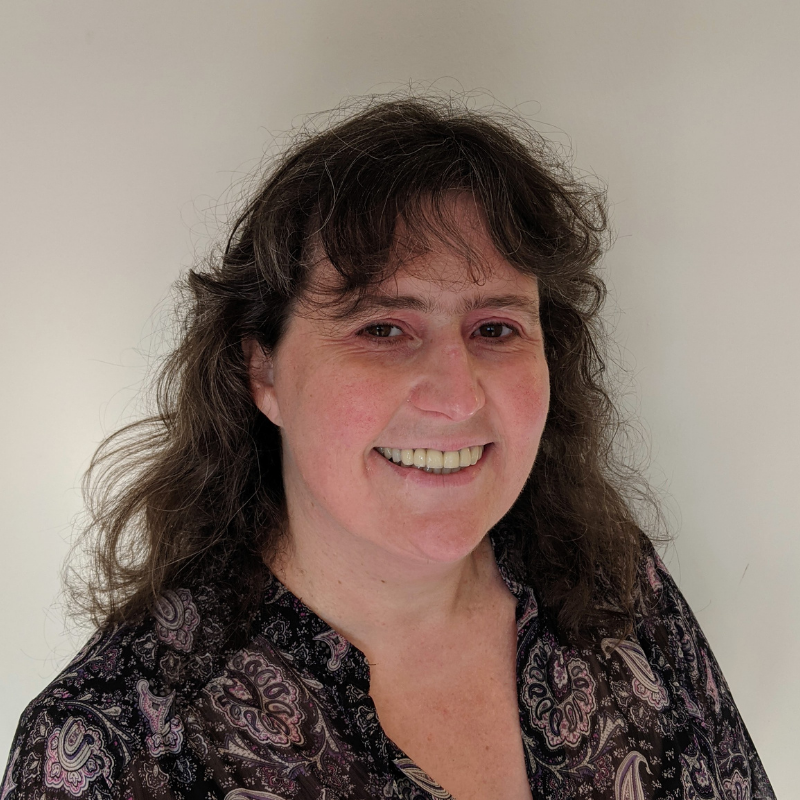
What is your role within the SCQFP?
As Lead for Projects and Employer Support, I am responsible for employer engagement, identifying, developing and maintaining new opportunities and partnerships, and supporting the SCQFP Forum to use and engage with the SCQF. I have been working to increase employers’ understanding of the range of alternative qualifications being taken across Scotland and beyond, and of the skills and experience people may have developed that are comparable to these qualifications. By encouraging the use of SCQF levels in recruitment instead of specific qualifications, I have been helping to make recruitment practices more inclusive, and grow our family of SCQF inclusive Recruiters. I have also been working on a project with the Ministry of Defence to map veterans’ skills and qualifications in order to help them to move more easily into the civilian world of work, and another to increase the number and range of credit rated qualifications and awards that can be taken in secondary schools in the area of Learning for Sustainability.
What do you enjoy most about your role?
I really enjoy being able to engage with such a wide range of different employers, finding out about the amazing work which is going on all over Scotland, and knowing that the work I am doing will help people find the right job roles where they can flourish.
Tell us a bit about to your career to date
I am a fully registered teacher for both Primary and Secondary education, with a wide range of experience in educational outreach and development. Working at Glasgow Caledonian University, I led a team who supported and encouraged over 400 schools to achieve their Eco Schools Green Flag award. I also developed and implemented a sustainable, environmental change and educational outreach programme across Wiltshire while working with the Wiltshire Wildlife Trust.
Whilst living in England, I also worked on a government funded pilot project, hosted by the Royal Society for the Prevention of Accidents, where we worked to increase the opportunities for young people to learn to assess risk through experiential learning. More recently, I have worked with Poppyscotland on the design and realisation of their mobile museum and learning space, Bud, which tours Scotland, exploring the history of Remembrance and starting conversations about its meaning in contemporary Scottish society. My most recent role was with Barnardo’s, working in various primary schools across Glasgow, to fully embed Social and Emotional Learning within their curriculum, ethos and values, with the aim of reducing the attainment gap and building strong mental health.
Tell us something interesting about yourself?
At the start of my career, I was one of only 8 female technical teachers in Scotland. I had to have a rethink, however, as I am allergic to metal and sawdust!

The Company Programme
The Young Enterprise Scotland (YE Scotland) Company Programme is an SCQF level 6 programme which was credit rated for the SCQF by Glasgow Kelvin College in 2019. Since the programme has been credit rated, over 800 pupils in Scotland have been certificated.
At the CDN Awards in December 2021 Glasgow Kelvin College won the Innovation Award for its development and continuing support of the Company Programme. The college has helped YE Scotland to extend its reach by enabling students to use the college virtual learning platform allowing school and college staff to support and assess students in a learner focused, accessible manner.
The Company Programme provides a real-life learning opportunity that introduces young people aged 15-19 to the realities of the world of work. This is the same SCQF level as a Scottish Higher and demonstrates a young person’s ability to work at this level in an innovative and enterprising manner, whilst attracting UCAS tariff points that can be used to progress into further learning.
What do the Young People Do?
Young people work in teams to set up and run their own Young Enterprise student company under the guidance of a Business Volunteer. Candidates decide on the company name and manage company finances as well as selling to the public through pop up shops and an e-commerce platform Trading Station.

UWS in partnership with YE Scotland
At the start of session 2021/22, staff from YE Scotland and UWS met to discuss a pilot scheme to recruit students from its Business programmes to act as mentors to the young people. This has been promoted widely and is seen as an opportunity to develop students through supporting their communities. The University offered this opportunity to Business students studying at SCQF levels 7 – 10 and Dr Robert Crammond, Senior lecturer in Enterprise from UWS said:
“The School of Business and Creative Industries, and its Enterprise Team at the University, are proud to continue its partnership with YE Scotland, as we continue to further emphasise the importance of enterprise and entrepreneurship within education. This initiative, where university students mentor those within high school education, is a great opportunity for mentors and pupils to engage with enterprise and gain valuable experience as they encourage others through an entrepreneurial journey. Mentors on this programme look to evidence key skills related to entrepreneurship and in providing business support, as well as develop leadership and managerial attributes. Working with YE Scotland in this mentoring programme is another example of enterprise in action, and we look forward to seeing more UWS students getting involved!”
Volunteering for YE Scotland
UWS student Rachel Marner is a Business Volunteer in St Columba’s High School in Gourock, an SCQF Ambassador School, and was a previous Company Programme participant herself.
Tracy Reilly, the Developing Young Workforce (DYW) Coordinator at St Columba’s High School said:
“Having Rachel available to speak with the team was a real privilege as she could relate to all the ups and downs the team were experiencing. Rachel had a wealth of knowledge and used her own experience to assist the team with all their questions and challenges they faced.”
Rachel thoroughly enjoyed her experience and hopes to be able to help again next year! Here is what she said:

“Having the opportunity to be partnered with a local school as their Business Volunteer has been great. I have thoroughly enjoyed taking my knowledge from when I participated in the Programme myself in 2018/2019 and also what I have learned so far in my Business degree and using it to help the young people in the team. The pupils are enthusiastic and have great ideas so it has been great to learn from them as well! This opportunity has also helped my confidence as it’s an area I struggle with and going in to the school to talk to the pupils and giving them business advice has allowed me to grow my confidence. If I was given this same opportunity next year, I will absolutely take it as I have enjoyed this new experience and feel it will also help grow the skills I will need for after I have finished my degree.”
If you would like to become a Business Volunteer please email: volunteer@yes.org.uk
If your School would like to take part in the Company Programme email: companyprogramme@yes.org.uk
Download a PDF version of the blog
This year is an exciting one for us as the SCQF is 21 years old! As part of the celebrations, we are holding our first online conference on 24 March 2022.
The conference will run from 10.00 – 15.30 and the theme is Recognising Skills in a Changing Landscape. Shirley-Anne Somerville MSP, Cabinet Secretary for Education and Skills, will provide a keynote address and Ruth Jennings, Skills Development Programme Manager at Sainsbury’s, as well as chair of the Apprenticeship Approval Group, has agreed to chair the event.
The event features a variety of speakers, a panel session exploring future use of the SCQF and five breakout seminars. These will allow delegates to hear more about how the SCQF is being used by learners, schools, employers, Credit Rating Bodies, CLD, colleges and HEIs, so covering a broad range of interests.
We see this as an opportunity to celebrate the distance travelled since the Framework was first launched back in 2001, so the conference will showcase and celebrate the growth of the SCQF, not just as a Framework, but as a tool to promote parity of esteem and play a central role in the learner journey.
The conference is free to attend and you can book your place at https://scqf.org.uk/workshops/events/2022/march/scqf-online-conference-2022/
We have lots up our sleeve to celebrate the 21st anniversary of the creation of the SCQF as the year progresses, so please keep an eye on our website and social media channels to be a part of it!
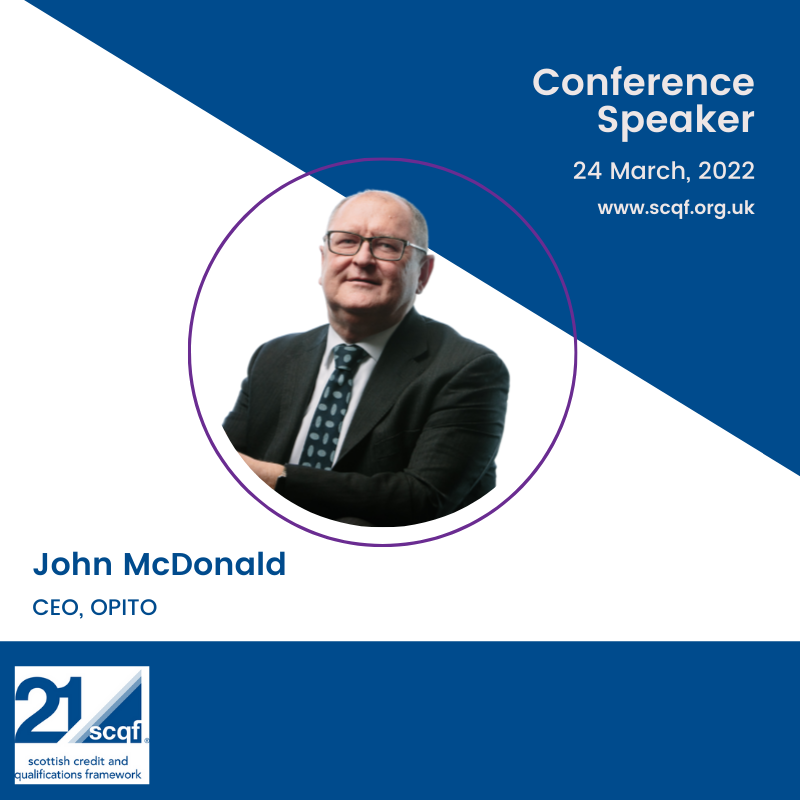
John is the CEO of OPITO, the global safety and skills organisation for the energy industry.
In this role, he is focused on driving the international skills agenda for the energy sector and the development of a safe and skilled workforce through the delivery of global standards and high-quality skills development, workforce development solutions, and by leading dialogue with industries and governments across the UK and Europe, Middle East and Africa, Asia Pacific and the Americas.
John established the Energy Skills Alliance in 2019, bringing together senior members of the UK and Scottish Governments, the energy industry, and industry bodies to create an integrated skills strategy for a net-zero UK energy industry.
He is also currently leading the publication of an integrated People and Skills Plan as part of the North Sea Transition Deal.
Appointed to the role in 2017, John previously held posts within OPITO as UK Managing Director and Director for International Workforce Development.
Prior to joining the business, John was a director at ACTVET, the government body charged with creating a vocational education and training system in Abu Dhabi. John was also a director for the Scottish Qualifications Authority (SQA), leading the development of new products and services, and creating new markets in Asia and the Middle East.
An alumni of Harvard Business School, John has worked at a ministerial level in several countries on capacity-building projects in education and training.