


What is your role within the SCQFP?
I am the Management Accountant at the SCQF Partnership. I put together the Management Accounts for the CEO, the Board and the Audit & Risk Committee. I pay supplier invoices, and ensure income is received by the organisation. I help put together the budget for each year, and assist with the annual audit. I’m generally responsible for the finance function at the SCQF Partnership, and all that it entails!
What do you enjoy most about your role?
As I am the only finance person within the organisation, I am responsible for all aspects, which makes my days quite varied. One minute, I’ll be grappling with a complicated Excel formula, (and Googling to find out how it works!) the next I’ll be venturing down to the basement of our office building to get the electricity meter reading! As I help with the costings of certain projects, it means I am involved in all aspects of the organisation, so you can often find me lurking around with my calculator! Or eating all the biscuits out of the biscuit tin!
Tell us a bit about your career to date
I didn’t really know what I wanted to do for a career when I was younger, and I just kind of fell into finance. I finished university with a not very good degree (having spent too much time in the pub!) and was faced with the prospect of having to live back at home with my parents with no money! Luckily, a position for an Accounts Assistant became available at a chain of local garden centres, which provided study support whilst earning. I managed to complete the AAT Qualification, which then enabled me to take my career further. I have worked for a variety of organisations, including a cable manufacturer, a property company in Sydney, Australia, and a renewable energy firm which generates electricity from chicken poo and straw. I have continued my studies whilst working, and am now a Fellow of the ACCA.
Tell us something interesting about yourself?
Err, hello? I’m an accountant! There’s nothing interesting about me!! But I can fit my fist in my mouth!
Background to the school
Bearsden Academy is a vibrant learning community that strives to respect the rights of our young people to fulfil their potential. To this end, we are committed to supporting and challenging all members of our school community to become successful learners, confident individuals, effective contributors and responsible citizens. We are committed to excellence by working together to be all we can be and we have found that by embracing the SCQF Ambassador Programme we are creating opportunities for our young people to develop skills for learning, life and work.
Bearsden Academy joined the SCQF School Ambassador programme in 2017 and we have worked collaboratively within our school community to actively promote the many benefits of being part of the programme. Our recently appointed Principal Teachers of Wider Achievement and Developing the Young Workforce are enhancing and developing our school’s work in terms of ensuring more of our young people benefit from a curriculum that will permeate elements of our SCQF programme.
SCQF Awareness
In order to raise awareness about the SCQF initiative to our school community and beyond we worked with the SCQF team to develop a video resource.
We have participated in CLPL with our staff and have a number of SCQF Ambassadors who are leading this within our school. Our young people have also taken on Ambassador roles. Our ambassadors support Curricular Evenings related to subject choice and actively promote the SCQF. We are also actively participating in training events led by the SCQF Partnership as part of refreshing our initiative.
Innovation
Due to the continued impact of Covid-19, as a school community, we have had to reflect on how we continue to support our young people. Developing innovative and creative ways to improve the life chances of our young people is key to meet the needs of all learners.
Our website is often the first port of call for our school community and partners. It is important that we continue to share information using this platform about the opportunities that we have within Bearsden Academy. Our website contains access to presentations and information related to our SCQF journey and how we embed the principles of this within our school.
Twitter is an exciting platform to share updates, information and success instantly with our school community and beyond. We have had to adopt a creative and innovative take on communication with our young people and parents in light of the continued impact of Covid-19.
Not being able to meet in person during the pandemic resulted in the creation of a live, digital platform and we have continued our SCQF journey with parent and pupil information sessions via Microsoft Teams related to progression within our curriculum. In order to reach all parents and carers, our presentations are recorded so that parents and pupils can access them at a time that suits themselves.
Changes to curriculum
Our staff are empowered to reflect on our curriculum and we are currently developing our curriculum rationale to embed the principles of the SCQF. Within our Senior Phase our young people are developing skills for learning, life and work through a range of SCQF credit rated programmes. These courses aim to offer breadth within our curriculum and provide opportunities for our young people to engage in a number of programmes. Examples of the courses that we have implemented as a result of our commitment to the SCQF Ambassador Programme include a range of National Progression Awards (NPAs), Level 5 Early Learning and Childcare and the Level 5 SQA Leadership Award. We also deliver a number of units to enrich curricular areas including the Internet Safety Award and Wellbeing units.
Recently, our Creative Collaborative programme was launched where many of our departments either created or strengthened our school/employer partnerships. Through this, there is genuine collaboration on curriculum delivery between school and industry. For example, our Design and Technology department has partnerships with BAE Systems as well as awarding for the Industrial Cadet Award.
Our links with tertiary education are also enhancing our curriculum design and delivery. Departments across the school have active links with institutions: for example, the Drama Department delivers the NPA in Technical Theatre in conjunction with the Royal Conservatoire of Scotland.
Through Wider Achievement, we also feel strongly that our young people should gain accreditation in areas that they are involved in outwith our classrooms. We offer young people opportunities to gain units within Level 5 SQA Volunteering and SQA Personal Development Awards.
For me, the NPA in Technical Theatre (SCQF Level 6) gave me a unique experience to get more hands on skills. This course gave me the opportunity to gain valuable skills, which I know I’ll be able to use later on in a real life context. This course gives young people an opportunity to be hands on with our work, from sitting and making model boxes or working on sound mixing desks, to helping teach a production. These skills give us an insight into the necessary skills we’ll need when working in the industry, and these put us at an advantage over other learners who may not have had the opportunity to do so. Again, our whole class loved how the curriculum is set up where the emphasis was on transferable skills that could be applied to the workplace – in fact many of the students put in place what they had learned to gain employment while still doing the course! Win-win!
Going for Gold
We are now at the stages of developing and renewing our Curriculum Rationale. Part of this work will be reviewing our status as an Ambassador School and we are excited to continue our journey towards the tiered recognition of the school ambassador programme. Celebrating the success of our school community promotes a positive school ethos and empowers our community and we look forward to gaining recognition through the tiered approach.
For more information on Bearsden Academy visit the website.
Energy Saving Trust is an independent organisation working to address the climate emergency. A respected and trusted voice on energy efficiency and clean energy solutions, it continues to work towards a smart, decarbonised, decentralised energy system.
Energy Saving Trust manages Home Energy Scotland, a network of local advice centres across Scotland and is funded by the Scottish Government. Home Energy Scotland‘s expert advisors offer free, impartial advice on energy saving, keeping warm at home, renewable energy, greener travel, cutting waste and more. Its mission is to help people in Scotland create warmer homes, reduce their bills and help tackle climate change.
Home Energy Scotland’s advisors are highly trained to be able to give expert advice in the constantly evolving world of energy efficiency, low carbon heating systems, renewable electricity and greener travel.
The Domestic Renewable Energy course, developed by Energy Saving Trust and credit rated at SCQF level 7 with 20 credit points, teaches Home Energy Scotland advisors about the range of low carbon, renewable technologies available to households across Scotland, including heat pumps, wood-fuel, solar panels, wind and hydro schemes. The course explains the operating principles behind each of these technologies including any site conditions and control strategies required to get the best performance out of them.
Having the course SCQF credit rated not only gives confidence to supported households that their advice is expert and accurate, but it also gives the advisors appropriate recognition for the in-depth knowledge they have acquired through their hard work completing the course.
Some recent course participants said:
“I found the course very informative with lots of information on renewable technologies and additional relevant improvements. It contained a lot of information, but it was delivered well at a structured pace with opportunities to ask anything I was unsure of. It was thoroughly enjoyable and informative. It has helped greatly in dealing with customers who are interested in renewables for their homes by letting them know what can be realistically done.”
– Stuart Whitney, Specialist Personal Advisor
“I thought it was an excellent introduction to domestic renewable energy. It went into a decent amount of detail without being excessive and really helped when talking to householders about their energy needs.”
– John Clarkson, Home Energy Specialist
“It helped me to consolidate and build upon my existing knowledge of renewables in a structured and well-prepared way.”
– Rory Hill, Technical Officer, Home Renewables
For more information about Home Energy Scotland visit homeenergyscotland.org

What is your role within the SCQFP?
I’m Head of Partnerships and Communications which is quite a wide remit and involves responsibility for the communications and marketing function of the SCQF as well as building relationships across a wide range of partners and stakeholders to develop understanding of and engagement with the Framework. I also keep an eye out for new opportunities for the SCQFP to get involved in new policies and strategies in Scotland.
What do you enjoy most about your role?
I very much like the variety of the role and diversity of stakeholders. We’re a small team with a large remit so no two days are the same. I really enjoy looking for new opportunities to support policy and strategy whether that be with Scottish Government or other partners. The SCQFP is hosting a conference in 2022 so I will be responsible for the organising of that along with other members of the team.
Tell us a bit about your career to date
I’ve worked in both the private and public sectors in different parts of the UK. Before I joined the SCQFP I was a Senior Adviser within Scottish Government and before that, worked down in the north of England for the North Yorkshire Business and Education Partnership developing training courses for teachers.
I’ve also been self-employed working on the Isle of Skye and was involved in sales and marketing and people development for a hotel company so a wide range of roles!
Tell us something interesting about yourself?
I once flew on Concorde (when I was much younger!) and have trekked in the Himalayas.
As so many of you requested, here is a recording of the the live Schools & Colleges information event hosted on 1st November by Donnie Wood and Fiona Garry, Development Officers at the SCQF Partnership and chaired by Jim Metcalfe, Chief Executive of College Development Network.
Speakers include:
Helen Young, Forth Valley College,
John Reid and Karen Cullen, Larbert High School,
Iain Hawker and John Elliot, Fife College,
Alan Cumming, Glenrothes High School,
Ollie Bray, Education Scotland.
Schools & Colleges Information Event Recorded Video

You can find out more about the School and College Ambassador Programmes:
Access information about our School Ambassador Programme
Access Information about our College Ambassador Programme
Glasgow Clyde College is one of Scotland’s largest colleges, employing more than 1000 staff and with 17,000 enrolled students. The College has three campuses in Anniesland, Cardonald and Langside and also offers a range of community-based, adult learning courses in local venues, including community centres, schools and libraries across south and north-west Glasgow.
THE AWARD
The Creative Recycling Award at SCQF level 3 with 4 credit points was developed to promote the idea to students of using trash instead of art materials to produce something creative. This creative piece could be produced by a group or individual. The unit was designed to be delivered to students working at SCQF level 3. At Glasgow Clyde College it is delivered within the Additional Support for Learning Department to young adults with learning support needs.
OUTCOMES
The unit consists of three outcomes, of which Outcomes 1 and 3 are linked. Outcome 1 involves the student researching the work of professional artists who produce artwork using recycled materials. The students then gather information on their selected artist and organise this information into a project or presentation, thus developing research and organisational skills. This activity often provides inspiration to the student for their own artwork, which is required for Outcome 3. Outcome 3 involves the students gathering recyclable resources with which they will produce their own piece of recycled artwork to be shared with others.
Outcome 2 looks at the effects of environmental change or damage within the past 60 years and requires the student to produce a graph to illustrate their findings. Previously, students have chosen to study subjects such as the number of solar panels installed in a specific area, worldwide tiger population, melting of the polar ice caps and deforestation.
By studying this unit students are encouraged to think about the rubbish they throw away, how they could be creative with this rubbish and what it means for the environment to reduce waste and save on resources.
WHAT THE STUDENTS SAY..
“I enjoyed finding out about artists and what they have created using trash.”
Alex Oliphant (student from 20/21 session)
“I enjoyed being creative with the toilet rolls and kitchen rolls I collected to make my thistle.”
Matthew McKinnon (student from 20/21 session), talking about his sculpture of a thistle.
RECOGNITION FOR LEARNERS
Both students produced an excellent graph using MS Word, illustrating the number of solar panels installed in the UK between 2003 and 2012, thus developing their ICT skills. They discovered that the number of panels rose remarkably in this short space of time.
Students are asked to demonstrate, and relate, simple knowledge and basic facts and ideas to complete pre-planned tasks within set timelines; working independently and with others, with some prompting from the lecturer.
The idea for the unit originated through the excellent artwork that was already being produced by students in the department during art and group-work classes. It made sense to formalise this, providing recognition for the learners and further promoting the idea that reusing trash can be fun; developing the creative mind, whilst thinking about the environment and contributing to its protection.
For more information on courses available at Glasgow Clyde College, visit the website.
VIEW THE GALLERY


Investors in People has announced a month-long celebration of their 30th birthday and have invited the SCQF Partnership to celebrate it with them!
The 30th birthday celebrations started on the 1st of November and will run until 30th.
It’s an opportunity for everyone connected to the community interest company (CIC) to promote their purpose over profit statement – make work better.
Founded in 1991, their prestigious accreditations have been awarded to over 55,000 businesses in 66 countries in the past 30 years – with plenty more to come.
Four themes in four weeks
Each week will have a theme, which represents the Investors in People brand, vision and mission:
- Appreciation – great work doesn’t happen without great people, so IIP will show how much they value everyone involved with the company.
- Nostalgia – who doesn’t love to reminisce about pleasant memories on their birthday?
- Relevance – speaking about what makes Investors in People relevant today and why do so many people still value accreditation
- Ambition – showing everyone what Investors in People plans for the future and how it benefits them
Opportunities for everyone to get involved
Investors in People want to show their value to the broader community, so there’ll be several key events taking place over the 30 days – with plenty of opportunities to get involved.
They’ll be sharing community stories, presenting thought leadership webinars, releasing exclusives from their CEO Paul Devoy and hosting the distinguished Investors in People Awards 2021 on the 23rd.
Investors in People CEO Paul Devoy enthused:
“My relationship with Investors in People dates back to 1999 when I had led all 17 Scottish Prisons to accreditation. What a journey it’s been. Starting as a government initiative to becoming independent in 2017 has to be a key highlight, but seeing how we’ve grown as a collective, promoting a cause that focuses on the greater good is something that makes our community so special. Here’s to the next 30 years. I can’t wait!”
The SCQF Partnership achieved Silver level accreditation in 2016 and progressed to Gold level late 2019. Successful accreditation against the Standard is the sign of a great employer, an outperforming place to work and a clear commitment to sustained success.
The vision of the SCQFP is: ‘To work with our partners and stakeholders to ensure the SCQF is seen both nationally and internationally as a symbol of quality and underpins the development of a robust education and skills system in Scotland that is fit for the 21st century.’
Upon receiving the Gold accreditation, Aileen Ponton, CEO of the SCQFP, said: “I was delighted but not surprised that our organisation was recognised as meeting the Gold standard. The whole team contributed to the review of our I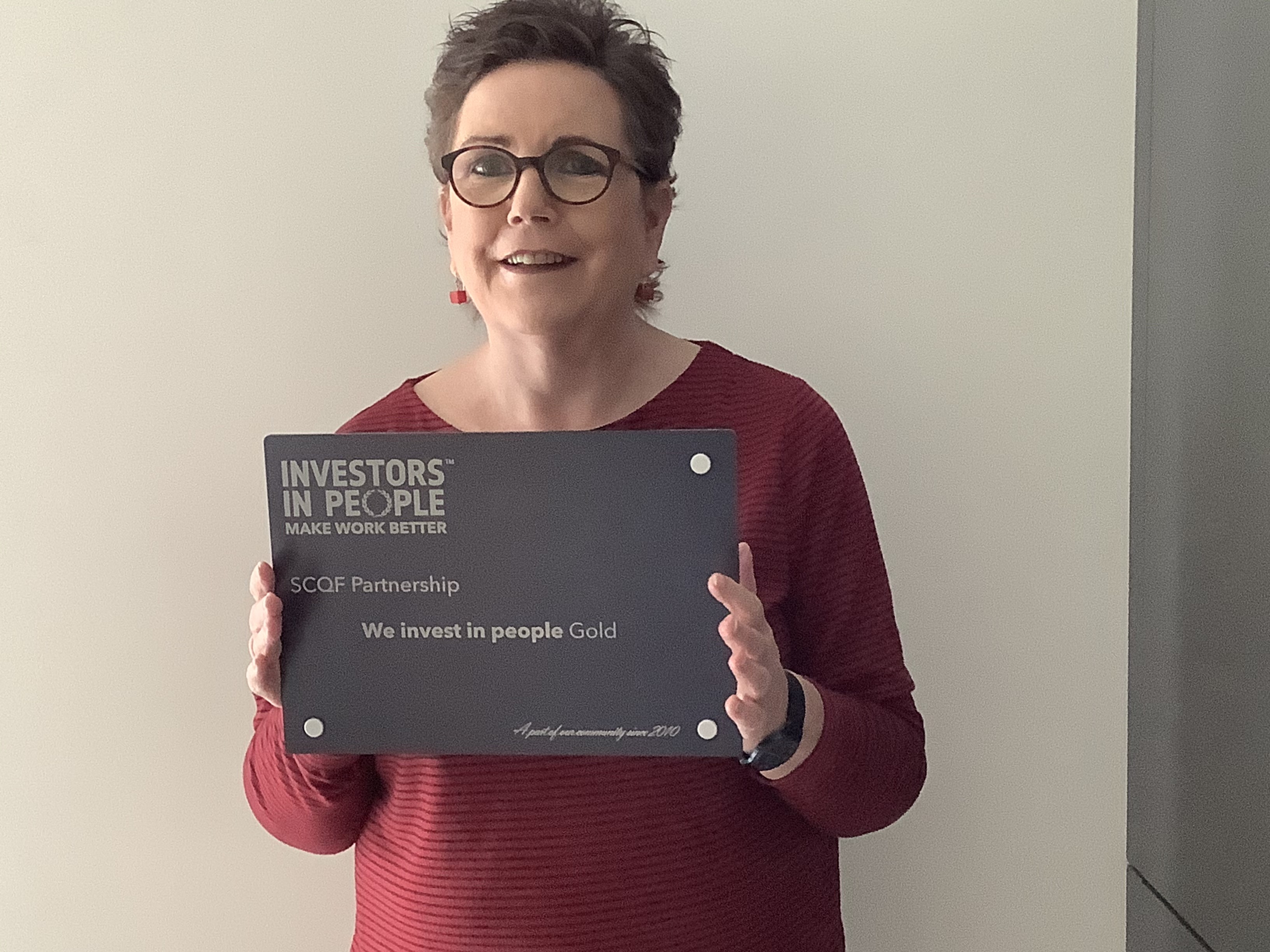 nvestors in People credentials and worked hard to identify ways in which we could improve or enhance our professional service to stakeholders and each other. My thanks go to them for their continued commitment to the success of the SCQF.”
At that time, IiP reps confirmed that the SCQFP’s particular strengths lie within the key areas of Empowering and Involving People, Structuring Work, and Creating Sustainable Success.
If you’d like to get involved, share this post and subscribe to the IiP mailing list for more content.
What is your role within the SCQFP?
I am currently the Head of Quality Enhancement and Recognition. This means that I am responsible for the activities relating to the quality and integrity of the Framework such as the direct support given to new and existing credit rating bodies (CRBs). This includes workshops, advice and guidance on credit rating and RPL as well as managing the quality assurance models to ensure the integrity of credit rating activities. I also work on activities relating the SCQF and its relationship to other frameworks in the UK and beyond, and was previously a member of the European Qualifications Framework Advisory group prior to the UK’s exit from the EU. I am currently a member of the Apprenticeship Approval group in Scotland.
What do you enjoy most about your role?
I like the fact that the work is really varied and the organisations I work with are of different types, sizes and come from a range of different sectors. So every day can be a learning day for me as well!
I enjoy talking to people about the benefits of the SCQF and having the opportunity to champion lifelong learning and the need for parity of esteem of learning no matter where and how that learning takes place.
Tell us a bit about your career to date
I have worked in education in Scotland in a number of roles over 30 years, starting as a Research Fellow in Higher Education researching Quality Systems in Education and then moving on to a number of roles in quality assurance working in FE and also for a short while for QAA Scotland where I was involved in the first launch event for the SCQF.
My links to SCQF continued in my next role in FE where I set up and managed the SCQF credit rating process in the college. I then took that experience and growing interest in SCQF and embarked on my role with the Partnership joining in 2012.
Tell us something interesting about yourself?
I once zip wired across the River Clyde!