

The Young STEM Leader Programme is an exciting opportunity for young people in Scotland to discover, create, inspire and lead in STEM. Derived from the Scottish Government’s Education and Training Strategy for STEM (2017), the programme is led by SSERC in partnership with a wide range of STEM focused organisations in Scotland.
The key aim of the programme is to facilitate the development of peer-to-peer STEM role models, inspiring more young people to develop an interest in STEM. As part of the award, young people will create and plan STEM activities for others, build their leadership, communication and employability skills, and help to build STEM capital within their learning community.
A Young STEM Leader from a youth group delivering centre said about delivering activities: “It was sometimes scary [but] I learned to be patient and calm”.
The award is offered in two versions:
- The non-formal programme at Curriculum for Excellence Second, Third and Fourth Levels (YSL2, YSL3 and YSL4). These awards are typically delivered in primary schools, the BGE phase of secondary schools and in youth work settings.
- The formal programme at SCQF Levels 4, 5 and 6 (YSL4, YSL5 and YSL6). These awards are typically delivered in the senior phase of secondary school, youth work settings, colleges and in some apprenticeship programmes.
The free programme is offered to all young people in Scotland who are supported by a Trained Tutor Assessor – an educator who has undertaken the necessary training by SSERC. To date, over 3000 young people have engaged with the programme in every Local Authority Area in Scotland.
| Award SCQF Level Credit points | ||
| YSL4 | 4 | 3 |
| YSL5 | 5 | 3 |
| YSL6 | 6 | 4 |
There are clear benefits to offering the programme as an SCQF credit rated award – from increasing participation in delivering centres to recognising the achievements of the young people involved.
A Tutor Assessor said: “It’s been a headache securing staffing to enable students to visit primary schools in years gone by, but now there’s a recognised qualification for it, the school is more likely to put it on the timetable.”
To get involved with the Young STEM Leader Programme, visit www.youngstemleader.scot
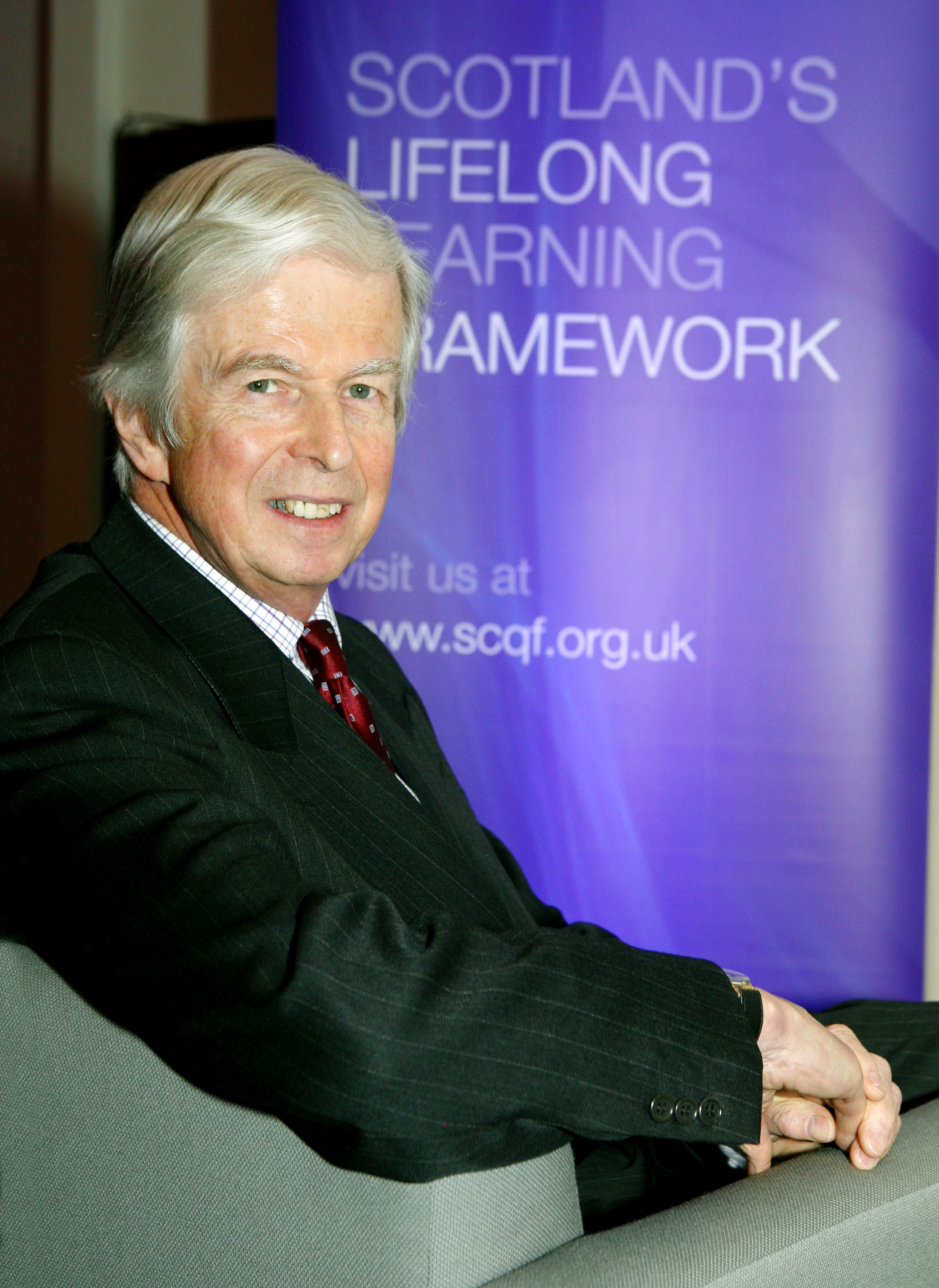
To celebrate 20 years of the SCQF, our former Chair and the first Chair of the SCQF Partnership, Sir Andrew Cubie CBE reflects on the educational priorities that led to establishing the SCQF back in 2001 and why these are still valid today.
Being invited to write a reflective article always contains dangers! How good is your memory and source material and in consequence your objectivity as you meander through your recollections? With these cautions let me as the first Chair of the SCQFP offer these thoughts.
In the aftermath of the “Cubie Committee” report being presented to the Scottish Executive in 1999, which recommended the abolition of student tuition fees in Scotland and the creation of a Scottish Graduate Endowment Fund to which all graduates would contribute once they began to earn in excess of £25,000 per annum, I was much identified with future educational thinking.
Having failed my 11+ I had long talked of the need for respect to be given both to vocational and academic qualifications. “Parity of esteem” was one of my mantras although I was often told it was unrealistic. So, when I was approached to become involved in formalising a Scottish framework to blend academic and vocational qualifications I could hardly say no. As I recall it, there was no real debate about whether we needed a single framework as opposed to multiple. After all I came from an employer perspective, having also at the time just been the Chairman of CBI Scotland. Employers in Scotland needed better guidance about qualifications as most of us then clung to a model of our own experience, predictably well out of date!
Scotland in the years before 2001 had been innovative in the ways in which it had sought to develop framework structures and so the land was fertile for the development of a single Scottish framework. Those who had offered early leadership were QAA Scotland, SQA and Universities Scotland. The backing of the Scottish Executive was also essential. My involvement from the employers’ perspective was also helpful. Whilst the assumption was perhaps easily made that any framework would be government led and controlled, (there were examples around the world where this was so), the view of others and certainly of me was that this initiative had to be led by wider society.
From there it was an easy step to create a company limited by guarantee with charitable status and membership drawn from supporting organisations.
The Board which I chaired reflected that membership with the Scottish Executive sending, after much debate, an observer. These arrangements were finally established over a lunch which I hosted in the Oloroso Restaurant in Edinburgh, which then amongst us became known as the “Oloroso Declaration”. Sadly, we did not sign a serviette to become the first artefact of SCQFP! I am in great debt to my then, and subsequent, Board colleagues.
We were clear from the outset that the Framework should be all embracing if possible, but that not all learning need necessarily be included. Our early struggles were around when and how to incorporate prior and/or informal learning and the Framework today is testament to lots of debate then. That was also true in regard to how we related to other National frameworks. There was, however, significant international interest in what we were creating. In due time there is no doubt that both the European and Asiatic Frameworks owe much to the SCQF. Speaking abroad from time to time about our work it was gratifying to hear plaudits for Scotland’s leadership.
However, none of this would have come about without Aileen Ponton as the Founding Director of SCQFP. She was an inspired appointment. In many ways she is synonymous with SCQF and certainly and rightly the public face of it. She is a global leader and authority about frameworks. For me it has been a singular privilege to work closely with Aileen and her dedicated and knowledgeable team over the last 20 years.
All that remains for me to say is that after a most dynamic and influential first 20 years, I trust that the next 20 years and beyond of SCQF will be equally valuable to the learners and employers of Scotland.
Andrew Cubie
Competency based qualifications have become the talking point of the fire safety sector over the last few months. With the publication of the Hackitt Review this has become more apparent with a clear recommendation to support the strengthening of the competence of those involved in all aspects of building work.
In the report, Building a Safer Future – Independent Review of Building Regulations and Fire Safety (May 2018), Dame Judith Hackitt commented that there is a ‘lack of a coherent approach to competence levels and experience required – or professional qualifications where these may be necessary – and how these qualifications and experience should be evidenced so that they are clearly understood by all those operating within the system.’
The subsequent ‘Setting the Bar – A new competence regime for building a safer future’ report by the Competence Steering Group published a recommendation to “apply stringent assessment of individuals”. It stressed “for individuals whose work materially affects safety, or who work unsupervised, compliance needs to be demonstrated by independent, third party assessment. All others working on higher-risk buildings should be supervised by individuals who have been third party assessed as competent to carry out the work and to act as supervisors.”
The key messaging from both reports can be deciphered as a message to individuals (and organisations) that believe they are already capable of particular skills without providing any suitable evidence of competency to deliver that service.
FireQual understands that, as part of this culture change, there is a need for individuals to have access to robust and fit for purpose qualifications providing developmental progression pathways within the fire safety industry.
With FireQual’s first qualifications now available within Scotland, a suite of qualifications is being built that supports individuals to develop the behaviours, knowledge, and skills to work within all areas and levels within the fire safety and related sectors. Our qualifications currently support those working within the fire detection and alarm sector, Fire Risk Assessors and Fire Safety Officers. Already in development, we will also soon support those within the fire door and domestic sprinkler and water mist system sectors.
Within the safety industry, there are many training programmes and qualifications available that fall under ‘self-regulation’, meaning these may not have been suitably reviewed by an appropriate independent body. This does not mean certain training available is not delivered to a high-quality standard, but FireQual will only provide qualifications that sit within the national qualification regulatory system and on the SCQF. This is an important factor to consider, as qualifications are set to fall under far greater scrutiny in the upcoming years.
Recognising the different complexities and levels of responsibilities within the fire safety sector and the difficulties in navigating the training environment, FireQual’s use of the SCQF aims to provide guidance so that individuals and employers can select the most appropriate qualification to meet their needs. Firequal currently has nine programmes credit rated on to the SCQF at levels 6, 7 and 8.
| Qualification Title | Credit Value |
| FireQual Award in Fundamentals of the Recommendations for Fire Detection and Fire Alarm Systems in Domestic Buildings at SCQF Level 6 | 1 |
| FireQual Award in Fundamentals of the Recommendations for Fire Detection and Fire Alarm Systems in Non-Domestic Buildings at SCQF Level 6 | 4 |
| FireQual Award in Fire Detection and Alarm Commissioning Theory and Regulatory Requirements at SCQF Level 6 | 9 |
| FireQual Award in Fire Detection and Alarm Design Theory and Regulatory Requirements at SCQF Level 6 | 12 |
| FireQual Award in Fire Detection and Alarm Installation Theory and Regulatory Requirements at SCQF Level 6 | 9 |
| FireQual Award in Fire Detection and Alarm Maintenance Theory and Regulatory Requirements at SCQF Level 6 | 9 |
| FireQual Certificate in Fire Safety Enforcement Officers (Scotland) at SCQF Level 7 | 15 |
| FireQual Diploma in Fire Safety Enforcement Officers (Scotland) at SCQF Level 8 | 40 |
| FireQual Certificate in Fire Risk Assessment at SCQF Level 7 | 24 |
Further information on FireQual and qualifications available can be found at www.firequal.com
University of the West of Scotland (UWS) is one of Scotland’s largest modern universities with campuses reaching across the south and west of Scotland, together with our London Campus. UWS is proud of its tradition of career-focused teaching with an international outlook and a far-sighted approach to technology and innovation. As a leading provider of undergraduate, postgraduate and research degree education, UWS provides a transformational experience for its some 18,000-plus full and part time students.
UWS Third Party Credit Rating
UWS has offered third party credit rating services for over a decade and the provision has recently been refreshed. In the relatively short time since the relaunch, UWS has approved nine programmes for multiple organisations from a variety of sectors which will be supported for the next five years. It is hoped this relationship will continue to blossom in the coming years with a view to continued credit rating provision.
The Scottish Credit and Qualifications Framework Partnership (SCQFP) has been very accommodating by offering a range of one to one support and guidance (and patience!) for the development of UWS’s Credit Rating provision to ensure the integrity of the Framework is maintained and that the service we provide to third parties is of the standard expected of a Credit Rating Body (CRB) as specified in the SCQF Handbook. The SCQFP has developed a comprehensive suite of Information Notes to assist any other Credit Rating Body looking to move into third party credit rating.
Why Choose to be Credit Rated?
Organisations and employers choose to have their programmes credit rated for many reasons, including offering employees formal recognition for in-house training programmes, creating access pathways to further learning and creating smaller chunks of learning or micro-credentials that can be used as building blocks for different further learning. Due to the flexible nature of the SCQF this means that credit may be transferrable from one learning programme to another (where appropriate) with Recognition of Prior Learning principles also applied.
Organisations and employers can be reassured that by offering a credit rating provision to their clients they are supported by a rigorous and thorough process of quality assurance, which is overseen by UWS and underpinned by the SCQF principles.
UWS appreciates having a programme credit rated may not only be a unique selling point for an organisation, but can also be a lifeline for the business. It shows that the organisation is serious about its product and committed to its customers, and UWS is proud to be able to support the business community in this way.
CASE STUDY – THE CODE INSTITUTE
The Code Institute approached UWS to explore the possibility of Credit Rating approval, and over a few conversations the shape of that Credit Rating approval was understood, and UWS QuEST colleagues were able to work with the Code Institute to support its application. Edinburgh Napier University had previously provided Credit Rating approval for the Code Institute which was up for renewal following a period of 5 years.

Europe’s only University credit rated coding boot-camp was established in 2015 to address the increasing global skills coding gap. The boot-camp type approach of the Code Institute’s Diploma in Software Development was designed to directly address the skills gap by providing entry level software developers with an appropriate course of credit bearing learning, following a structured programme of immersive and accelerated tuition. Delivered fully online, the Code Institute Diploma gives participants hands-on experience in creating employer-ready web technologies for both front and back-end. Content is industry-validated by the Industry Advisory Council and is suitable for beginners or those with an existing skill-set who wish to enhance their career prospects. Participants are job-ready with their own portfolio of projects on completion. The programme has evolved since it was first introduced and this latest version gives students the opportunity to specialise in areas as part of their diploma, including E-commerce Applications and Dev Ops Practitioner with further specialisms in development.
Following the application process, the Code Institute was able to map its learning outcomes to the SCQF framework. This, and other supporting information was reviewed by a UWS Internal Expert (a member of the academic staff who had a relevant background and knowledge of the IT sector), and following consideration by the UWS Credit Rating Group the application was approved.
“The Credit-Rating by UWS of our Diploma provides academic validation of the programme along with the levelling on the SCQF, and, in addition to being mapped to the EQF, provides context for our global student population, distinguishing us from our competitors. We are delighted to partner with UWS on this Credit-Rating provision and it is a pleasure to work with the QUEST team.”
Quality Assurance
Credit rating is quality assured by the Quality Enhancement Support Team (QuEST) within UWS and the small team from QuEST creates a single point of contact for applicants. UWS will undertake due diligence on applications received and has three Credit Rating review dates throughout the year where applications are considered. It is common for UWS to contact applicants for further information or clarification on an aspect of their application. After due diligence has been completed and the application has been considered by its Quality process UWS then begins credit rating the programme of learning. Normally credit rating approval will last for 5 years, with annual monitoring taking place to consider any changes that may have been made to the learning outcomes that may impact upon the original decision of SCQF level and credit points. If this has happened the programme would be re credit rated to take this into consideration.
Beyond Credit Rating
Where possible, organisations who gain UWS Credit Rating approval will be invited to explore additional ways to utilise their connection with the institution. This could be through guest lectures, student placements or the creation of a more formalised partnership. UWS is keen to ensure the Credit Rating connection works for both parties.
UWS Centre for Continuing Professional Development
The UWS Centre for Continuing Professional Development offers flexible and innovative Career Progression and Development (CPD) opportunities for organisations and individuals and works with the QuEST team to identify potential opportunities for a CPD/Credit Rating approach. Whether you’re looking to build on your existing skills, looking to change career or provide training opportunities for your staff, UWS is committed to providing courses and an excellent student experience.
The UWS CPD team assists in the delivery of a range of accredited and non-accredited CPD courses that draw on diverse areas of expertise across the university and prides itself on working with industry partners to ensure that its students receive practical, industry focused training.
UWS works closely with both domestic and international organisations to design bespoke training for staff which can be delivered in a number of formats including: workshops and seminars, masterclasses, short courses, group coaching and part time degree programmes. Thanks to the UWS Upskilling Fund (a fund delivered by the Scottish Funding Council to address skills gaps across Scotland), the institution can also offer fully funded and part-funded places on many of its CPD courses.
The latest news and events from the UWS Centre for Continuing Professional Development is available on Twitter and LinkedIn.
Sounds Interesting?
If this sounds like something you or your business would be interested in exploring, UWS would love to hear from you! More information on Credit Rating is available here or you can contact the QuEST Credit Rating team at quest@uws.ac.uk for an informal chat.
Download a PDF version of this blog
College Development Network (CDN) supports and develops the skills and training of college staff. During the pandemic, the team has focused on enhancing the quality of teaching and learning for the rapid changes that have been required to deliver online and blended learning.
CDN recently launched two new ‘Teaching in Colleges Today’ (TiCT) which are credit rated on the SCQF at levels 7 and 8. These have been developed to better meet the initial professional development needs of new college lecturers coming into the sector. The programmes take account of the professional competences and practices expected of college lecturers today, as required within the Professional Standards for Lecturers in Scotland’s Colleges. The new TiCT programmes were launched at College Expo21 and staff have been able to use the online learning materials and register for the programmes since Thursday 10 June.
The original SCQF level 7 Teaching in Colleges Today unit was initially developed in 2013 and credit rated by Coatbridge College, now part of New College Lanarkshire. Since then, hundreds of candidates across Scotland have been certificated. CDN is delighted to be continuing to build on this success through continuing and enhancing the provision with Fife College, which has taken on the role of the SCQF Credit Rating Body for the new programmes.
Iain Hawker, Assistant Principal – Quality and Academic Partnerships at Fife College, said:
“Fife College is proud to be the Credit Rating Body for the two new CDN Teaching in Colleges Today qualifications. The credit rating process we followed is aligned to the SCQFP guidelines and involved three robust levels of panel scrutiny and review. The panels included independent expert reviewers to ensure confidence in the content and of the SCQF levels at which the qualifications have been credit rated.
“Teaching in Colleges Today provides a sound platform for new lecturers to gain the knowledge and understanding of professional teaching practice and is an important part of career long professional learning and development for lecturers.
“It has been a pleasure working with CDN on the credit rating project and we are confident that the new qualifications will continue to meet the changing needs of the Scottish College education sector.”


The new programmes provide a flexible way for new entrants to the sector to gain formal recognition of their ability to plan and deliver high quality learning, teaching and assessment. The programmes and the online learning materials have been specifically designed to encourage early career engagement with the Professional Standards required to teach in Scotland, and to support candidates to reflect on and evaluate the impact of their current practice. It is anticipated that this will enable candidates to identify areas of enhancement and development in their practice.
The General Teaching Council for Scotland (GTCS) states that
“From August 2021 all lecturers (covered by the national agreement) who hold a TQFE or other GTC Scotland recognised teaching qualification will receive an invitation to register with GTCS. Alternative pathways to registration for lecturers who are currently ineligible to register (lecturers who qualified outside Scotland, lecturers who hold Higher Education or other alternative teaching qualifications and lecturers who do not yet hold a teaching qualification) will be confirmed by GTCS and should be available from April 2022 onwards”.
The ability to choose from an SCQF level 7 or SCQF level 8 gives candidates the scope to enter the programme at a suitable level to their existing level of competence. It then creates a clear progression pathway into further learning and professional qualifications such as the SCQF level 9 Professional Development Award (PDA) Teaching Practice in Scotland’s Colleges or the SCQF level 9 PgCert Tertiary Education (TQFE) or SCQF level 11 PgDip Tertiary Education (TQFE).
Candidates who have previously completed CDN’s original TiCT programme at SCQF level 7 will find that the new SCQF level 8 programme offers a challenging bridging programme while waiting to complete more advanced professional qualifications should they decide to undertake more learning.
A learner who completed the original TiCT Programme, said:
“TiCT is a great foundation course for any new lecturer… it is clear to use with good links to current legislation and relevant topics”.
Read about the new TiCT programmes and find out about enrolment options.
Download a pdf version of this blog
The Scottish Council for Voluntary Organisations (SCVO) is the national membership body for Scotland’s vibrant voluntary sector. It champions the sector, provides services and debates big issues. SCVO is passionate about what the voluntary sector can achieve and along with its community of 2,000+ members, believes that charities, social enterprises and voluntary groups make Scotland a better place.
SCVO has been working on the digital inclusion agenda for around 8 years now, with a focus on supporting the voluntary sector to embed digital inclusion in core service delivery. SCVO and Glasgow Kelvin College are now offering a range of free qualifications which will help to address some of the challenges of digital inclusion in Scotland’s communities:
• Certificate in Digital Inclusion Support – SCQF Level 4 (with 1 credit point)
• Essential Skills for Digital Champions – SCQF Level 6 (with 4 credit points)
• Digital Inclusion Project Management – SCQF Level 8 (with 8 credit points)
After the past 15 months, there is no question that being digitally included is no longer a ‘nice-to-have’ but an essential lifeline. Digital has helped us stay connected to one another, enabled us to access services and find reliable public health information. It is often those working in frontline services that help build the skills and confidence of those who are digitally excluded. We call these people ‘Digital Champions’ and they embed digital skills in the core support they provide to their communities. The qualifications have been created to formally recognise the amazing work Digital Champions are doing across Scotland.
The Level 4 Certificate is an introductory course aimed at anyone starting their digital inclusion support journey, introducing some of the basic concepts. This is a great starting point for anyone who is new to helping address digital inequality. The Level 6 qualification builds on the Certificate, helping practitioners develop their digital support skills, with a focus on practice-based learning and reflection.
Our previous work at SCVO has taught us that well-intentioned attempts to promote digital inclusion can fail if there isn’t a commitment at senior management level that helps create the culture to sustain this work. We created the Level 8 qualification, aimed at managers, to help this cohort of learners to design and develop their own digital inclusion initiatives. This is a very practical course, taking learners through the different stages of project management and securing organisational buy-in.
Learner from the Level 8:
“Its guided assessments through project planning, delivery and evaluation put into focus approaches I had been doing unconsciously and allowed me to critically reflect their effectiveness. It challenged my assumptions of my community and was incredibly helpful in my role in Digital Inclusion.”
Enrolment for the new academic year will open again in September 2021, and you can find out more about all three qualifications on the SCVO website.

ScotRail is the most recent organisation to become an SCQF Inclusive Recruiter, committing to using SCQF levels in its recruitment processes.
ScotRail provides nearly 100 million passenger journeys each year, with over 2,300 intercity, regional and suburban rail services a day, more than 340 stations, and just under 800 trains serving Scotland’s railway. The ScotRail network is vital to Scotland’s communities and to the country’s booming tourist industry. With over 5,000 employees based across Scotland, it is a large employer with a proud history.
Launched in 2019, the aim of SCQF Inclusive Recruiter is to help employers and HR professionals understand that many different qualifications have the same worth, and to encourage use of SCQF levels in the recruitment process to offer clarity around skills and experience.
By using SCQF levels rather than specific qualifications in job adverts, employers large and small can widen the pool of potential applicants who may have a variety of qualifications, skills and experience at the required level. They can therefore recruit the right person with the right skills into the right job which is great for the organisation’s productivity and employee satisfaction.
Neil Archibald, ScotRail Head of Strategic Workforce Planning, said:
“This is a really progressive move by ScotRail as we continue to develop our methods of attracting the best candidates for vacancies. By adding SCQF levels into the recruitment mix, we are confident we will be able to identify skills and experiences that might previously have been ignored or overlooked. We believe this will be good for applicants, for ScotRail and for the wider rail network, as we will all benefit from a more flexible and robust selection process.”
Aileen Ponton, CEO of the SCQFP added:
“The SCQF Partnership is delighted that ScotRail has become an Inclusive Recruiter. It is really heartening to see a major company recognise that using SCQF levels in recruitment, rather than stating specific qualifications, can open up a wider pool of talent for them and we will follow their progress with real interest to assess the impact it has on the workforce.”
Want to find out more? Becoming an SCQF Inclusive Recruiter is free and simple! Visit the Inclusive Recruiter section of our website or contact us at info@scqf.org.uk.
SCQFP Head of Partnerships and Communications, Julie Cavanagh, recently took part in a podcast focusing on the range of education opportunities available for Ex-Forces and those Serving Personnel resident in Scotland.
In the podcast Julie talks about how the SCQF can help veterans and serving personnel to articulate their skills and experience to move into alternative employment or gain access to further and higher education learning pathways. She also refers to the ongoing project with Skills Development Scotland and the Ministry of Defence to develop an online skills profiling tool specifically for service leavers, to support them in understanding the skills they have gained in the military.
Julie is joined on the podcast by host, Matt Pybus and:
· Claire Biggar – Inclusion & Wellbeing Consultant, Capability & Engagement Team, HR at Edinburgh Napier University
· Shaun Calvin – Support Officer for Veterans Scotland
· Gerri Matthews-Smith – Associate Research Professor and Lead for Military Research at Edinburgh Napier University
Watch the podcast below
Podcast – Education opportunities and support for veterans in Scotland
