

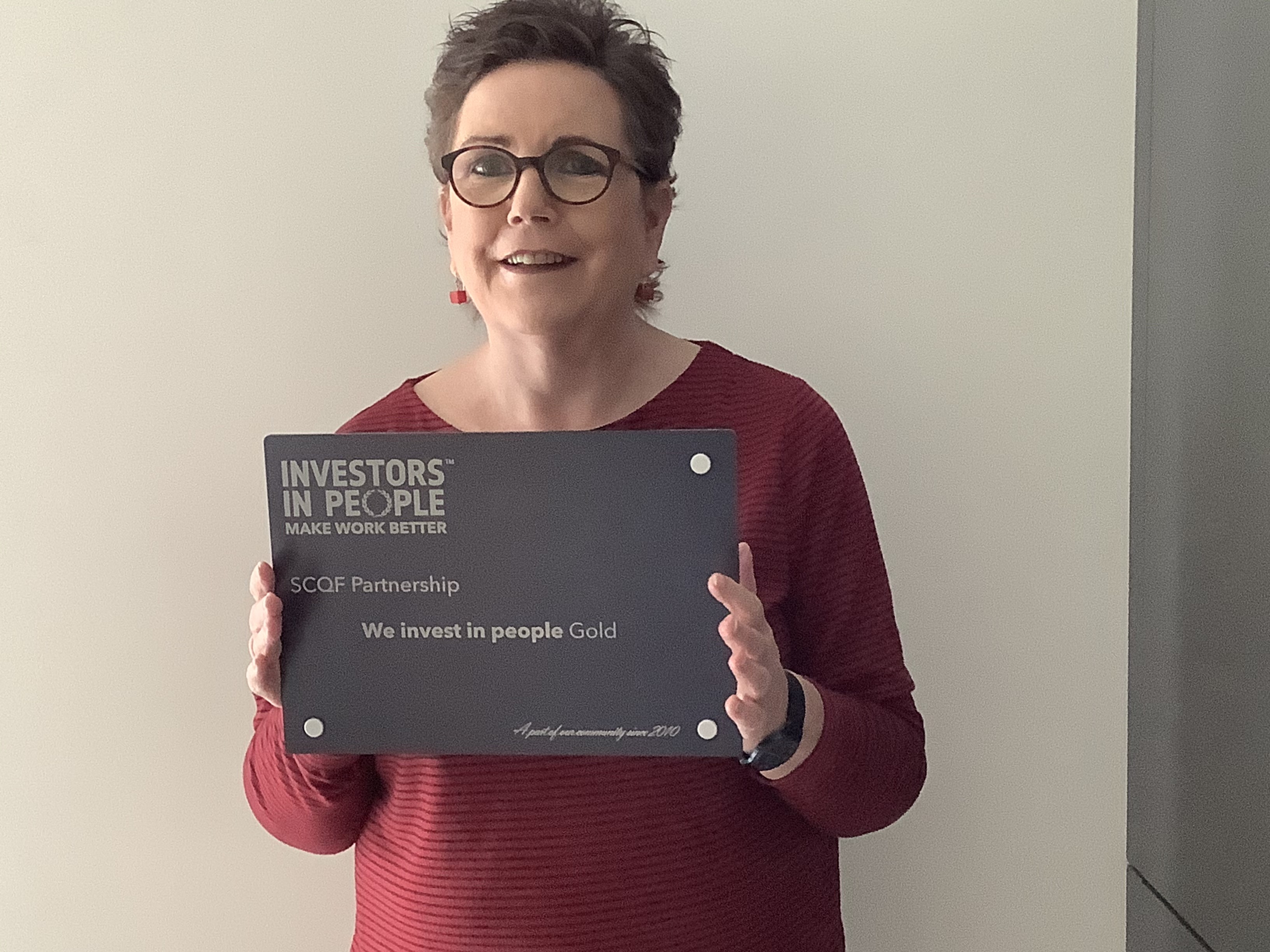
The SCQF Partnership has been awarded the Investors in People Standard at Gold level.
Based on 30 years of leading practice, the Investors in People Standard is underpinned by a rigorous assessment methodology and a framework which reflects the very latest workplace trends, essential skills and effective structures required to outperform in any industry.
Successful accreditation against the Standard is the sign of a great employer, an outperforming place to work and a clear commitment to sustained success.
IiP reps confirmed that the SCQFP’s particular strengths lie within the key areas of Empowering and Involving People, Structuring Work, and Creating Sustainable Success.
The vision of the SCQFP is: ‘To work with our partners and stakeholders to ensure the SCQF is seen both nationally and internationally as a symbol of quality and underpins the development of a robust education and skills system in Scotland that is fit for the 21st century.’
Aileen Ponton, CEO, said: “I was delighted but not surprised that our organisation was recognised as meeting the Gold standard. The whole team contributed to the review of our Investors in People credentials and worked hard to identify ways in which we could improve or enhance our professional service to stakeholders and each other. My thanks go to them for their continued commitment to the success of the SCQF.”
Investors in People Scotland is delivered by Remarkable. The organisation specialises in business advisory, consultancy, leadership and organisational development.
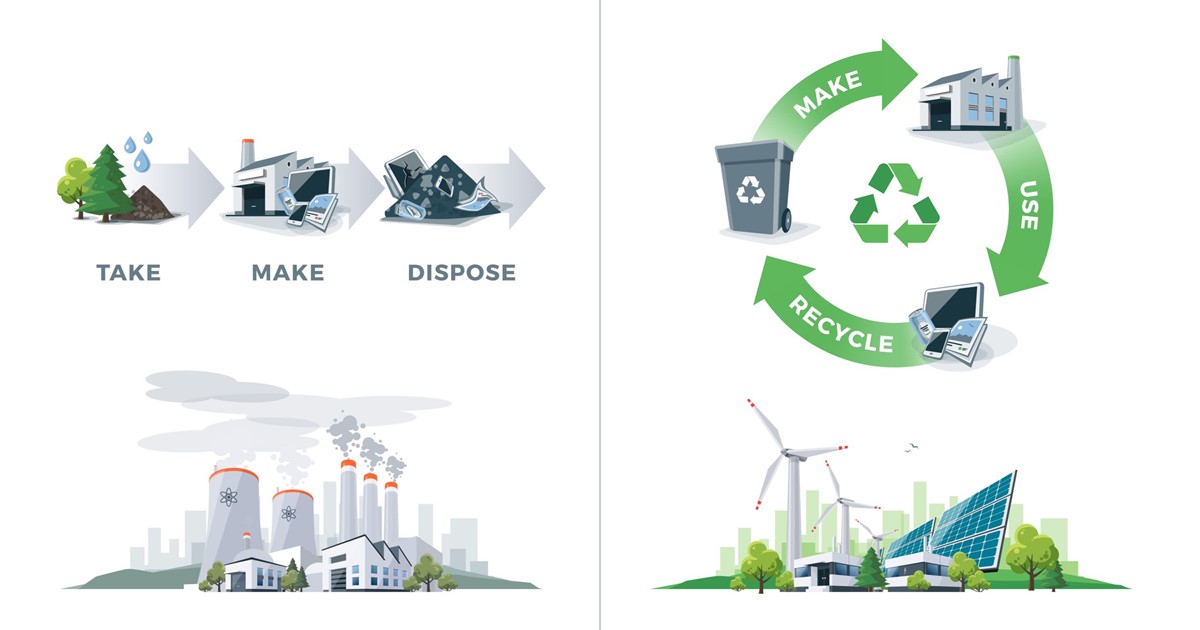
Following consultation with learning and teaching practitioners, waste experts WasteSwitch Ltd and training specialists Playback ICE have developed the ‘Waste in the Circular Economy’ award.
With the environmental revolution in full swing, the passion and commitment to deliver additional enhancements to core learning, covering areas such as the environment, sustainability and the circular economy has never been greater or more important: this was the clear objective from the outset.
‘Subject matter expertise provided by WasteSwitch Learning and Playback ICE’s skills in producing high quality credit rated programmes resulted in the development of this unique award’’
Steven Kiakowski, Director, WasteSwitch Ltd
Who the programme is aimed at:
The programme is at SCQF level 5 with 3 credit points. It has been designed to benefit multiple groups of learners undertaking the following programmes/opportunities:
• Core and essential skills development
• Enhancing apprenticeship programmes
• Employability programmes
• Senior phase school students, including Foundation Apprenticeships
• People returning to work or changing career
• Employees with specific roles relating to waste management and the environment
The knowledge gained improves the students’ ability to relate the learning to their future careers and personal development. Understanding these key aspects of the current and future ‘world’ will differentiate each learner from their peers in the heartbeat of the ‘’Green’’ Recovery. A clear and detailed commitment from Government can be viewed in this article: The Green Recovery Plan
What benefits does the credit rating of this programme provide for learners completing it?
The credit rating process provides a cornerstone of recognition for both ourselves as the provider, and the learner.
The SCQF provides recognised and understood levels within, not only Scotland, but the rest of the UK and Europe. This provides a platform for the learner to consider holistically their educational and workplace progression.
Credit rating also allows those already within education to understand the content, the level and approach within the award, allowing them to ensure learners undertaking the award are at the appropriate level.
Quotes from learners on the impact the programmes has had in their work/lives:
1 Student 1, West Lothian College
‘’I now view waste as a valuable commodity because by separating and recycling at source as much as possible we can make waste work more effectively. We all have our part to play in influencing others, from recycling and/or re-using our household waste to large and small companies.’’
2 Student 2, West Lothian College
‘’I have been able to identify where we need to manage our waste consistently and ensure we understand our local authorities’ services and approach to waste I produce. The award has made me see waste products as valuable commodities that if recycled, re-used or recovered properly can save energy, leading to more green jobs, improved economies and more importantly make us all healthier.”
3 Graeme Binnie, Lead Course Lecturer, West Lothian College
‘’The SCQF Level 5 Waste in the Circular Economy unit was a standout success for our pre-apprenticeship carpentry and joinery group last year. I feel this was one of the very best units I have taught to construction students as it relates to not only the industry they are moving into, but also has such a profound effect on their lives and those around them.’’
4 Susan McSeveney , Depute Centre Head for Construction and Automotive, West Lothian College
‘’I have a passion for developing sustainable skills and widening people’s knowledge of environmental issues in and outwith their college experience, and through the award from WasteSwitch Learning I was able to offer this to a cohort of students with unintended consequences that ultimately enhanced their experiences beyond our expectations. The offering from WasteSwitch Learning exceeded our expectations in both a content and delivery perspective, it was very well supported by staff and was easily customised to take account of programme needs.’’
For more information on the services provided by WasteSwitch Learning, please contact us on 0800 689 9222 or visit our website for further details.
The Scottish Credit and Qualifications Framework (SCQF) Partnership Board is delighted to announce the appointment of a new non-Executive Director to its Board of Management.
Professor Malcolm Foley has taken on the role of Chair of the SCQFP Quality Committee and a Director of the Board with effect from 1 August.
The Quality Committee was established by the Board of the SCQF Partnership to make recommendations to it on all issues concerning the ongoing maintenance and quality assurance of the SCQF.
Speaking about his appointment Professor Malcolm commented, “I am delighted to be appointed to the role of Chair of the Quality Committee at SCQF. I look forward to contributing to the outstanding work of the Partnership as it addresses the challenges facing education in Scotland and beyond.”
Professor Foley retired from his role as Vice Principal and Dean of Business and Enterprise at the University of the West of Scotland (UWS) in May 2018.
As a full professor of the University while employed there, he was awarded the honorary title of Professor Emeritus by the University Senate upon his retirement in recognition of his contribution to Scottish higher education teaching and research over 38 years.
Prior to joining UWS, he simultaneously held a Professorship and management roles at Glasgow Caledonian University. In his long career in higher education, he also held academic roles at Heriot Watt University, Moray House College of Education, Dunfermline College of Physical Education and the University of Edinburgh.

The Circle Academy is a 12-week intensive, practical and educational training programme for individuals interested in running ‘more than profit’ businesses. The programme provides the tools and building blocks to launch and grow a More Than Profit organisation, alongside one-to-one support and guidance with industry experts as proposals are formulated and refined.
Through the Academy programme, The Circle is focused on developing individuals’ skills and knowledge in the following key areas: mindset, business planning, finance, legal structures, governance, people, social impact, and sustainability through multiple income streams.
The programme is aimed at individuals who would like to set up or develop an organisation or project with a social impact. This includes sole traders, founders, Chief Executives and Directors of organisations, project leads and employees of existing third sector organisations.
The Circle Academy offers dedicated time and space, as well as critical guidance and support that allows individuals to work ‘on’ their business rather than ‘in’ it. Allowing space to expand knowledge, explore possibilities, and emerge with an informed and viable plan for the future of their organisation.
On completion of the programme, successful participants will be awarded with ‘The Circle Academy Award In Social Entrepreneurship’ at SCQF level 7 with 21 credit points, having built a detailed and an actionable business plan, cash flow, and marketing plan, as well as gaining skills, knowledge, networks and ongoing support.
An SCQF credit rated qualification will give participants of The Academy programme an internationally recognised symbol of the quality of education and significance of their achievements and the ability to run a successful More Than Profit business. It is evidence of their dedication to the success of their organisation and will, in the eyes of funders and investors, make them highly investable individuals. We hope the qualification will give participants a strong sense of confidence in their abilities, a competitive edge in the field, and empower them to seek out further opportunities for themselves and their organisations.
Eddie Baines was a participant on cohort 1 of The Academy programme; he runs an expanding network of community larders. His time on the programme and successes thereafter, are a testament to the power of equipping passionate social leaders with the business knowledge and acumen to succeed:
“I had the passion and the drive to push the idea forward but no business acumen. I now realise that this is vital for a charity and is the exact reason that many charities and community groups are failing. Getting the basics right can be the difference between success and failure. I now see that having the passion is great but failure will happen through the lack of correct procedures, poor governance and no systems. This is how I was beginning to burn out. Through my rushed decisions, I now see I am in a relationship with the Larder that will be tricky to navigate in future but I have learned through The Academy how not to fall into this trap in future.
The Academy is more than a classroom, or sessions. The cohort have sat privately, sorted issues in each other’s business ventures, without sugar coating the reality. It is genuinely support, not just a pat on the back.”
Emma Charlton, a participant of cohort 2 is planning to open an upcycled homewares store, which employs individuals with additional support needs. She has attributed her ability to produce a thorough and viable business plan to the Academy’s intensive course structure and constructive, yet supportive, environment:
“The Academy gave me space to focus my thoughts on my pending venture and time to consolidate my learning without distractions.”
Visit our website or contact Alice for more information on how to apply for the next cohort of The Circle Academy.

You may have opted to receive your SQA results by text or email but all students will receive a Scottish Qualifications Certificate (SQC) via first class mail by TUESDAY 4th AUGUST.
With your SQA certificate you get a profile sheet which includes your SCQF Profile. Understanding the SCQF will help you to make sense of your exam certificate, and can help you plan your next steps, particularly if you didn’t receive the results you hoped for and have to make alternative choices.
Watch our short video
What is the SCQF?
The SCQF is the Scottish Credit and Qualifications Framework – it is a way of comparing Scottish qualifications. It covers the qualifications you will achieve at school, college, university, and many qualifications you may go on to achieve at work. It does this by giving each qualification a level and credit points. The level of a qualification shows how difficult the learning is.
For example, one person may study a National 4 at SCQF Level 4, and another a Higher at SCQF Level 6. Both qualifications have 24 SCQF credit points but have different levels of difficulty. The credit points show how much you need to learn to achieve that qualification.
What is it for?
The SCQF makes it easier to describe, compare and understand qualifications. Before the SCQF, there was no easy way to compare different qualifications. Now it is easy to see that, for example, an NPA at SCQF Level 5 is at the same level as a National 5. Most Scottish universities and colleges now use SCQF levels and credit points to describe their courses.
The SCQF can:
- help you plan your learning and make the right choices;
- help employers understand your qualifications;
- help universities or colleges identify the level you have studied at in a particular subject, and make it easier to transfer credits between different learning programmes;
- increase your confidence by showing you the level of learning you have achieved; and
- recognise other areas of formal and informal learning or skills that may help you to develop and achieve your goals.
See your level of learning and compare qualifications on our interactive framework diagram
SCQF Levels
The Scottish Credit and Qualifications Framework has 12 levels. The different levels indicate the level of difficulty of a particular qualification.
SCQF Credit Points
Credit points are a way of showing how much time it takes, on average, to complete a qualification or learning programme. Along with the Level Descriptors, they allow learners, learning providers and employers to compare different qualifications at the same or even different levels.
In common with other credit systems, the SCQF works on the basis that one credit point represents the amount of learning achieved through a notional 10 hours of learning time which includes everything a learner has to do to achieve the outcomes in a qualification including the assessment procedures.
Credit Transfer
In some instances it may be possible to transfer SCQF credit points to other learning programmes to ensure that a learner does not have to repeat any learning they have already undertaken.
Universities and colleges, SQA and other awarding bodies decide how many of the credit points already received from previous learning can be transferred into their programmes. In all cases of credit transfer it would be the decision of the accepting learning institution as to how many credit points could be transferred.
There are over 11,500 qualifications on the SCQF. Here are just a few others:

Frequently asked questions
Are SCQF credit points the same as UCAS tariff points?
SCQF credit points are not the same as UCAS tariff points. UCAS tariff points relate to the grades you have achieved. SCQF credits are a measure of how much you need to learn to achieve a qualification, no matter what grade you get.
Why does an ‘A’ at Higher get the same number of SCQF credit points as a ‘C’ at Higher?
The number of SCQF credit points you’ve gained doesn’t change depending on your grade at any particular level. SCQF credits reflect how much learning you’ve done, not how well you’ve learned a subject.
Will my qualifications be recognised if I move abroad?
SCQF levels are now referenced against the European Qualifications Framework (EQF), so learning institutions and employers in Europe can easily compare your qualifications against their own country’s qualifications framework.
If I build up SCQF credit points, will I get into college or university?
Not directly, although SCQF credit points help admissions officers in colleges and universities know exactly how much learning you have done and at what level. The admissions officers still have other factors to consider, such as the subjects you studied and grades you achieved.
Will the SCQF help me to get a job?
Not directly, but it will help employers understand the level of difficulty of each qualification, as well as the number of credit points you have achieved as part of your personal development. As your career develops, any work-based qualifications you achieve may add to the number of credits you already have.
SQA Support
If something is wrong or missing from your certificate, call your school/college who will contact SQA.
The SQA Candidate Advice Line is available from 4-7 August for help regarding your certificate please call 0345 279 1000
Results Helpline
Skills Development Scotland’s Results Helpline will open at 8am on results day with careers advisers from across Scotland offering advice, information and support for young people and their parents and carers.
They can help with advice and information on UCAS course vacancies at UK colleges and universities, Confirmation and Clearing, apprenticeships, jobs, volunteering and more. Just call 0808 100 8000.
Find out more now at Scotland’s careers website My World of Work.
Other Support
Remember there is lots of support out there for learners via SQA, Young Scot and My World of Work and for parents via NPFS and My Kid’s Career.
Should you have any further questions relating to SCQF Credits or Levels please get in touch via email on info@scqf.org.uk, or connect with us on Twitter, Facebook or Instagram.

RUTS is a charity committed to providing vocational training and employability support to young people, including the delivery of SQA qualifications which have been credit rated on to the SCQF. Since these qualifications have an SCQF level and credit points, this supports RUTS to achieve additional tangible outcomes for young people which include re-engagement with school/further/higher education or progress along the Employability Pipeline.
The themes along which RUTS delivers this support and training include motorbikes, bicycles and boxing. Two popular programmes delivered by RUTS which are on the SCQF are:
1. Motolearn
Motolearn is a motorbike themed practical qualification at SCQF level 5 that consists of three units;
Think Bike: where participants are taught about legal requirements and responsibilities of being a bike user
Fix Bike: where participants are introduced to mechanical theory and practical tasks
Ride Bike: where participants will ride one of RUTS’ off-road trials bikes.
Through this engagement there is a focus on personal development by acknowledging the core skills required to be successful.
2. Bikefix Leadership Award
The Bikefix leadership Award is a bicycle themed qualification, also at SCQF level 5, where participants gain skills on how to use a range of hand tools by learning how to carry out a bicycle service and complete practical maintenance tasks, supporting the development of core skills for work and skills for life. Through this qualification, candidates also learn safe riding practices with a view to using cycling as a mode of transport to support employment or attendance at training or in education.
Skills
Clearly, these programmes are aimed at participants who have an interest in learning practical skills and who may benefit from learning outside of a typical classroom environment. There are multi-faceted benefits as the core skills learnt through these qualifications are transferable into everyday life and into the world of work.
Benefits
There are obvious benefits for SCQF credit rating of these activities. Participants are learning new skills and this certification adds value and merit to their work. This credit rating is also appealing to clients such as schools and employers, meaning more young people are provided with the opportunity to participate. Completing nationally recognised qualifications also supports the achievement of tangible outcomes particularly in relation to the achievement and sustainment of employment.
Progression
A recent participant of a Motolearn programme described the programme as really interesting as he has aspirations to work in the motor vehicle industry. On completion of the programme, he insisted that he was going to work with his support network to “find out how to get into college to do more advanced mechanics or see if I can get an apprenticeship”.

We are all adapting to different ways of working and the myriad of methods of communicating with each other in these current times. Colleges have been working extensively and quickly to develop different ways of delivering programmes for learners, alternative methods of assessing as well as thinking about the different types of programmes which might be needed for existing and future learners over the coming months.
As we move forward to whatever the new normal may be, many of you will also be turning your thoughts to the need to develop new, short and engaging programmes for a potential whole new cohort of learners needing to address new training and upskilling requirements.
Online learning has now become ever more important and there is a vast array of options out there for learners. Everyone’s inboxes are inundated with offers on a daily basis. For learners, identifying those that will help them progress to the next stage in their learning journey or into employment can be daunting and confusing.
So how can you make your online learning stand out from the others and ensure recognition of the skills your learners will gain?
By making sure it meets the 4 criteria for SCQF credit rating and credit rating it onto the SCQF:
- Written in learning outcomes
- A minimum of 10 notional learning hours
- Formally assessed
- Quality assured
Credit rating online learning onto the SCQF gives a recognition of the quality assurance behind your programme and gives your learners a formal level and credit points that they can use to move forward in their learning and employment opportunities.
As SCQF Credit Rating Bodies, colleges in Scotland are all able to develop and credit rate new programmes onto the SCQF. Some colleges are already using this authority extensively and have credit rated many programmes, others have dipped their toe in the water with one or two ventures and some of you are still to take that first step.
By using your credit rating authority colleges have the potential to develop flexible programmes to meet local needs and credit rating these programmes allows colleges to provide successful learners with formal credit for their achievements. The SCQF Principles cover all types of learning including online and our SCQF database already contains many programmes which are delivered online.
We have a number of examples of colleges using their credit rating processes on our website.
Case Study: New College Lanarkshire
If you are not quite ready to leap into new credit rating projects but are looking at adapting existing credit rated programmes from classroom to online, then this blog might help you think about ensuring that the changes you make don’t affect the level or credit of your programme. Sandra-Jane Grier at CDN talks about using the SCQF Level Descriptors to ensure that your learning materials and assessments are pitched at the right level.
The Descriptors can be downloaded free of charge from the SCQF website.

If your college is new to credit rating or you want some advice on credit rating your programmes, get in touch with us.

Learning providers are having to adapt rapidly in these times with many of you moving your provision online. Amazing amounts of work are being carried out to adapt materials and assessments by staff who are having to become more adaptable every day and get to grips with the wide range of technological solutions out there.
So you have already taken the step to get your learning programmes recognised on the SCQF providing your learners with recognition for the skills they gain with you. You might have done this some time ago.
But what now?
What does it mean when you are making all of these changes to the way you deliver your programmes and assess your learners? How do you make sure that you are still meeting the requirements of SCQF and ensuring that your learners can still be certificated?
The most important thing to do is keep in touch with your Credit Rating Body and let them know what you are doing and about any changes you might be planning to make to your programmes and assessments. They will be able to advise you if any of that might impact on your credit rating.
Remember that the SCQF Principles cover all types of learning including online and our SCQF database already contains many programmes which are delivered online. So moving online is not a problem in itself, however it is important to make sure that you are still able to demonstrate that your learners are meeting all of the learning outcomes of their programmes.
You might find this article useful. Sandra-Jane Grier at the College Development Network talks about using the SCQF Level Descriptors to ensure that your learning materials and assessments are pitched at the right level.

Download your free copy of the Descriptors
If you are having any difficulty getting in touch with your Credit Rating Body, please send a message to us here at the SCQF Partnership and we will try to help you make contact. You can find our details on the Meet the Team page.