

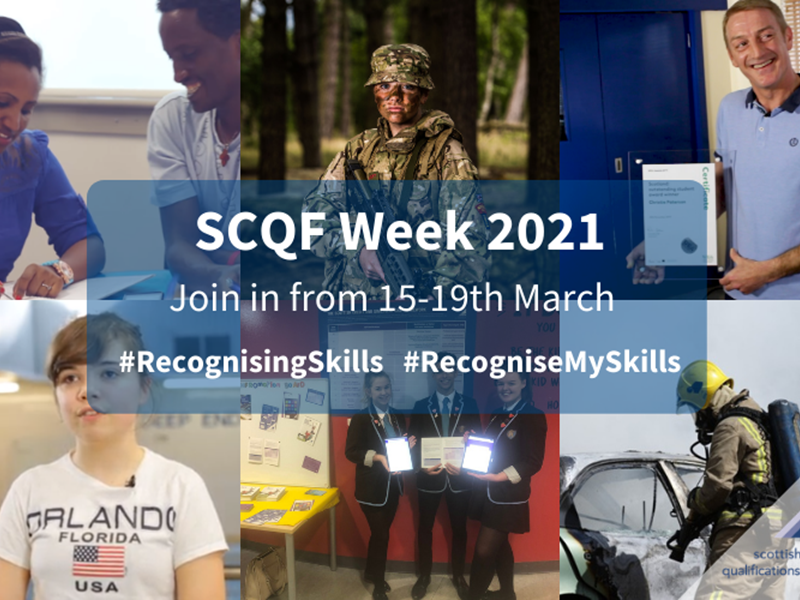
The Scottish Credit and Qualifications Framework (SCQF) is the national qualifications framework for Scotland and plays a vital role in the recognition of the skills and experience of individuals in Scotland.
SCQF Week is an online event running between 15-19 March, and intends to highlight the important part the SCQF plays in the learner journey. It will celebrate the achievements of individuals, showcase best practice in the use of the SCQF across a range of sectors, as well as raise awareness of the SCQFP’s latest projects and developments amongst partners and stakeholders.
A major part of the week’s activities include ‘live sessions’ of interest to employers, schools, colleges and SCQF Credit Rating Bodies. Colleagues from Education Scotland, University of the West of Scotland and Scottish Fire and Rescue Service will co-host sessions with the SCQFP Team and will provide valuable insight from their own experiences of using the SCQF, so it’s definitely worth having a look at the schedule and booking your place asap as spaces on some sessions will be limited.
This is the first ever SCQF week, created in response to the pandemic rendering our conference impossible for now. The team has been working really hard to make it an engaging and dynamic event and we hope that it goes some way to bridging the gap until we can all be together again.
Register now
You can also support the promotion of SCQF Week:
Access our social media toolkit.
#RecognisingSkills #RecogniseMySkills

ASET International Oil & Gas Training Academy has achieved the status of becoming an approved Credit Rating Body (CRB) through the Scottish Credit and Qualifications Framework (SCQF) Partnership. This allows the organisation to make decisions about the SCQF level and SCQF credit points allocated to qualifications developed to train staff in the oil and gas sector.
ASET International Oil & Gas Training Academy is a trading name of Aberdeen Skills and Enterprise Training Ltd (ASET), a wholly owned subsidiary company of North East Scotland College (NESCol). The Company operates mainly on a commercial basis for the Oil & Gas, Engineering and Construction industries in Process, Maintenance Engineering, Electrical and Ex Hazardous Areas, Emergency Response, Marine, including DP and Stability and Scaffolding on a worldwide basis. ASET remits all revenue surpluses to NESCol and does not retain any cash or profit.
Atholl Menzies, CEO at ASET commented: “We are delighted and honoured to be awarded Credit Rating Body Status by the SCQF Partnership. The ASET International Oil & Gas Training Academy fulfils an important and integral role in supporting the ongoing skills development and continuing professional development of individuals employed in the UK Oil & Gas Industry and the wider energy industries. Our new relationship with the SCQF Partnership will add further value to our vocational training portfolio and underpin our commitment to supporting the education and skills agenda, particularly as our customers and industries transition into alternative sources of energy.”
Aileen Ponton, Chief Executive of the SCQF Partnership, added: “To become a CRB for the SCQF, ASET had to demonstrate that it had robust quality assurance processes and a rigorous approach to qualifications development and credit rating. It provided clear evidence of these along with a real commitment to ensure that those working in the oil and gas sectors gained appropriate recognition and has plans to credit rate a number of programmes over the next 12 months.”
Being an SCQF approved CRB allows ASET to make its own professional judgements, using tools provided by the SCQF Partnership, about what level a qualification sits at on the SCQF. Once a qualification has an SCQF level it attracts national and international recognition for the learners who achieve it.
As part of the application ASET credit rated Centrifugal Pump Maintenance & Trouble Shooting at SCQF level 6, with 1 credit point.
ASET is now one of eight SCQF approved CRBs which, along with SQA, universities and colleges, is allowed to make its own credit rating decisions.
More information on SCQF Credit Rating Bodies
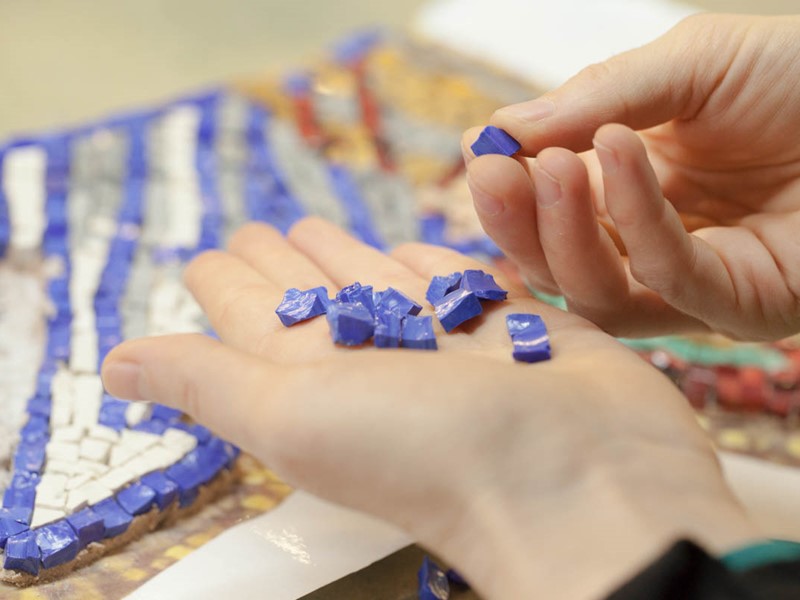
London School of Mosaic is the first education institution in the UK focusing on teaching mosaic up to higher education level through both practice and theory. We were formed in 2017 with the aim to provide a sustained programme of teaching that reflects the ambition for self-trained mosaic makers to professionalise their practice. We are one of a handful of institutions for mosaic worldwide and are proud to be building on mosaic’s British heritage from the Romans to the Victorians.
Our curriculum extends this tradition through technical and design expertise from the Italian master mosaicists who work with us. In 2018 we established the Diploma in Mosaic Studies, which is the first sustained one-year programme in the subject taught in the UK (and in the English speaking world).
The course has been credit rated by the SQA (Scottish Qualifications Authority) at SQCF Level 7 with 120 credits. The core module is focused on practice as students specialise in traditional mosaic making techniques through projects completed in the workshop, which is contextualised by 2 terms of design training and history of mosaic lectures. At the end of the year students produce a final project and get to present this at an exhibition. In our first year we had 8 students enrolled and our second year cohort consisted of 12 students. We also teach around 100 students each term in short courses and vocational training.
We are the only institution in the UK teaching mosaic at higher education level. Before forming as a school we had over 10 years’ experience through Southbank Mosaics, which was a studio that used mosaic as a catalyst for social impact. We continue to build on this ethos as we run several free activities for the local community and would like to recruit more students onto our diploma from disadvantaged backgrounds. We found there to be many knowledge gaps in our area of work that prevented professional development. Many of the techniques and design approaches were not well understood or contextualised and practitioners lacked experience of critical analysis of what they were making, which is what we specifically address in our diploma.
The diploma is unique because our students learn the traditional mosaic making techniques using Hammer and Hardie so they know how work with materials such as marble and smalti, a specialist mosaic glass used in many cathedrals. Prior to our diploma there was no opportunity for mosaic makers to specialise in these techniques here in the UK. This prepares our graduates to work on Britain’s historical buildings in which those materials were used as well as on commissions of new work. Our course contextualises this with intensive training in mosaic design, which introduces aspects of composition, colour theory, andamenti (pattern) and material composition. It enables students to develop design ideas through to technical designs. This is unique in the context of UK art schools where aspects of skill and technique have been side-lined in favour of more conceptual approaches. The History of Mosaic module not only gives students theoretical insights into the origins of mosaic from Roman through to Byzantine art, students also do archaeological experiments into ancient practice which allows reflections on modern mosaic.
Our aim is for the course to nurture excellent mosaic makers, who can either open their own studio or teach mosaic so that our practice is not lost to future generations. The diploma is embedded in our studio which takes on commissions and in which we have various other teaching activities going on, which our diploma students are welcome to take part in to gain professional experience.

Longer duration mobility (LDM) for vocational students and apprentices, lasting several months, has been fast developing across the UK, mainly spurred by its introduction into EU programmes and, more broadly, by its being seen as a way of improving the quality of international mobility.
LDM has a range of challenges as well as opportunities and has repercussions as to how to ensure a high-quality experience. However, the benefits to the individual and employers are well documented, regardless of the funding stream.
Quality in International Long-duration Mobility: Lessons from the Erasmus+ Programme was produced during 2020 by the UK ECVET Experts Team, whose role for the last decade has been to support vocational organisations and employers in implementing ECVET principles. These principles have contributed to the development of quality mobility experiences across the UK, supporting the identification and assessment of appropriate learning outcomes for the mobility periods and providing tools such as a Memoranda of Understanding and Learning Agreements.
The paper has relevance to international as well as European mobility, and its aim is to offer guidance to policy-makers and practitioners on how to address these issues.
Its content will be of value to anyone involved in mobility, even in light of the UK’s departure from Erasmus+.
If you have any questions, email Andrew.
Further information about ECVET
Updated Sept 2021:
Following Scottish Government guidance regarding the coronavirus outbreak, the SCQF Partnership offices are closed to the public and staff are working mainly from home.
All workshops and meetings remain online.
If you would like to speak to specific members of the team then individual contact details are here.

Apprentices who have been made redundant will be able to get help to achieve their qualifications, recognition for their learning and assistance to take the next step in their careers through a new service.
The Apprentice Transition Plan service will see more support for apprentices made redundant to help them get qualified; to provide a statement of their achievement recognising prior learning and an action plan for their next steps. The SCQF Partnership has worked closely with Skills Development Scotland and Scottish Government in the development of resources and training for the Apprentice Transition Plan.
The COVID-19 pandemic is expected to have a disproportionate impact on young people and the Scottish Government and Skills Development Scotland are putting support for apprentices and young people at the heart of recovery.
The introduction of the Apprentice Transition Plan service is part of a range of measures to support the Scottish Government’s Youth Guarantee Scheme with an aim to prevent long-term scarring of youth unemployment.
The service will be delivered by either the apprentice’s learning provider or a designated third-party provider.
Those benefiting from the support will receive one-to-one guidance to help them achieve their qualification and move on through further learning or employment.
Part of the service will include creation of a Record of Achievement that documents an individual’s skills, training and qualifications to date.
The Record of Achievement aims to support job applications and will outline an apprentice’s capabilities benchmarked against a national SCQF standard, to help employers make informed recruitment decisions.
Skills Development Scotland Head of Work based Learning Quality Delivery, Karen Murray said: “It’s vital that apprentices affected by the pandemic are given support to help them achieve their qualification and progress on to a positive destination, whether that is on to further learning or into a new job.
“The support through the Apprentice Transition Plan service will help to ensure that talent developed through apprenticeships is not lost as a result of COVID-19.
“The Apprentice Transition Plan aims to make sure individuals have support to complete their apprenticeship if they can, take the next steps and best demonstrate their achievements and transferable skills to prospective employers.”
Find out more about the Apprentice Transition Plan at Apprenticeships.Scot

On behalf of the National Commission for Further and Higher Education (NCFHE) in Malta, the SCQF Partnership was commissioned to undertake an impact review of the Malta Qualifications Framework (MQF) which commenced in January 2020.
The MQF was formally established in 2007 and much has been achieved in the 13 years that it has been in place. However, very little work had been undertaken to review impact and the NCFHE felt it was important to address this for a number of reasons.
Primarily:
- to ensure the objectives of the MQF are being met;
- to consider whether there are improvements to the MQF which are required;
- to identify how the MQF can remain relevant for stakeholders going forward; and
- to establish a baseline for future impact assessment.
The SCQF Partnership has extensive experience in reviewing the impact of NQFs and defined the objectives of the impact assessment to:
- assess and analyse the impact of the MQF across a wide number of sectors/stakeholders;
- provide recommendations on possible areas of both policy and technical improvements for the MQF and its referencing to the EQF;
- provide recommendations for further implementing, promoting and regulating the MQF; and
- provide baseline indicators for future reviews.
The methodology used was a mixture of quantitative and qualitative approaches designed to gain maximum responses.
Quantitative data was collected by means of a comprehensive online survey tailored to each sector and promoted through partner organisations as well as via the NCFHE website and social media channels.
The next step was to hold a series of focus groups. These groups allowed for a more detailed discussion on specific questions and were facilitated by NCFHE, with SCQF Partnership attending to hear the conversation. Interviews with key partners were then conducted. This allowed for key themes or issues which had emerged from the survey and focus groups to be picked up with specific stakeholders in much more detail. These interviews included a specific question around possible solutions to some of the issues or questions which had emerged in earlier discussions.
This data has enabled the SCQFP to identify key themes in relation to recommendations for the NCFHE to consider for future implementation. The SCQFP team working on the project has written a final report which will be submitted to the NCFHE in December.
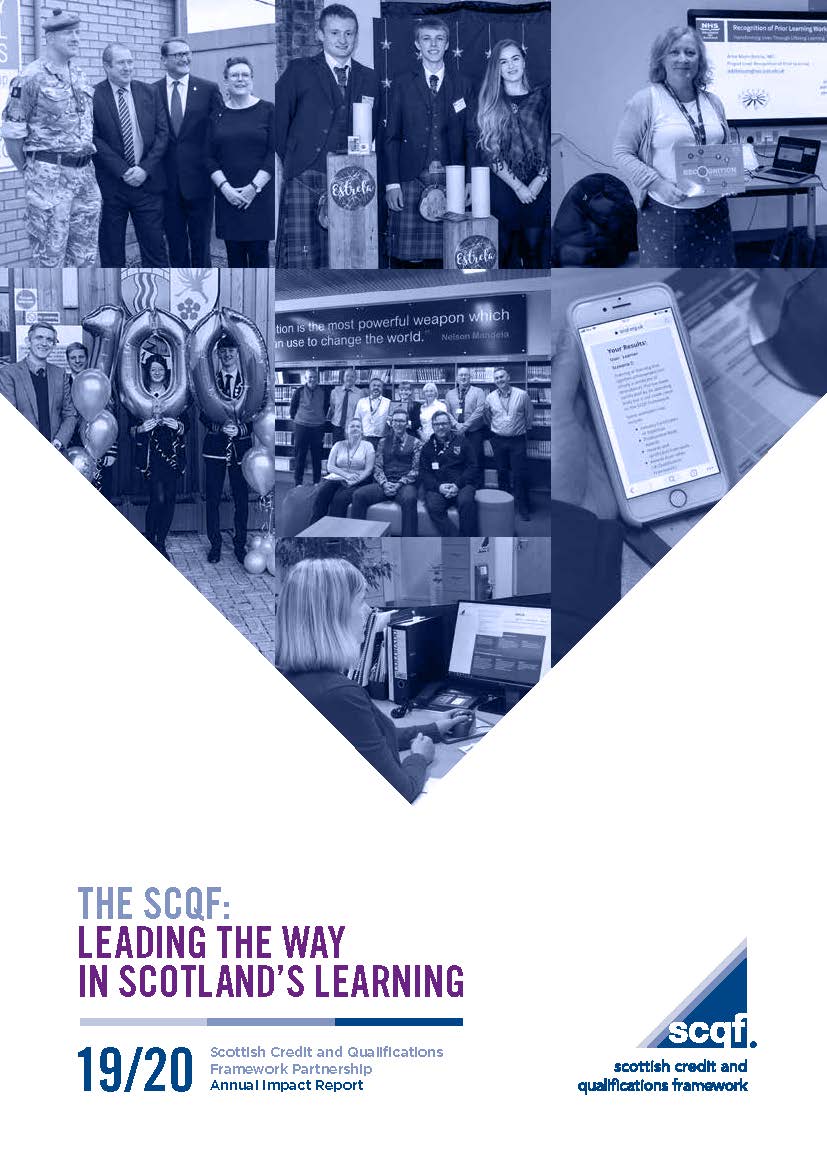
The SCQF Partnership has released its Annual Impact Report for 2019-20.
We have taken a different approach to our impact reporting this year and the information takes the form of infographics to provide stakeholders with an at-a-glance summary of our impact and successes over the year.
The report has an introduction by Richard Lochhead, Minister for Further Education, Higher Education and Science and key activities undertaken included:
- launch of new online RPL Tool
- continuing success of the SCQF School Ambassador programme, with special recognition of the 100th Ambassador school to be recruited
- launch of the SCQF Inclusive Recruiter programme
- NQF Impact Review completed for Malta
- 96,000 web users accessing the interactive Framework
- SCQFP Team awarded the Gold Investors in People standard