


The SCQF Partnership (SCQFP) is delighted to announce the internal recruitment of two staff members to new, more senior roles.
The appointments reflect the organisation’s continued focus on strengthening Scotland’s lifelong learning landscape.
Head of Operations
Marissa Lippiatt is now Head of Operations, taking on responsibility for the overall management and delivery of the SCQFP’s operational functions.
Marissa, who previously served as Head of Development and Engagement, brings extensive experience in programme delivery and stakeholder engagement. In her new role, she will focus on strengthening operational performance and reporting, digital transformation and ensuring the effective delivery of the organisation’s objectives.

Head of Pathways Policy
Donnie Wood has taken up the post of Head of Pathways Policy, having previously been the Lead for Learning Pathways. Donnie will now have strategic oversight of the SCQFP’s work in developing pathways across the education, training and employment sectors, helping to ensure that the SCQF remains central to skills planning and workforce development in Scotland.
A fourth member of SCQF Partnership’s Leadership Team, the Head of Assurance, has been externally recruited and will be joining the team in September 2025.
‘A wealth of knowledge’
Pauline Radcliffe, Chief Executive of the SCQFP, said: “I am delighted to see Marissa and Donnie step into these important roles. Both have been instrumental in driving forward our work in recent years and bring a wealth of knowledge and commitment to the organisation.
“Their appointments strengthen our capacity to support the needs of learners, employers and education providers across Scotland, ensuring the SCQF continues to play a vital role in supporting progression and widening access to learning.”
The SCQFP remains committed to promoting the value of the SCQF as Scotland’s national qualifications framework, helping people of all ages and backgrounds navigate learning pathways and achieve their potential.
To meet the SCQFP team, visit https://scqf.org.uk/about-us/team/
A national Recognition of Prior Learning (RPL) system for Scotland is a step closer, with the appointment of an experienced team to lead the first phase of work.


The SCQF Partnership (SCQFP) confirmed in May that it will support the Scottish Government to establish a national RPL system, as outlined in the 2025-26 Programme for Government.
Appointment
Following a competitive tender process, Susan Stewart Communications has been appointed to lead the project, working with Julie Cavanagh of JCC Consulting.
Susan and Julie will support the SCQFP in gathering key insights and bringing together education providers, employers and learner voices to inform the design of a more streamlined and consistent approach to recognising prior learning across Scotland.
Susan, the former Director of the Open University in Scotland, brings a wealth of experience in communications, stakeholder engagement and education policy, while Julie has an extensive background in developing and promoting RPL in Scotland and internationally. Both have built strong relationships across Scottish education and business sectors.
Recognising skills
The new RPL system will make it easier for individuals to have their skills — gained through work, volunteering, or life experience — formally recognised. This will support faster re-skilling, smoother career changes and greater access to further learning.
Pauline Radcliffe, Chief Executive of the SCQFP, said: “We are excited to be working with Susan and Julie to support the Scottish Government’s significant commitment to ensuring that all learning and skills count, through an RPL system, regardless of the context in which they are gained.
“Their experience and fresh perspective will help us bring together and listen to the voices of individuals, employers, education providers and other key partners to ensure Scotland’s RPL system is robust, inclusive and fit for purpose.
“This is a key step towards unlocking opportunities for people and strengthening the country’s skills system, contributing to a more inclusive and sustainable economy.”
Learn more
For more information on RPL, explore our RPL Hub at https://scqf.org.uk/rpl-hub/
In our new blog series featuring our Quality Committee (QC) members, we speak to Karen Murray, who is the head of work-based quality delivery at Skills Development Scotland.

- What attracted you to the role of Quality Committee member?
I am a huge advocate of the SCQF as a means to create rigour into skills qualifications and learning in Scotland.
Having done some credit rating activity in my own subject area and having been involved in qualification development for a number of years, I really felt I wanted to understand more and contribute to maintaining the integrity of the framework and its use, so when the vacancy came up. I was very pleased to apply for it.
- How long have you been working with the SCQF Quality Committee?
I think it was in 2017 that I first became a member, but it may have been earlier. It always amazes me how quickly the quarterly meetings come around.
I have definitely seen three quality committee chairs (possibly four?) and two SCQFP Chief Executives in my time served!
- How did you work/life experience prepare you for the role?
I felt that I knew quite a lot about the SCQF and its many uses when I applied to be on committee, through my qualification development experience and credit rating activity in the land-based sector.
I also thought that my background in managing the quality assurance and enhancement of apprenticeships, and previously having being Assistant Principal of Quality Assurance and curriculum at a college, meant that I was well prepared. However, I have learned so much more from the committee and continue to do so.
It’s great to work alongside colleagues from different parts of the education sector and the SCQF executive team. I learn so much from them all.
- In your opinion, why is the quality assurance aspect of the work that the SCQF Partnership does so crucial?
It’s vital to maintain the integrity of the SCQF and its reputation as a way of applying robust standards. This allows qualifications and learning to be both levelled and quantified in a quality-assured way.
Through the quality assurance work of the Partnership, we are validating the work of credit rating bodies and Scottish learning provision, which is crucial to the reputation of Scottish learning provision. The SCQF is truly the key to supporting flexible learning paths.
- What challenges have you come across relating to the SCQF?
My biggest bugbear is that I don’t know how many people I have to explain to that the SCQF level is independent of the amount of credit in a qualification. So many people – even those who have been in skills for a long time – want to associate the amount of credit with the level. It drives me nuts!
We’re looking for a skilled and motivated professional to help us deliver the first phase of a national Recognition of Prior Learning (RPL) system for Scotland. You’ll work with employers, colleges, universities, and government to bring ideas to life – coordinating a national steering group, leading pilot activity, and ultimately helping people get recognition for the skills and experience they already have.
Introduction
This tender specification invites interested parties to submit the proposal for delivering project management services on behalf of SCQF Partnership in relation to a significant Recognition of Prior Learning initiative. The consultant/s will devise and deliver a Development Plan, with demanding deadlines for the first phase delivery of a national system for RPL in Scotland.
Background to the SCQF Partnership
The Scottish Credit and Qualifications Framework Partnership (SCQFP) is an independent not-for-profit company with charitable status, responsible for upholding the quality and integrity of Scotland’s National Qualifications Framework, the SCQF.
The Partnership works to secure the Framework’s relevance in the current and evolving learning and skills landscape in Scotland, seeking to raise awareness and understanding among learners and employers and those who advise them, focusing its efforts on increasing:
- access to lifelong learning for those who face most barriers to education and training
- mobility for Scotland’s learners and workforce to transition to further learning and training and the new industry the economy requires
- equity in how comparable learning and skills are recognised by learning providers and employers.
The Company’s objectives are:
- to maintain the quality of the Framework.
- to further promote and develop its use.
- to maintain and develop relationships with other frameworks in the UK and Europe.
The Partnership Board comprises 9 Trustees, 4 of whom are Appointed Members of the company being the Chief Officers of:
- College Development Network.
- Quality Assurance Agency for Higher Education.
- Scottish Qualifications Authority (or its successor body)
- Universities Scotland.
The Partnership is largely funded through annual grants from Scottish Government and the Scottish Funding Council. The CEO and leadership team liaise closely on delivering national priorities with both bodies.
The Partnership’s Board recently approved a new set of Strategic priorities (3 pillars) for 2025-30, following an extensive consultation, evaluation and organisational development review process. A re-structure of the team of 13 is currently underway to underpin the new priorities and a revised operating model, with Heads of Assurance, Operations, and Pathways Policy reporting to the CEO.
Current position
The Framework (SCQF) provides the mechanism for RPL in Scotland, providing a set of Principles (Principles 20-25) to which all Credit Rating bodies must adhere. These are used to develop policies and processes by institutions and other organisations in Scotland including SCQF Credit Rating Bodies (CRBs). QAA has also produced guidance for universities on RPL policies and the SCQF Partnership continues to support education providers and employers with tools and resources to enhance their delivery of RPL, from informal, non-formal to formal.
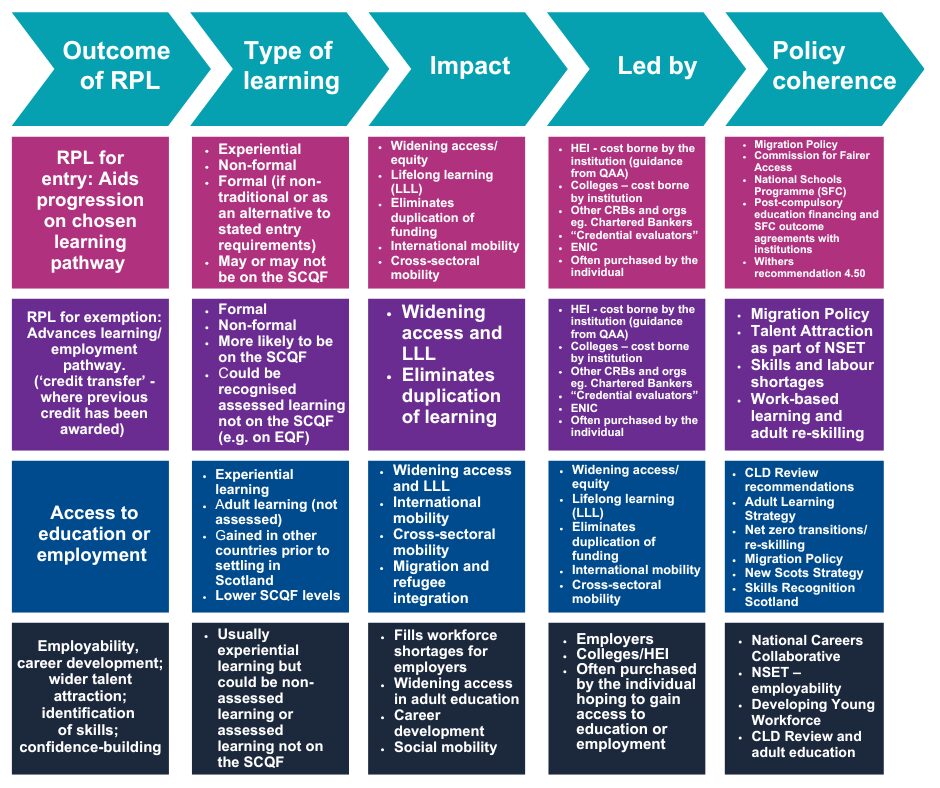
The SCQF Partnership has been calling for a national policy and strategy for RPL to be adopted by the Scottish Government for many years and in Autumn 2024 was invited to submit a proposal and business case for a national approach.
SCQF Partnership proposal to Scottish Government
Our proposal (contained in Annex 1) to Scottish Government stated that:
A coherent national system and overarching vision of learner entitlement to RPL will help ensure that all actors in education and skills are adopting and implementing RPL practices. The objective will be to embed the recognition of prior learning and skills of school leavers, adult learners, and those settling in Scotland within our education and skills system. This approach aims to value diverse learning pathways, enable shorter and more efficient progression routes, and align with labour market demands.
As a result, SCQFP recently secured Scottish Government commitment to developing a National System, through its stated Programme for Government published in May 2026.
“To capitalise on economic opportunities, we need people with the skills to grasp them.”
(Actions to enable this include):
“Establishing a national Recognition of Prior Learning system – formally acknowledging an individual’s skills and knowledge gained through work experience, training, or other learning outside of formal education.”
Ministers have supported the development of a system that properly values and acknowledges prior learning, skills and experience, enabling learners to gain credit/recognitions for existing skills, reducing the need to repeat learning and enabling quicker progression through education and training. Prior to the Scottish Parliamentary elections in May 2026, there is an expectation that a number of actions will be completed by Spring 2026:
Key actions required
- Assemble a steering group of employers, education providers (universities, colleges, training), and agencies, with international best practice input and focusing on leveraging existing resources and partnerships to agree a coherent, cost-effective approach to delivering a national approach.
- Develop a plan to streamline formal RPL for college and vocational students entering universities, using the Joint Articulation Group as the key vehicle for consultation and delivery (existing priority for the Scottish Funding Council).
- Focus on existing RPL and micro credentials pathways and processes and create a pilot programme for employers to utilise existing micro-credentials and benchmarking of skills using the SCQF through efficient informal RPL processes. Focus on priority industries with identified skills shortages.
Invitation to tender
Interested parties are invited to tender to deliver project management services to the SCQF Partnership with the primary objective of delivering the actions set out in the Scottish Government’s funding objectives for the SCQFP for fiscal year 2025-26 (as above).
The successful tenderer will report directly to the CEO and be provided with necessary secretariat, communications and project development support by the Head of Pathways Policy and the wider SCQFP team.
Specification for services
In the period from end June 2025-March 2026 the contractor will manage the delivery, with the support of the SCQFP team and its existing networks with employers and education providers, the following outputs:
- The creation and management of a National Steering Group for Scotland’s RPL System, which is inclusive in its approach and secures buy-in and ownership for a diverse range of interests, including Scottish Government officials, learners themselves, industry representation and tertiary institutions.
- A development plan for formal RPL for articulating students into HEI from college and vocational based learning pathways, embedding approaches developed by the Joint Articulation Group convened by universities and colleges, consulting with the Scottish Funding Council and the Commissioner for Widening Access.
- A road map, demonstrated through an action research pilot, for the use of informal RPL and micro-credentials by employers working in partnership with education and training providers and proposing cost-effective funding model for credit rating of micro-credentials in one priority industry. SCQFP will provide guidance on existing networks and relationships on which this will be built. Additional funding will be available for this activity.
- An evidence-based reporting framework for assessing the effectiveness of actions for regular, transparent reporting to the SCQFP Board of Directors, Scottish Government and the education and skills community
- Regular progress reports to the CEO and be prepared to discuss the project with the SCQFP Board and Scottish Government Ministers as/if required
- Identify additional early research and data analysis activity necessary to direct the focus of the development plan, for which additional funding will be made available.
Your approach
Interested parties are invited to review SCQFP’s original Proposal in Annex 1 and outline your approach to project management for this complex brief, involving a diverse range of actors in the Scottish education, skills, and economy landscape. Additional funding will be available to support the delivery of specific project deliverables, following agreement of a project development plan.
Your approach should consider:
- how you would approach defining clear roles, responsibilities, and performance reporting
- how you will approach the opportunities and risks for this project
- the membership of the Steering Group and its governance
- The inter-relationships within existing widening access, RPL and skills recognition initiatives and reporting structures in Scotland’s tertiary sector and how you would intend to avoid duplication of effort and competing agenda
- The need for ‘quick wins’ as well as longer term planning for delivery and future impact.
- Your resourcing of the project management, as a consultant or consultancy business sharing the delivery work across a number of consultants/ associates.
Budget
A budget of up to £30,000 (including VAT) is available for this work over an 8-month period. Contractors are invited to provide a breakdown of fees, including day rates and inclusive of all expenses.
Tender instructions
Tenders should include the following information:
- Your understanding of the brief and your proposed methodology
- Brief example/s demonstrating your record in delivering national level complex projects.
- Your project management approach, including a brief overview of roles, responsibilities and reporting.
- Key milestones within the contract period that you believe will be critical to delivery over the 8-month period.
- A high level, brief, risk assessment of the project and how you would intend to mitigate the risks and challenges encountered.
- The total fee (inclusive of VAT) for the contract period, for each element of service provided (or example, day rates of the project team), inclusive of all expenses.
- Brief CVs of the consultant/s who would deliver the service.
- Two referees /references of those who know your work.
- Your commitment to Fair Work, if employing staff.
- A written statement assuring SCQFP that you will have business insurance and be registered with HMRC tax purposes as a small business.
Please do not hesitate to contact Pauline Radcliffe if you require further information or would like to discuss prior to submitting a quotation.
E-mail: p.radcliffe@scqf.org.uk
Deadline for tender submission
Tenders, of no more than four pages (with CVs appended), should be submitted by Tuesday 10 June 2025 at 17.00 by email to Pauline, as CEO.
An initial inception meeting will arranged in the week beginning 23 June and thereafter contractor(s) will be required to work flexibly over the year ahead.
Assessment of tenders
Tenders will be assessed on the following criteria:
- Demonstrable executive level experience and a compelling reputation for delivery within the tertiary education and /or skills sector and with Scottish Government officials at a senior level
- A passion for and understanding of RPL Policy and processes, and its benefits for recognising wider learning and achievement and /or practical application of credit transfer within institutions.
- Your understanding of the project’s requirements and key milestones for delivery
- History in delivering complex projects, collaborating with diverse stakeholders and within challenging deadlines
- Evidence of understanding the challenges and risks associated with delivery the brief and how you might approach these
- The quality and experience of any proposed team as well as cultural fit
- Approach to wellbeing, equality, and diversity in the workplace
- Value for money.
Download tender document – https://scqf.org.uk/wp-content/uploads/2025/06/SCQFP-ITT-RPL-Project-management-MAY25.docx
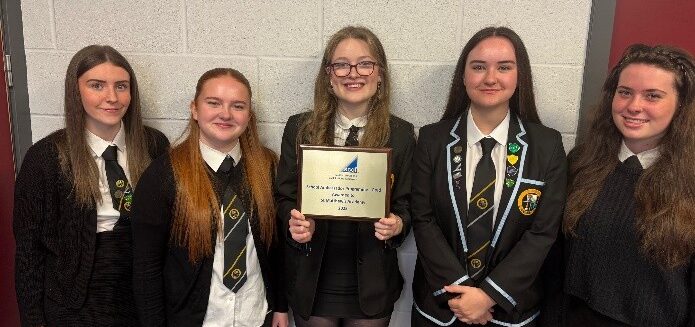
At St Matthew’s Academy, a six-year denominational school in Saltcoats established in 2007, we take pride in our community of approximately 1,325 young people.
Our mission remains steadfast: to provide every member of our school family with the opportunity and encouragement to achieve their full potential.
Our commitment to educational excellence is reflected in our impressive retention statistics. The proportion of S4 pupils returning for 5th year in 2023-24 stands at approximately 85%, with the S5-S6 transfer rate reaching around 75%. These figures demonstrate the continued value that our students find in our curriculum.
SCQF Ambassador programme
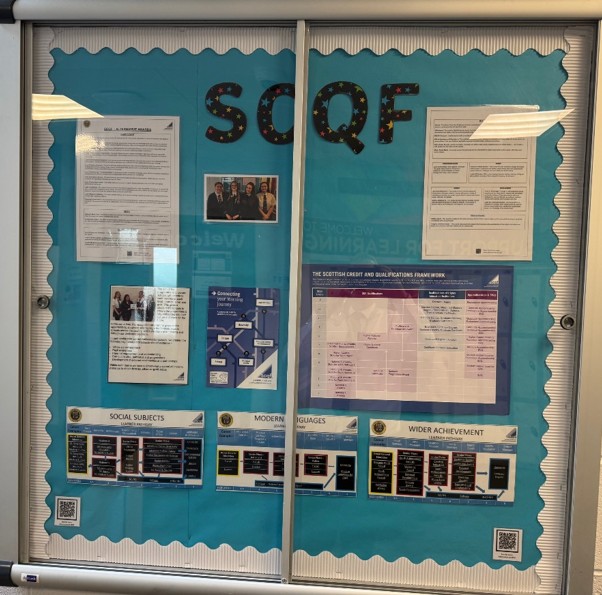
The SCQF Ambassador programme is thoroughly embedded throughout our school. It features prominently in both our whole-school improvement plan and individual department improvement plans.
Information on the SCQF has been provided through whole-school assemblies and classroom presentations to recruit new Ambassadors for the coming academic year. These Ambassadors can incorporate their participation as part of their Level 6 Leadership Award if they’re pursuing this qualification.
Interactive curriculum pathways
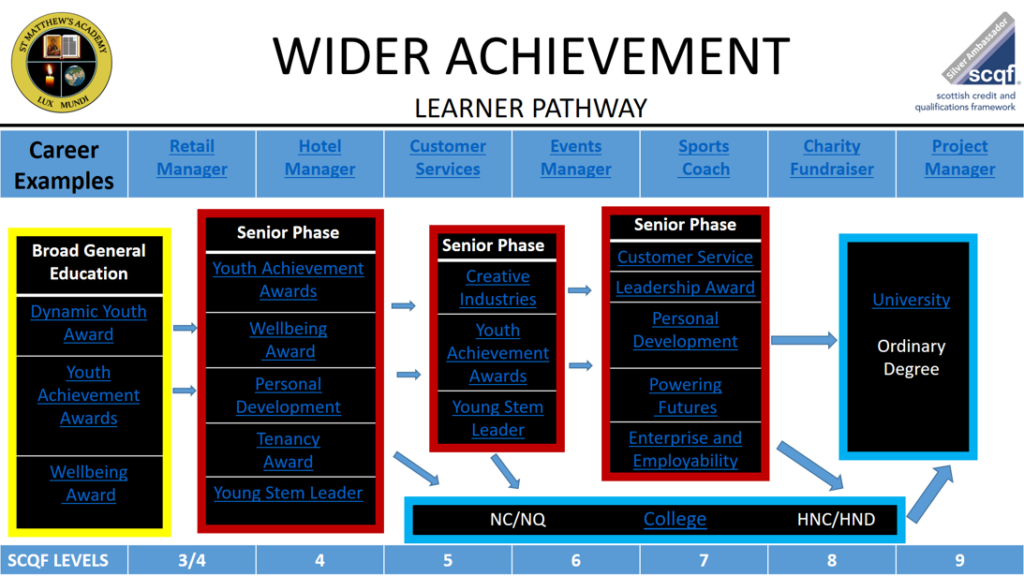
Our curriculum pathways document represents a significant innovation. This interactive resource illustrates subject pathways, with direct links to the SQA arrangements page for each course, relevant My World of Work pages highlighting example careers, and college/university course pages for selected options.
May activities programme
For pupils not sitting exams, we organise a four-week block of activities and experiences each May. Throughout the month, pupils work with different agencies and organisations such as Street League, Morrison’s Construction, Seamill Hydro and many more, to gain a raft of different experiences and to improve their skills.
Through this initiative, participants can also earn wider achievement qualifications upon completion of the programme. These carefully curated activities lead to various awards, including Youth Achievement Awards, Young STEM Leader certifications and qualifications in wellbeing and leadership.
Sixth year skills development
In 5th year, our pupils can select skills from their option choices for 6th year, where they complete two or three SCQF level 6 awards. This has become an integral component of our S6 curriculum, creating inclusive learning environments where pupils of varying abilities collaborate to achieve different level 6 qualifications.
External partnerships
We maintain robust relationships with numerous external partners, offering pupils opportunities to develop existing skills and acquire new ones. These partnerships also enable students to obtain additional qualifications that may enhance their prospects when moving into positive destinations.
Some examples are volunteering at Doon the Beach café, Learning through Landscapes, Ardeer Golf Club and Gowanbank, to name a few.
Pupils develop many different meta skills through our partnerships, including teamwork, communication, and problem solving, that they can use in their future studies and in the workplace. They also gain qualifications such as leadership, Youth Achievement Awards and Customer Service Awards.
Raising awareness with parents and carers
Beyond parents’ evenings and Twitter/X updates, we’ve created a dedicated SCQF display board and comprehensive parent information sheet showcasing all our SCQF course offerings, featuring a QR code. Parents can scan this code to access the SCQF website for additional information – a project completed by our Ambassadors.
We’ve also included the QR code on option choice sheets, enabling parents to easily access information about the SCQF.
Opportunities to succeed at St Matthew’s Academy
We seek to provide opportunities for young people to develop skills for learning, life and work. By ensuring a variety of learning pathways, we support young people to move into positive destinations. Through our desire to ensure excellence and equity for all students, we will provide a curriculum that challenges and supports all.
We are very proud to be a Gold SCQF Ambassador school and look forward to continuing to prepare young people to be adaptable, to allow them to think independently, to be creative, and move away from just having a knowledge-based skill set.
Pupil Ambassadors have their say
Olivia said: “I have a much better understanding of the different qualifications that can be studied.”
Eileen said: “I feel confident when discussing the wider qualifications and the pathways where they can lead with others.”
Useful links
Learn more about our School Ambassador Programme – https://scqf.org.uk/support/educators/school-ambassador-programme/
Watch our Powering Futures case study with St Matthew’s Academy – https://scqf.org.uk/case-studies/case-study/powering-futures-st-matthews-academy-saltcoats-2/
The SCQF Partnership, which is responsible for Scotland’s National Qualifications Framework, has welcomed a commitment by the Scottish Government to establish a Recognition of Prior Learning (RPL) system.
The Partnership has long called for a coherent Scotland-wide approach to recognising previous educational achievements, skills and experience, enabling more people to access shorter routes into further learning and employment.
The commitment was one of many aimed at addressing Scotland’s skills gaps in the Scottish Government’s recently published Programme for Government. The SCQF Partnership will support the Scottish Government to deliver on their pledge.
Recognition of Prior Learning
A national RPL system will allow individuals to have their skills, knowledge and experience – gained through work, volunteering, or non-formal learning – formally recognised, enabling faster reskilling, easier progression, and greater workforce mobility.
This commitment comes at a time when businesses across Scotland are facing skills shortages in key industries, including health and social care, construction, and engineering.
Unlocking economic potential
Pauline Radcliffe, Chief Executive of the SCQF Partnership, said: “Recognition of Prior Learning has the power to unlock economic potential – not just for individuals, but for Scotland as a whole. By recognising skills wherever they are gained, we can support career progression, reduce duplication of learning, and help employers fill roles more efficiently.
“The Programme for Government’s commitment signals a shared ambition to build a more agile and inclusive skills system – one that reflects the realities of modern work and learning.”
John Evans, chair of the SCQF Partnership, added: “Scotland has an opportunity to lead the way in skills recognition and workforce planning. A national RPL system will ensure that the SCQF remains a key tool in supporting economic growth, closing skills gaps, and valuing the breadth of learning that takes place beyond the classroom.”
The SCQF Partnership will work closely with employers, education providers, awarding bodies and learners to develop a robust and flexible system that delivers for both the economy and the individual.
Useful links
For more information on RPL, visit our dedicated Hub at https://scqf.org.uk/rpl-hub/
In the first of a new blog series featuring our Quality Committee (QC) members, we speak to QC Chair Gillian Brydson, Executive Director of Education, Skills and Community Wellbeing at Dumfries and Galloway Council.

- What attracted you to the role of Quality Committee Chair?
I saw the advert for the role of Quality Committee Chair in late 2023 via LinkedIn. It sparked my interest but I didn’t immediately apply.
The opportunity kept popping into my head, which made me curious, and so I decided to call Pauline to discuss what skill-set was expected.
I had not worked in FE/HE for over 20 years and while I had a lot of experience in the education sector, I thought my profile might not be a good fit for the role.
Pauline was such a strong advocate for the Partnership that, from that conversation, I wanted to play a part.
After a tough interview – good to see it was rigorous even for a voluntary role – I was delighted to be appointed from April 2024.
Contributing to a national organisation is enriching for me. Having a broader perspective helps my local authority role and also my personal and professional growth.
- How did your work/life experience prepare you for the role?
I was aware of the SCQF from my work in the college and university sectors from working in the late 1990s and early 2000s with Credit Accumulation and Transfer, and Recognition of Prior Learning.
I thought even then it was a practical way to make sense of how to compare and articulate the range of available qualifications. I had one of the first SCQF mousemats – which are almost as famous as COSLA pens.
For the last 22 years I have worked in local government and now I am responsible for early years, primary and secondary schools, lifelong learning, youth work and employability in a large rural council.
These formal roles, alongside my wider involvement as a Member of a College Board, Chair of Audit Committee, Young Woman’s Network Mentor and Doctorate supervisor, all have helped me have a practical understanding of the various parts of the overall system and how the SCQF fits in.
I see it as an organiser, a way to help understand qualification parity for learners at all stages, whether in education or in work.
I see young people, parents and staff try to plan their learning and employers explain what they are looking for in their future workforce.
I think the institutions and training providers have a responsibility to make sense of their world – that it is our job to describe levels of learning and working which are clear and accessible.
- In your opinion, why is the quality assurance aspect of the work that the SCQF Partnership does so crucial?
The quality assurance aspect of the work that the SCQF Partnership does is crucial as there must be trust and confidence in its integrity.
There is so much movement across the education system at the moment that the Framework is an important, independent constant, and that it is mapped to other international frameworks helps us as we navigate the changes globally.
Rigour and transparency are essential to quality assurance and core to the integrity and reputation of the SCQF. However, I’m also aware that we need to take a balanced approach between our essential focus on ‘process’ and the outcomes we are trying to achieve.
My previous boss referred to getting that balance out of kilter as ‘bureaucracy masquerading as quality improvement’ and it’s a valuable reminder for anyone involved in providing assurance.
I have taught classes, designed assessment, written and validated programmes of study, managed inspections, investigated complaints and overseen scrutiny processes.
Now, as chair of the Quality Committee, I’m reminded again of how crucial it is to take a balanced, thoughtful approach to quality assurance.
The SCQF Partnership is committed to keeping our learners and employers at the heart of every decision we make.
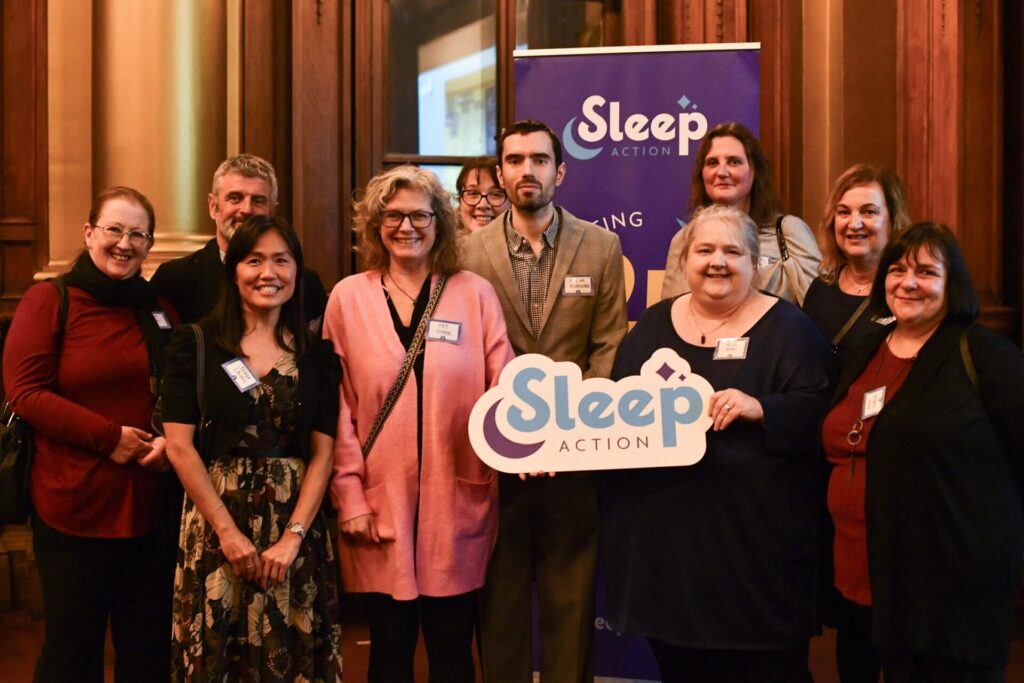
Sleep isn’t always at the top of the public health agenda, but it should be.
For 27 years, Sleep Action (formerly Sleep Scotland) has led the way in sleep support and training, and now our Paediatric Sleep Counselling course has been credit rated at SCQF level 7 with 4 credit points.
About Sleep Action
As the UK’s oldest sleep charity, Sleep Action has long recognised the deep impact poor sleep can have on health, learning and behaviour, especially in children and young people with additional support needs.
Our training combines evidence-based theory with practical case studies and reflective work, empowering professionals to make meaningful change.
The course is delivered by expert lecturers and supports learners in developing the confidence and skills to assess and support families experiencing sleep difficulties.
Who is it for?
The course is tailored for professionals across health, education, and social care, including health visitors, social workers, teachers, residential staff, psychologists, nurses and occupational therapists. It is also suitable for those working in the voluntary sector.
These professionals undertake the course because they want to provide informed, tailored support. Sleep problems can hinder physical and mental well-being and emotional regulation, proving that sleep counselling, effectively, can be life changing.
The value of SCQF credit rating
Having this programme credit rated onto the SCQF recognises its quality, rigour and professional relevance. With this recognition, trainees and service managers can be confident that they are receiving a credible and valuable education, enhancing professional qualifications and career prospects, while supporting children and young people with additional support needs to improve their sleep.
What learners say
This has been one of the most beneficial training packages I have attended. The course leaders have been warm and very enthusiastic about sleep. They have listened and answered queries and backed by the science.
I thought I was quite equipped beforehand to offer sleep advice, but have realised there is so much more to learn. I particularly found the science part really useful and had never considered its importance in-depth before.
Useful links
To find about more about the qualification, visit Sleep Action’s website.
Learn about how you can get your learning or training programme on the SCQF.