

Support for young people and community activists interested in getting involved in national and local decisions on services and budgets is here! Launched in May 2022, the Participatory Budgeting and Grant Making course has been developed in partnership between YouthLink Scotland, COSLA, Young Scot, the Democratic Society, Homeless Network Scotland, Glasgow Young Movers, and the Scottish Centre for Community Development.
Participatory budgeting is a way for people to get involved in community decision-making by voting directly on how local money is spent. By giving young people and community activists the skills and confidence to participate in the important decisions that affect them, the course will help to deliver a range of benefits for communities:
- Community engagement builds social unity by developing shared visions and aspirations
- Increased transparency in decision-making
- A sense of ownership over local spending boosts volunteering rates
- Local young people can come together with local authority employees/politicians to develop more effective partnerships.
The qualification is at SCQF Level 5 and free places are available for 750 participants who are volunteering with PB and/or Grant Making processes in Scotland. Participants will be expected to undertake around 30-40 hours of self-directed study to complete the course. The qualification received funding of £40,000 in total from Scottish Government, Scottish Children’s Lottery, and the Coalfields Regeneration Trust.
Who is the course aimed at?
This course is particularly suited to young people who have a keen interest in supporting communities. They will explore what Participatory Budgeting and Grant Making is, the backgrounds of both, and the benefits and impact the processes have on communities and individuals. The course will help young people explore ways to improve both their own practice and experiences for others in the future. Participants will develop the skills to bring people together at a local level through face-to-face events and how to take an innovative approach to budgeting. They will also develop skills in how to create empowered and resilient communities, and how to tackle poverty by sharing opportunities and power more equally.
There are no formal entry requirements for the Participatory Budgeting and Grant Making Programme, just an interest in supporting communities.
What benefits does the credit rating of this course provide for learners?
The Participatory Budgeting and Grant Making course is SCQF credit rated by Fife College. On completion participants achieve 3 credits at SCQF Level 5.
Quote from the course launch in May 2022
Community Wealth Minister Tom Arthur MSP said:
“The Scottish Government has supported this initiative from day one and I congratulate everyone behind the launch of this online course – the first of its kind in Scotland. The Scottish Government wants to empower communities to shape their individual and collective futures, with participatory budgeting at the forefront for involving communities in decision-making that benefits local economies, the people, and businesses within it.”
This week, the SCQF Partnership welcomed a delegation from the Ministry of Health in Singapore as part of a week-long study visit hosted by the University of Glasgow. The delegation, which included Deputy Permanent Secretary for Health Benjamin Koh and Chief Nursing Officer Pauline Koh, was keen to learn about developing a qualifications and skills framework for their nursing and care workforce.
During the visit, the delegation learned about the background and history of the SCQF, its place within the Scottish education system, and the values and mission of the SCQF Partnership. They received an overview of the SCQF and credit rating bodies, as well as its stakeholders and relationships across sectors, and how it compares to and works with UK and international frameworks, and the EU. The delegation was also very interested in how the SCQF partnership engages with employers, and they received information about the SCQF Inclusive Recruiter program.
The delegation was informed about credit rating and quality assurance for the SCQF, including the allocation of SCQF credits and levels, and why employers choose to have their programs credit rated. They were also given an overview of the framework impact assessment, RPL (Recognition of Prior Learning), and the Scottish RPL landscape, as well as our capacity-building activities. The presentations were made by SCQFP Chief Executive Pauline Radcliffe and Development Officers Helen Murdoch-Wilson, Nicola Smith, and Fiona Garry.
The delegation’s visit highlights the interest in the SCQF and the potential the implementation of a qualifications and skills framework can provide to the challenges faced by healthcare sectors globally.
Read more information on our bespoke offerings including Study Visits


In 2022, the SCQF Partnership was asked by the Scottish Government to administer a small amount of funding for learning programme providers to bid into to support the work they are doing in the area of Learning for Sustainability. The project aim is to increase the understanding and participation of young people in this area and build skills for future green jobs. This follows on from a report we developed for Scottish Government in 2021 which identified some of the barriers faced by providers to having programmes in this area credit rated on to the SCQF.
Eight of the bids submitted were successful and work on each of the projects has already begun. These are:
East Lothian Council Outdoor Learning Service
The Outdoor Learning Service manages East Lothian Council’s HSE Adventure Activities Licensing Authority (AALA) licence and offers advice and support to the community. The fund will allow the service to credit rate their AWE (Adventurous Week of Education) programme, designed to integrate outdoor learning, local adventurous activity journeys and school based learning to support delivery of curriculum outcomes, specifically focused on Learning for Sustainability, Literacy, STEM and Health & Wellbeing.
Young Enterprise Scotland
Young Enterprise Scotland offers a wide variety of enterprise & financial education programmes and development opportunities for young people across Scotland. The fund will enable the credit rating of their Circular Economy Challenge, designed to introduce young people to the benefits and principles of the Circular Economy through case studies and interaction with business ambassadors.
Daydream Believers
Daydream Believers are a group of passionate, award-winning educators, and employers who have come together to embed creativity at the heart of education because they believe that innovation, curiosity, and resilience are crucial to unlocking the potential of the future workforce. The fund will provide for the creation of new materials to support their Creative Thinking and Innovation qualifications which will be offered in S4 to S6.
Keep Scotland Beautiful
Keep Scotland Beautiful is a long-established organisation with significant experience in delivering Learning for Sustainability related learning to pupils and the wider community. Targeted at S1 to S4, uniform and local climate community groups and organisations providing learning opportunities, a new Biodiversity Action programme will be created and credit rated, which aims to develop understanding of biodiversity and local and global threats, and will encourage local action to prevent biodiversity loss.
SSERC
SSERC is a local authority shared service, offering a broad portfolio of services, principally in support of the STEM areas of the curriculum. The fund will support the credit rating of their Young STEM Leader Programme (YSLP) at SCQF level 7.
Royal Highland Education Trust
The Royal Highland Education Trust is a charitable organisation with the aim of educating young people and teachers about food farming and the working countryside through offering free resources, visits and training in schools and on farms throughout Scotland. It has been funded to develop a suite of Learning for Sustainability and food resources for use in its learning programmes.
Social Enterprise Academy
The Social Enterprise Academy is a social enterprise that connects change-makers with transformational learning and development. Social Enterprise Schools enables every young person to step up, realise their potential, and create the change they want to see in the world. The funding will support production of resources to support schools to embed Learning for Sustainability in everything they do at the same time as setting up a sustainable social enterprise.
Youth Scotland
Youth Scotland is the national charity supporting the delivery of community-based youth work and the largest national youth work organisation in Scotland. The funding will cover the cost of the creation of new materials in the area of Learning for Sustainability to support its existing Hi5 and Dynamic Youth Awards.
Later in the year we will focus on each of the projects in more detail and catch up with those involved to hear about progress, the new materials created and the results of the credit rating activity, meaning that relevant programmes will be listed in the SCQF database
For more information on the Learning for Sustainability projects, contact Nicola Smith, SCQFP Development Officer.
by Linda Livingstone, Quality Assurance and Standards Manager, Chartered Banker Institute
Our Certificate in Green and Sustainable Finance, updated for 2023, is a global, benchmark qualification at SCQF level 8 with 13 credit points designed to help individuals develop their understanding of, and apply, green and sustainable finance principles and practice in their roles and within the organisation they work for.
The Chartered Banker Institute (“the Institute”) is the oldest professional banking institute in the world. The Institute was founded in 1875, operates globally, with over 33,000 members in over 100 different countries and nearly 1,000 financial institutions worldwide. The Institute has driven an agenda of ethical professionalism throughout its existence; promoting professional standards for bankers, providing professional qualifications for retail, commercial and private bankers, and offering professional membership to qualified individuals.
Consisting of 12 units which can be completed in as little as 12 weeks, the Certificate includes a wide range of interactive e-learning units and knowledge check tests to ensure learners understand the material.
The Certificate in Green and Sustainable Finance aims to increase the learner’s knowledge and understanding of:
- climate change and its impacts
- climate risks and emerging environmental and sustainability risks
- the evolution of green and sustainable products and services in the banking, investment and insurance sectors; and
- increasing awareness of the role of the finance sector and finance professionals in supporting the transition to a low-carbon world.
Who is the Certificate aimed at?
The Certificate is aimed at financial services professionals globally who wish to develop and demonstrate their knowledge and expertise of green and sustainable finance. This includes:
Bankers, insurers, investment managers, central bankers and regulators, risk managers, analysts and consultants. There are no entry requirements for the Certificate in Green and Sustainable Finance, and no prior knowledge of the green and sustainable finance sector is assumed.
What benefits does the credit rating of this programme provide for learners?
The Certificate in Green and Sustainable Finance is SCQF credit rated, by the Chartered Banker Institute in their capacity as an SCQF approved Credit Rating Body. Being SCQF credit rated, the credits awarded are in line with qualifications at a similar level. On completion of the Certificate in Green and Sustainable Finance, you will have achieved a globally recognised ‘benchmark’ qualification. You can, if you wish, progress from Certificate to Diploma level.
Read some of the testimonials written by previous learners of the Certificate in Green and Sustainable Finance below:
“Exciting to be certified as a Green and Sustainable Finance Professional by The Chartered Banker Institute. The scope and depth of the course content was quite comprehensive and apt compared to a few other courses I have done before. I was pleasantly surprised to learn about the numerous initiatives and efforts already underway in different parts of the world to address the issues related to climate change… And this will also require each of us to play our part – professionally and personally.”
Varun Rana, Director I Institutional Banking I Relationship Management I Sustainable Finance I ANZ
“Delighted to have received this in the post this morning from The Chartered Banker Institute… As we continue to support and help our customers’ transition to a sustainable, low carbon world, the role of finance professionals in this area is going to be vital.”
Alex Borland, Chartered Banker / Green & Sustainable Finance Professional (GSFP)/MCIB/Relationship Director at Royal Bank of Scotland, Corporate & Commercial Banking
“Around November last year, I decided I wanted to pursue my interest in #sustainability by learning more about what it and #climatechange means in the context of #finance. I did some research and enrolled in the Certificate in Green and Sustainable Finance awarded by The Chartered Banker Institute, the first global benchmark qualification in this field. After 4-5 months of studying while working full-time, I am excited to share that I passed the exam yesterday morning. I am looking forward to applying what I have learned from this challenging yet ultimately very rewarding course of study!”
Dhanya Nageswaran, Associate at KPMG Singapore
To learn more about the Certificate in Green and Sustainable Finance, watch the video or click here.
OPITO is the global, not-for-profit, skills body for the energy industry. More than 450,000 learners are trained to OPITO Standards every year in more than 50 countries through 230 approved Centres. With operation hubs in four regions – UK and Europe, Middle East and Africa, Asia Pacific, and the Americas – OPITO is driving safety and competency improvements to benefit the industry. OPITO is industry-owned, and works with governments, national oil companies, operators, and contractors, offering a range of services and products to meet international skills needs and support workforce development.
Our credit rated programmes, designed in accordance with the SCQF, provide the opportunity for learners to benchmark their learning against a recognised qualifications framework. We currently deliver programmes from SCQF level 3 to level 7. We have a comprehensive selection of global qualifications, which has been expanded to include emerging energy topic areas and information to increase learners’ knowledge of the UK’s energy balance.
Within this ‘Introductory Energy Transition Qualifications’ suite, OPITO currently offer four credit-rated programmes as follows:
- Introduction to the Oil and Gas Industry at SCQF level 6 with 9 credit points,
- Introduction to Carbon Capture, Utilisation and Storage at SCQF level 6 with 8 credit points,
- Introduction to Offshore Wind Power for Fixed and Floating Assets at SCQF level 6 with 8 credit points, and
- Introduction to Hydrogen at SCQF level 6 with 8 credit points.
The development of these qualifications supports the people and skills-centric work OPITO is leading under the North Sea Transition Deal, which aims to support 40,000 jobs in the sector.
These qualifications focus on developing the core skills that are urgently needed to move at pace towards a more integrated offshore energy system and workforce, turning the ambition of decarbonisation and the green economy into reality. The qualifications provide an introduction to the energy industry transition and key knowledge of emerging energy transition specialisms for technicians and others looking to up-skill or move between relevant energy industries.
The development of the qualifications took place with the collaboration of the Energy Skills Alliance (ESA). This powerful cross-industry working group is developing a compelling all-energy industry career proposition that will deliver an agile and fit-for-purpose workforce for the Net Zero era.
The qualifications will take between 10 and 14 days to complete. Credit rated at Level 6 on the SCQF, they are comparable to Level 3 on the Regulated Qualifications Framework (RQF) in England and Wales.
For more information, please visit www.opito.com.
As announced earlier this month, SCQF Week 2023 will take place 13-17 March with a theme of Recognising Skills and Qualifications for the Future.
SCQF Week showcases best practice in use of the SCQF across a range of sectors, as well as raising awareness of the SCQFP’s latest projects and developments amongst partners and stakeholders.
SCQF Week will also encourage users to share their own SCQF journey across a range of social media platforms.
How you can support Us
Partners & Stakeholders
We need your help to raise awareness of SCQF Week and our online activities. Please use the suggested social posts to help raise awareness of our toolkit and bite-size workshops.
Individuals
We encourage the sharing of personal achievements whether that be through Youth Awards, Wider Achievement, Community Learning Programmes or the Recognition of Prior Learning process.
Schools, Colleges, Universities, Teaching Staff, and Learning Providers
Can use the week to highlight how you are using the SCQF, your achievements, and the individual success you have had.
We also invite our school and college ambassadors to host ‘awareness sessions‘ for young people and parents in your school/college, online, via social media events, or even through podcasts. Be as creative as your resources allow! (Please get in touch with Sam if you require any additional resources for these events).
SCQF Inclusive Recruiters and Employers
Can use the week to highlight how you are using the SCQF in recruitment and staff development or perhaps your in-house training is credit rated on the SCQF and you’d like to shout about it.
SCQF Credit Rating Bodies
If you’re an approved SCQF Credit Rating body we’d like you to share how this benefits and adds value to your training programmes.
Remember to tag @SCQFPartnership and use hashtags #SCQFWeek23 #RecognisingSkills
Support SCQF Week: Access the Toolkit
SCQF Week Workshops/Live Sessions
SCQF Week will have a specific focus with a relevant bite-size workshop for each day of the week, as well as 2x hour-long sessions for schools. All sessions are free to join
- MON 13 MARCH FOCUS: VETERANS AND EX-MILITARY PERSONNEL
- TUES 14 MARCH FOCUS: EMPLOYERS AND SCQF INCLUSIVE RECRUITERS
- WED 15 MARCH FOCUS: RECOGNITION OF PRIOR LEARNING
- THURS 16 MARCH FOCUS: SCHOOL AND COLLEGE AMBASSADORS
- FRI 17 MARCH FOCUS: SCQF CREDIT RATING AND CREDIT RATING BODIES
View Workshops/Live Sessions
We’re supporting Scottish Apprenticeship Week 2023 to show the positive impact work-based learning has on businesses, people and the Scottish economy.
This year’s theme is Unlocking Potential, with the aim of showcasing what individuals and employers can achieve through
apprenticeships.
By unlocking potential and providing the skills employers want, apprenticeships support sustained employment, upskilling and a productive economy.
Foundation, Modern and Graduate Apprenticeships are supporting over 43,000 apprentices and 12,000 businesses across the country.
Apprenticeships open opportunities for individuals from diverse backgrounds and abilities to gain and develop skills that will
support them throughout their life and in work.
Employers can realise their potential with the support of apprenticeships, by developing a workforce that supports the skills they need for now and the future.
Apprenticeships are providing critical skills needed to support economic priorities and renewal, including Net Zero ambitions,
to help Scotland to become a stronger, fairer, greener and wealthier economy.
Scottish Apprenticeship Week is a time to show the great things that happen when people and businesses are supported to reach their potential through apprenticeships.
To find out more on how apprenticeships are unlocking potential and how to get involved visit apprenticeships.scot
Young people are sewing their way to a brighter future with an SCQF level 5 Kindred Clothing qualification.

In 2020, Front Lounge, in Dundee, launched Kindred Clothing Award (Garment Production) at SCQF Level 5 with 30 credit points.
Sewing course
Kindred Clothing takes learners through the key stages of the garment production process, from setting up and using a sewing machine to mood boards, pattern making and garment construction.
Learners also gain practical fashion photography skills and techniques to showcase themselves, their stories and their clothes.
Each element of the course is delivered by industry professionals (Clothes Making Learning Partnership members), and learners build up portfolios documenting all the things they have learned.
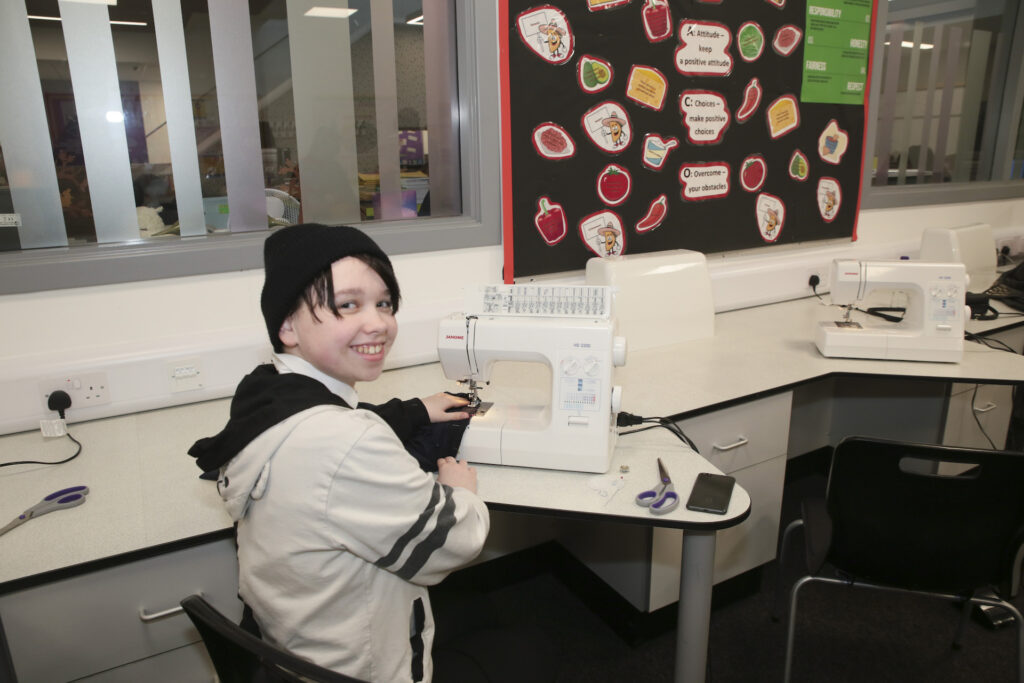
To gain the qualification, learners must complete all the necessary assessments, achieve the mandated number of hours, and present a portfolio of their work at the end of the course.
Kindred Clothing in schools
As well as working with young people in the community, Kindred Clothing is also making an impact within schools. Two Dundee secondary schools have trialled the course, providing motivation and opportunities for pupils who are disengaged with mainstream learning.
One of the latest participants to complete the course is Amy, 24, mum to two-year-old Leo. Amy said:
I had just moved to Dundee when I found out about Kindred Clothing. I was struggling with anxiety and needed a distraction. Kindred Clothing gave me a break from the negative things going on in my life and really helped with my mental health. I’ve learned so many skills – I’ve made a bag, lounge suit, bucket hat and a T-shirt dress. Don’t get me wrong, it’s not been easy. I’ve been stressed, I’ve been confused, but I’ve also had such a laugh and made so many new friends. I’ve also learned that patience is key and there’s always a solution. One day, I’d love to open a clothes shop in Kirriemuir for all ages and sizes.
Maureen King, support worker at Baldragon Academy, added:
Kindred Clothing is making a fantastic and important contribution to our pupils and the school. Most of all, it’s given these young people a focus and the chance to work towards a credible and valuable qualification in a different way than they might have realised was possible. They’re also creating new friendships, building their confidence and seeing their true potential. The young people are genuinely surprised at what they can do, so Kindred Clothing is also opening their eyes to new possibilities down the line.
For more information, email hello@frontlounge.org, call/leave a message on 01382 220330 or visit www.frontlounge.org
See how this SCQF level 5 course compares to other qualification using our Interactive Framework.
All photography by Grant R Keelan of PPG Photography