


As the Scottish Credit & Qualifications Framework (SCQF) marks its 25th anniversary in 2026, we’re shining a spotlight on the people shaping its direction — the SCQF Partnership (SCQFP) Board. First in the series, we meet our Chair, John Evans, who shares his insights into the Framework’s successes and challenges.
John was appointed to the role of SCQFP Board Chair in December 2023.
He holds a number of non-executive positions in the private, public and third sector and is also a director of a Scottish League Football Club. John has worked in senior leadership roles across a range of sectors, including education.
About John’s role
Q: What motivated you to apply for the role of SCQFP Board Chair?
A: I had worked with the SCQFP during my time as HR Director with the police and also as Chair of a Sector Skills Council. I knew the importance of the work and the role to be played in creating a mobile and skilled workforce in Scotland. I felt I could bring an employer’s perspective o the Board.
Q: What’s been the most rewarding aspect of serving on the Board?
A: Seeing the SCQFP team and our contribution develop has been the most rewarding aspect. I believe we now truly understand our value and impact and how we can make a difference. For example, the recent collaboration with the British Council Scotland showed just how much we can offer to other countries.
Strategic vision
Q: What do you see as the SCQF’s most important contribution to Scottish education and skills development in the past 25 years?
A: The most important contribution has been providing a framework and common language for learning and qualifications in Scotland. We often take it for granted, but it’s been a long journey and we’ve benefitted from some fantastic contributions and people.
Q: How do you see the SCQF evolving over the next 25 years?
A: Recognition of Prior Learning will become increasingly important, particularly as people move between roles and sectors throughout their careers. For the SCQF, that means continuing to ensure that the processes around RPL are robust, trusted and clearly communicated. We are in the midst of a skills and work revolution that is possibly greater than the Industrial Revolution and we need to make sure that we have a mobile, agile and skilled workforce. I believe that AI makes human skills and judgement even more important and our work will be at the forefront of that evolution.
Impact and value
Q: Can you share an example of how you’ve seen the SCQF make a real difference to learners, training providers & employers?
A: I have seen first-hand how the SCQF can transform training and development. One example that stands out is my work with the Scottish Police College, where learning moved from a largely rote-based approach to a more work-based model. Crucially, it gave that learning a recognised currency, allowing it to be understood and valued beyond policing. That shift did more than strengthen skills and knowledge – it helped broaden routes into leadership, influenced the profile of people being recruited, and ultimately supported better outcomes for communities across Scotland.
Q: Why should learners, training providers and employers care about the SCQF?
A: It gives us a common currency, understanding, standards and dialogue that connects employers, learning providers and qualification bodies and, most of all, has the learner at the heart of that framework.
Collaboration
Q: What makes the Partnership model effective for Scotland’s qualifications landscape?
A: Just that …. it’s a partnership.
Q: What’s one thing you’d like more people to understand about the SCQF?
A: We need to make it simpler to understand – for everyone involved. I’m not sure that when a learner (or parent/carer) sees an SCQF level on a certificate they always know what it means. Likewise for employers. We do our utmost to help people understand the SCQF, but there’s always work to be done.
Learn more about the SCQFP Board at How We Operate.

Here’s something that might surprise you: Street Soccer Scotland isn’t really about football.
Well, it is — but only about 30% of it. The other 70%? That’s about you. Your confidence, your wellbeing, your future.
Street Soccer Scotland is a charity built on a simple but powerful idea: football is a way in. For people dealing with homelessness, poverty, poor mental health, isolation or just feeling like life has pushed them to the edges, walking onto a pitch is often the first step back. No judgment. No barriers. Just a game, a community, and people who genuinely care about what happens next.
More than a kickabout
The sessions are free and open to adults, and there are also dedicated programmes for young people, women and people with additional support needs. But whether you come along for a casual game or something more structured, you will find the same thing: a safe, welcoming space where you can just be.
And, for those who want to go further, there’s one-to-one mental health support, personal development and even the opportunity to gain qualifications that are recognised on the SCQF.
Street Soccer Scotland also works inside prisons across Scotland, using football-based learning to help people prepare for life after release – rebuilding connections, skills and hope before they walk back out into the world.
Turning football skills Into life skills
Here’s where it gets really exciting. Street Soccer Scotland partnered with Glasgow Clyde College to develop a set of SCQF credit rated modules – real, recognised qualifications – built entirely around football.

If you’re 14 or over, you can work towards modules such as:
- Communicating (SCQF level 4)
- Delivering a Street Soccer Event (SCQF level 5)
- Street Soccer Coaching (SCQF level 5)
- Player Support Skills (SCQF level 5)
A lot of the people who come through the door have had tough experiences with school and education. The last thing they want is to sit in a classroom again. These modules meet people where they are – embedding learning in something that already feels relevant and engaging. The skills you build on the pitch? Turns out they’re exactly the skills employers are looking for too.
You can mix and match modules depending on what suits you and most are delivered in small groups so you get real support along the way.
Paddy’s Story: Football, a World Cup and a new outlook on life
Paddy Maloney joined Street Soccer Scotland in 2020 and never expected it to take him to a World Cup – especially representing Scotland as an Irishman. But that’s exactly what happened when he travelled to Sacramento for last year’s Homeless World Cup.
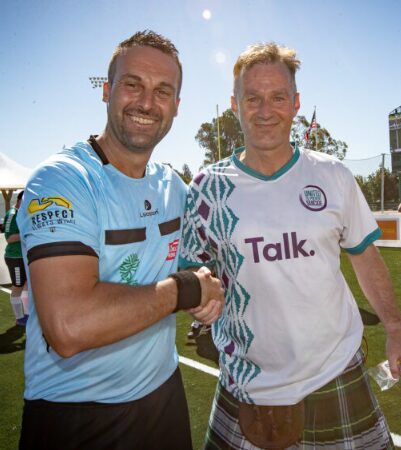
For Paddy, who has been open about past mental health struggles, the experience was transformative. “It’s really changed my perspective. It’s lifted me into a really positive place,” he said. “I’ve struggled in the past with my mental health but I am in a really happy place. It’s changed everything for me.”
“Street Soccer is like a family to me. Even in bad times, you can use something like football as the hook to lift you.”
Paddy’s journey – from weekly sessions in Portobello to a World Cup in California – is exactly what Street Soccer Scotland is all about: using football to take people places they never imagined possible.
The numbers speak for themselves
More than 420 people have already earned a recognised qualification through the programme. But perhaps the most telling statistic of all? 60% of Street Soccer Scotland’s own staff came through their programmes.
That’s not a footnote – that’s the whole point. People who once showed up just for a game are now coaching, supporting and leading. Some have gone on to volunteer or work with other organisations in the sector. The football was the door. What they found inside changed everything.
If you or someone you know could benefit from Street Soccer Scotland’s programmes, get in touch. The game’s just the beginning. Contact andy@streetsoccerscotland.org
Useful links
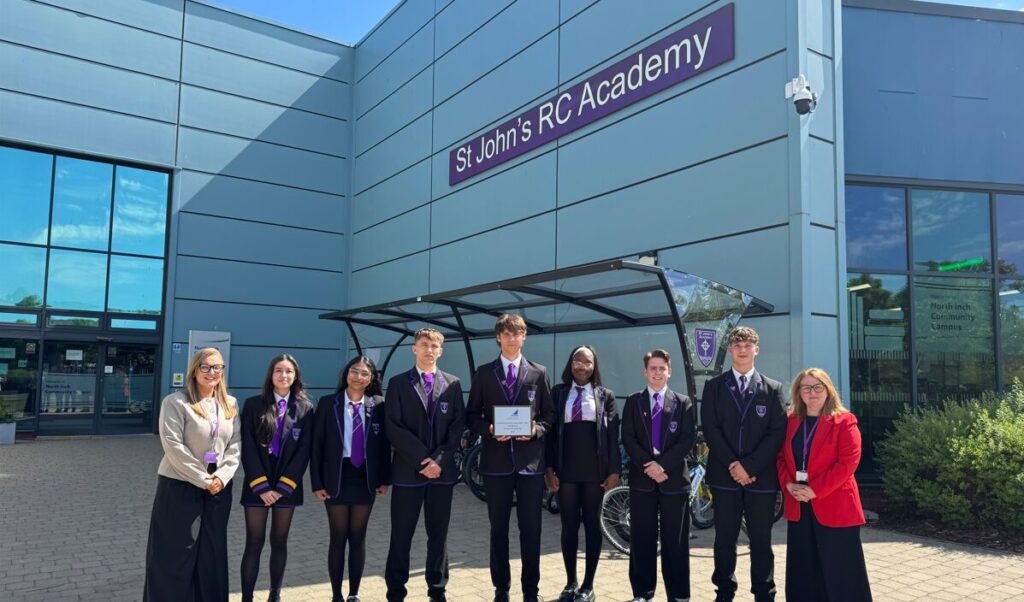
A Perth school is widening pathways, building confidence, and championing equity through the Scottish Credit and Qualifications Framework.
A journey three years in the making
While St John’s RC Academy officially registered as an SCQF Ambassador School in session 2025/26, the school has been championing the Framework for over three years. It has been a genuine grassroots effort, beginning with conversations among Curriculum Leaders and Classroom Practitioners, growing into whole-school discussions and ultimately reaching pupils and parents alike.
The SCQF has been discussed at leadership meetings and staff meetings, and information has been shared with pupils during assemblies. The school’s own enthusiastic SCQF Ambassadors have taken the lead in presenting to their peers and to parents and carers at senior parent nights. The feedback has been overwhelmingly positive, particularly from parents who came away with a clearer sense of how today’s qualifications compare to what they experienced when they were at school.
Raising awareness in creative ways
St John’s hasn’t relied on a single approach to spreading the word. The school has built up a comprehensive set of channels and resources to keep SCQF front of mind for its whole community.
- Pupil bulletin and Assemblies: Regular updates keeping pupils informed about qualifications and opportunities
- Social media: Videos shared on X (Twitter) to guide pupils through course choices
- School website: Dedicated SCQF sections for both pupils and parents with detailed guidance
- Classroom displays: Posters and resources in classrooms across the school
- Visual learner pathways: Clear curriculum pathway guides for pupils and parents at parent evenings
- Ambassador board: A pupil-created board highlighting the benefits of different awards
Expanding the curriculum
Alongside raising awareness, St John’s has been actively broadening what it offers to pupils. New qualifications have been introduced over recent years, and the school has strengthened relationships with local colleges, partnering schools, businesses and Developing the Young Workforce (DYW). Staff are also using the Awards Network to research further awards that pupils could benefit from, ensuring the range of options continues to grow.
Looking outward: engaging employers
One of the most exciting developments on the horizon is the school’s plan to have its SCQF Ambassadors present directly to local businesses. The aim is to help employers understand the real skills and experiences that young people have developed when completing a National 4, National 5, Higher, Advanced Higher, National Progression Award or Foundation Apprenticeship. The school hopes that building this understanding will benefit pupils as they step into the world of work.
The school is also developing pupil case studies, real-life examples of how different qualification pathways can be used to maximise learning and attainment, which will be shared on the website and social media channels.
Aiming for gold
Currently at Silver level, St John’s is already looking ahead to the next stage of the SCQF Ambassador Programme, with ambitions to achieve Gold Ambassador status. The team believes the tiered programme has provided clear targets and a framework for driving real improvement for pupils.
Lorraine Winwood, principal teacher of Raising Attainment, said: “There are young people across our school community – and nationally – who have achieved both academically and improved their confidence because of the opportunities offered to them through the SCQF.
“We will continue to work to maximise the available opportunities for our pupils to achieve and keep encouraging pupils to engage with varied qualification types – promoting equity for all.”
St John’s RC Academy is proof that championing the SCQF isn’t just about paperwork or policy: it’s about opening doors, building confidence, and making sure that every young person, whatever their path, has the opportunity to achieve.
St John’s RC Academy is an all-through nursery, primary and secondary school in Perth and Kinross. With a catchment covering the whole of Perth & Kinross, the school serves a diverse community and is committed to offering a wide range of qualifications to support every learner.
Useful links
1. What is the SCQF?
The SCQF is the Scottish Credit and Qualifications Framework. It brings together all the mainstream Scottish qualifications gained at school, college, university, in the workplace and in the community. Each qualification has credit points, which show how much learning has been achieved, and a level, which shows how challenging the learning is. You can use the Interactive Framework to compare qualifications and it can help you plan your learning journey. The SCQF Partnership is the custodian of the SCQF.
2. Do you have a record of my qualifications?
We do not keep records of the qualifications a person achieves. To access a record of your qualifications, please contact the awarding body, such as Qualifications Scotland (formerly SQA).
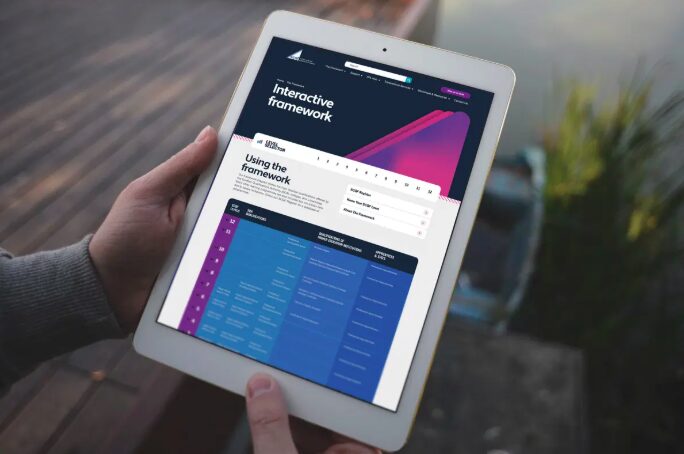
3. How do I find out the SCQF level of my qualifications?
You can check the Interactive Framework on the SCQF website, which lists qualifications such as Nationals, Highers, HNCs, HNDs, degrees, apprenticeships and more. If you can’t find your qualifications there, try the SCQF Register, a searchable database of over 10,000 qualifications.
4. How can I get my learning programme on the SCQF?
If your organisation has a learning programme that’s not already on the SCQF, you can apply for it to be credit rated by an approved credit rating body, such as a university or college. You can find out more at Get Your Programme on the SCQF.
5. Are my qualifications enough to get into teaching?
Entry requirements for teacher training are set by the General Teaching Council for Scotland (GTCS). You’ll need to check their website to see if your qualifications meet the requirements.
6. Can I compare qualifications across the UK?
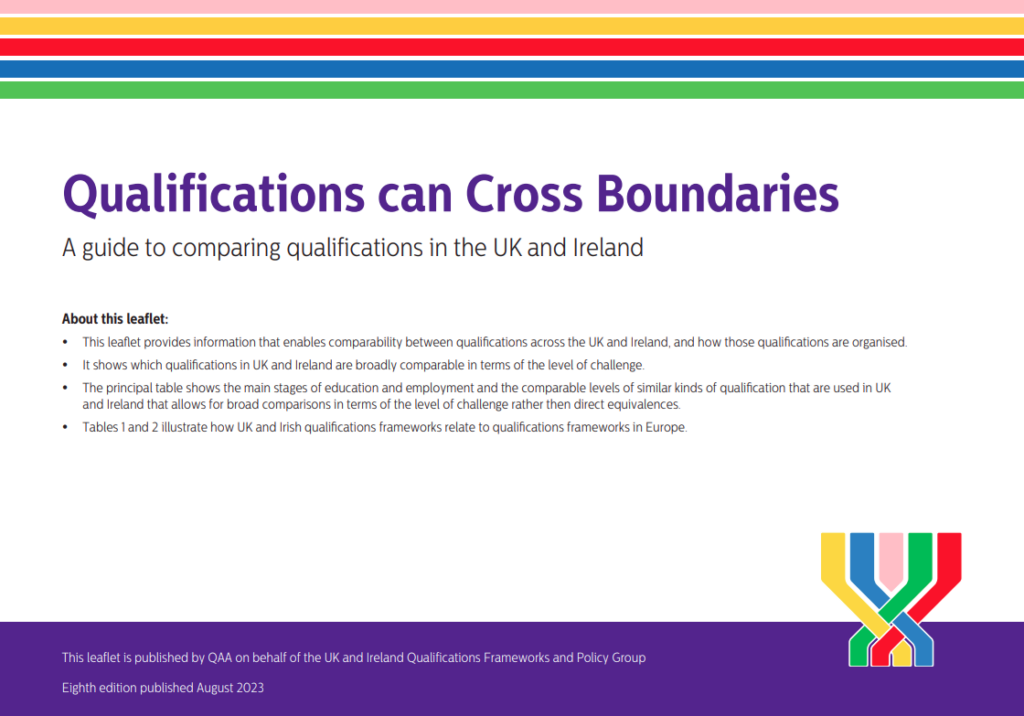
Yes – the SCQF can be compared with other frameworks in the UK, including the:
- Regulated Qualifications Framework for England and Northern Ireland (RQF)
- Credit and Qualifications Framework for Wales (CQFW)
- National Framework of Qualifications for Ireland (NFQ)
- Framework for Higher Education Qualifications (FHEQ)
The Qualifications Can Cross Boundaries guide can help you understand how they align. For example, if you have a Higher at SCQF level 6, that’s comparable to an A Level at RQF level 3.
7. Can you provide an equivalency certificate?
No – the SCQF Partnership does not issue certificates of equivalency. If you need formal recognition of a qualification for work, study or immigration purposes, you will need to contact UK ENIC, the UK’s agency for international qualifications recognition. There is a cost associated with this service.
8. What’s my SCQF level?
You can use our handy guide – Know Your SCQF Level – which explains how to check your SCQF level based on your qualifications and experience.

9. Can I use Recognition of Prior Learning (RPL) to enter a course if I don’t meet the entry requirements?
Yes – many colleges, universities, and training providers use RPL to grant course entry, advanced entry, or module exemption if learners can show that their previous experience or qualifications is comparable to the entry requirements. We provide guidance on RPL at our dedicated RPL Hub, however you will need to contact the institution directly to find out if they accept RPL claims.
10. What are my military qualifications equal to?
If you want to compare your qualifications to mainstream Scottish qualifications, you can use the Qualifications Can Cross Boundaries guide. Military qualifications are in the yellow Regulated Qualifications Framework(RQF) column. You can compare these to the blue SCQF column. For example, Functional Skills in Maths at RQF level 2 is comparable to an SCQF level 5. Visit Service Leavers & Veterans for more support in understanding your qualifications.
Do you have a question that is not featured above? Explore our in-depth FAQ at SCQF Partnership FAQs. You can also email info@scqf.org.uk
Across Scotland, employers invest heavily in developing high-quality in-house training. Much of this learning is highly structured, assessed and essential to workforce competence – but without formal recognition outside the organisation.

Third party credit rating provides a way to change that, by formally placing learning on the Scottish Credit and Qualifications Framework (SCQF).
At Glasgow Clyde College, we support organisations through this process from initial enquiry through to approval and ongoing review.
Most recently, we credit rated NHS Scotland’s Central Decontamination Unit (CDU) Training Programme. Let’s take that as an example to see what happens behind the scenes.
1. Initial enquiry and suitability check
The process usually begins when an organisation asks a simple question: “Could this be credit rated?”
At this point, we carry out an initial discussion to assess whether the programme is likely to meet SCQF requirements. We are looking for four core conditions:
- Clearly written learning outcomes
- A minimum of 10 notional learning hours
- Formal assessment of learning
- A quality assurance process already in place
If these are in place (or close to being in place), the programme is likely suitable to progress.
In the CDU programme, NHS colleagues already had a highly structured, assessed training pathway aligned to clinical safety requirements, which made it a strong candidate from the outset.
2. Due diligence and organisational credibility
Before any credit rating work begins, the college must be satisfied that the organisation is a credible and stable training provider.
This involves reviewing evidence such as:
- Quality assurance systems and governance arrangements
- Assessment and marking processes (including independence, where applicable)
- Staff qualifications and training capability
- Internal verification or audit processes
- Learner support arrangements
- Organisational stability and delivery capacity
A formal agreement is then put in place between the college and the organisation setting out responsibilities, ownership of materials, and use of SCQF branding.
For the CDU programme, this included clarity on NHS Scotland Academy’s national delivery model and existing quality assurance structures across multiple sites.
3. Programme development and mapping
Once approved to proceed, the detailed credit rating work begins.
The organisation submits:
- A full programme specification
- Unit outlines (or structured learning components)
- Assessment materials and guidance
- Evidence of delivery and internal quality assurance
At this stage, we work closely with the organisation to refine documentation so it clearly demonstrates:
- What learners will know, understand and be able to do
- How they will be assessed
- How consistency is maintained across delivery
For NHS Scotland’s CDU programme, this involved breaking down technical workplace learning into clearly defined units aligned to practice in decontamination units.
4. SCQF level and credit allocation
A subject-specific credit rating panel is then convened by Glasgow Clyde College.
The panel includes:
- Subject specialists
- SCQF experts
- Independent members not involved in programme design
The panel’s role is to:
- Map learning outcomes against SCQF level descriptors
- Agree the appropriate SCQF level
- Calculate credit points based on notional learning hours (10 notional learning hours equates to 1 SCQF credit point)
- Record and justify decisions formally
This is one of the most important stages, ensuring consistency and integrity across the framework.
5. Outcome and formal approval
Once the panel has agreed the level and credit value, the college issues formal confirmation.

This includes:
- SCQF level and credit points awarded
- Any conditions or recommendations
- Requirements for use of the SCQF logo and terminology
- Confirmation of recognition
At this point, the programme becomes officially credit rated and can be promoted as SCQF-recognised learning. It is also added to the SCQF Register, which is a searchable database of all credit rated qualifications.
For the CDU programme, this meant the training was formally recognised at SCQF level 6, giving national visibility to a critical NHS workforce pathway.
On average, it takes around 6 months for a learning programme to go through the credit rating process, and it’s largely dependent upon the size of the project.
6. Ongoing monitoring and review
Credit rating is not a one-off exercise.
We maintain oversight through agreed review points to ensure:
- Programme content remains current
- Assessment methods remain valid
- Any changes are re-checked against SCQF levels
- Quality assurance continues to meet agreed standards
This ensures the integrity of SCQF credit rating over time.
Why the CDU programme matters
The CDU Programme demonstrates something important – structured, workplace-based training already delivering high standards can achieve national recognition without being redesigned as an academic course.
For learners, this means:
- Skills are visible and portable
- Clearer progression pathways within the NHS
For employers, it means:
- Stronger workforce development and retention
- Greater consistency and governance
- Recognition of complex, safety-critical training
Is your programme suitable for the SCQF?
Many organisations are surprised to learn their training programmes are already close to meeting SCQF requirements.
If your training:
- Develops real workplace competence
- Includes assessment and quality assurance
- Supports progression beyond basic induction
… it may already be ready for credit rating.
Getting started
Most organisations begin with a simple conversation and a draft outline of their programme. From there, we can advise on suitability and next steps.
To discuss a potential project and costs, which start at around £3,500, contact Elaine Donnelly at edonnelly@glasgowclyde.ac.uk
Useful links
Get Your Programme on the SCQF

Teachers across Scotland are telling us the same things. They want to build skills that actually matter for young people’s futures, but feel boxed in by assessment structures that don’t leave room for creativity.
They know employers are crying out for people who can problem solve, communicate and think on their feet, but there’s a gap between what education says it values and what it formally recognises.
And when something new comes along, they’re often expected to commit before they’ve had a proper chance to see what it looks like.
We built the Creative Innovation qualification with all of that in mind.
Turning creative thinking into real-world skills for learners
Our Creative Thinking qualifications, already delivered in schools across Scotland, teach young people how to think differently.
Creative Innovation takes that further. It asks learners what they’re going to do with those ideas.
They research, develop concepts, test and iterate when things don’t work, pitch their thinking persuasively, and evaluate the impact of what they’ve built.
Five learning outcomes drive the whole qualification: Research, Conceptualise, Fail & Fix, Communicate, and Evaluate.
If that sounds more like what happens in a design studio or a startup than a traditional classroom, that’s deliberate. This is a qualification that gives young people the tools to take an idea somewhere real.
Industry-led challenges that build employability skills
Creative Innovation is designed for S4 to S6 learners at SCQF levels 5 and 6, and it’s structured around playlists of challenges created with real industry partners:
- The Caring Innovators challenge, developed in partnership with NHS Scotland, invites learners to pitch ideas that help people thrive, exploring how creativity and empathy can shape the future of healthcare.
- Other challenges see learners reimagining how we experience school, designing bold new food concepts, or building business ideas rooted in joy.
- Opencast, a technology company, is another partner helping to ground the qualification in what the workplace actually needs.
These aren’t abstract exercises. The challenges connect learners to communities and industries beyond school, and the skills they’re developing are the ones that employers and universities are actively looking for.
Try before you deliver: download the full teaching playlist
Here’s something we think matters: you can download a full playlist, an entire academic year of challenges, resources, and activities, before you decide whether to deliver. No commitment, no sign up. Just download it, look through it, and see if it’s right for your learners.
Each playlist contains three challenges with structured project decks, creative warmup activities, video content and downloadable templates.
Teachers are also supported by Dreamcatcher (our electronic marking tool), a network of Daydream Ambassadors, and a Slack community, so no one delivers in isolation.
The qualification is open to any teacher interested in fostering creativity, enterprise and innovation. You don’t need to be in any particular department.
How does the qualification fit within the SCQF, Insight and UCAS?
The qualification carries 24 SCQF credits at level 5 or level 6, Insight points and, at level 6, UCAS tariff points for grades A to D.
It’s credit rated by Edinburgh Napier University and sits within the SCQF, connecting to the progression pathways schools already understand.
Assessment is portfolio-based, practical, and creative, built around the innovation process learners have been living through all year.
Learn more about the Creative Innovation qualification
Find out more about the qualification here and see for yourself. If you’d like to find out more or talk to us about delivering Creative Innovation in your school, get in touch.
We run introductory meetings to support new teachers through the process, and we’d love to hear from you.
We are hosting a CPD event at Dovecot Studios in Edinburgh on Monday 11th May. Walk The Walk brings the five learning outcomes of our qualifications off the page and onto their feet. You’ll step through each one and see what they actually look like when teachers and learners are in the thick of them. Sign up for the event.
This blog has been hard to write – so many perspectives to consider, issues to distil and questions to articulate, but they’re important so bear with me while I try to explain.

Do you know the difference between a Higher, a National Progression Award (NPA) and a Foundation Apprenticeship (FA)?
No need to panic if not as, for this blog, it’s their similarities that are important.
Potentially, all three learning programmes could be deemed to have the same level of difficulty as they are credit rated at level 6 on the Scottish Credit and Qualifications Framework (SCQF). They could also all earn those successfully completing them the same number of SCQF credit points – 24 (one SCQF credit point equals 10 notional hours of learning).
How SCQF level 6 qualifications are structured and recognised
All Scottish Highers are awarded 24 SCQF credit points, but some NPAs carry fewer while FAs carry more. All three are potential programme types on offer in fifth and sixth year in Scottish schools and, as of April 2026, there are 735 level 6 programmes on the SCQF Register.
In addition to differing credit values, some programmes must also meet specific design principles to be classified as a particular type of qualification – a Higher, for example, typically requires an externally marked exam.
Others have no such set criteria and credit rating against SCQF level descriptors has enabled them to be assigned a level on the SCQF and, through doing so, built credibility, confidence and recognition of attainment in a way which previously wasn’t possible.
SCQF qualifications: Freedom, flexibility and choice
The variety of programmes on the register is vast and caters for interests as diverse as E‑sports, classic ballet and Scottish Studies, through to Preparation for HE (all are 24‑credit SCQF level 6 courses – see more examples below).
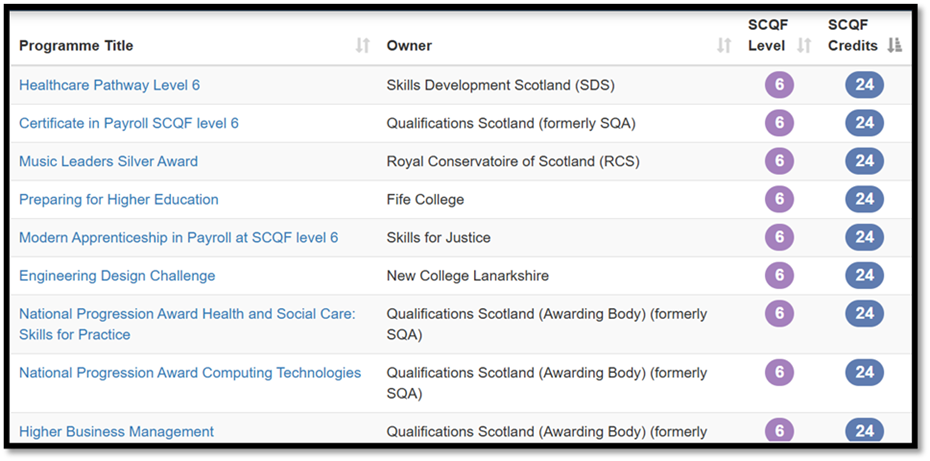
Many of these are often referred to as ‘alternative level 6 qualifications’ (alternative to a traditional Scottish Higher qualification, even though they may carry fewer SCQF credit points). They are offered to senior phase pupils in our secondaries and the range of choices are far from those on my own 1990s school options forms.
Increased personalisation and options can be very motivating for young people, indeed for any learner, but freedom, flexibility and choice present other challenges, particularly when it comes to university entry.
The value of alternative qualifications
These courses have intrinsic value and often practical relevance in the workplace: one pupil told me recently that they secured a job in Costa Coffee because they had completed their SCQF level 5 Barista Award in school.
The majority of learning programmes aren’t designed with university entry in mind. However, when we start delivering them in schools, we all want to get it right for those pupils undertaking them, especially those who are applying to university and, therefore, need to know whether alternative qualifications at SCQF level 6 will be considered currency for entry or not.
Will SCQF level 6 alternative qualifications allow university entry?
If a learning programme has been credit rated at SCQF level 6 and carries 24 credit points (as a Higher does), should it be considered ‘equivalent’ to a Higher as an accepted qualification for university entry? And if not, why not?
Is the level of difficulty someone can cope with (which is what an SCQF level tells us) what universities need to know to determine that individual’s ability to succeed on a degree course? Or is sitting an exam in the traditional sense a fundamental measure or gauge of degree potential? Or is the type of assessment not as important as the requirement that it is marked externally (not by your own teacher)?
Once core curriculum aligned qualifications have been attained (e.g. Physics and Maths are usually required Highers for Engineering degrees), what else determines degree readiness as few (if any) universities only ask for 2 Highers for entry to a degree? Do the other 1, 2 or 3 Highers normally required indicate an individual’s ability to work at a certain level of difficulty and, if so, could this also be demonstrated through attainment of an alternative 24-credit, SCQF level 6 qualification?
Putting equivalency of SCQF level 6 in the spotlight
Unfortunately, I can’t answer these questions but I can raise them, and my role at Scotland’s Community of Access and Participation Practitioners (SCAPP) affords me the opportunity to set up online discussions and to invite key stakeholders along to probe important questions like these. We did this at an initial webinar on this topic in January, but it was clear that more stakeholders representing different organisations and perspectives were needed in the virtual room to try and answer these questions and explain the complexities further.
There were admissions officers, careers advisers, teachers and widening participation practitioners present, but we would love to have Qualifications Scotland and Education Scotland representatives among others in attendance at a follow-up session.
The challenges of SCQF level 6 alternative qualifications
Some of the issues and challenges raised at the initial webinar include:
- Learners, parents, teachers and advisers can find it hard to keep track of universities’ entry criteria as these vary not just by university but course by course, and some courses and universities will recognise an alternative SCQF level 6 qualification for entry while others will not.
- Universities are autonomous institutions free to set their own entry criteria, so there is no requirement for them to adopt a blanket policy on accepting FAs, NPAs or other SCQF level 6, 24 credit point qualifications for entry onto their degrees.
- Many universities will consider alternative SCQF level 6 qualifications in the holistic context of an individual’s application, but sometimes applicants incorrectly describe these on their UCAS forms, so it can be difficult to assess their merit.
All of these factors contribute to the challenges presented by alternative SCQF level 6 qualifications.
What does this mean for widening access?
Does uncertainty about the recognition of a qualification create an additional barrier for university applicants from widening‑access backgrounds, potentially compounding the difficulties they already face?
I don’t know the answer to this either, but it’s where my professional interest in this topic lies.
Reflection and next steps
Scrolling through the SCQF Register, I think I would have loved the level 6 Achieving Excellence in Sport 24-credit qualification (if it had existed in 1998 and been on offer to me). But, as it’s not a Higher, would it have affected my chances of getting into university, even though the Higher Music I did in S6 was no more relevant in terms of curriculum alignment to the Arts degree I was applying for? The SCQF level 6 Preparation for HE course would have been infinitely more useful but, again, would it have counted towards ‘getting me in’, despite there being no doubt it would have helped me ‘get on’ well in my studies once there?
If we can all agree, which I think we can, that we want university applicants to make well informed options choices, knowing the currency of alternative SCQF level 6 qualifications when it comes to admissions criteria, then a discussion on how to move closer to achieving this should be had by all those involved in the writing, delivery and credit rating of, as well as those advising and participating in, these programmes.
Join the follow-up conversation online on Thursday, 28 May, from 3pm to 4.15pm. Find out more and sign up here.
To keep in the loop, sign up to the SCAPP mailing list.
Patricia Anderson is a former secondary teacher and current Development Manager for SCAPP (Scotland’s Community of Access and Participation Practitioners).
The Scottish Credit and Qualifications Framework Partnership (SCQFP) has launched a tender to develop an interactive eLearning pilot.
The project will convert existing SCQFP workshops into a modern, engaging online learning experience, helping to extend reach and improve accessibility.
What SCQFP is looking for
The successful supplier will deliver a fully developed, learner-centred eLearning experience hosted on the SCQFP website, including:
- Interactive modules and multimedia content
- Assessment tools with reporting functionality
- Storyboards, wireframes and technical documentation
- A solution that is easy to maintain and update internally
Key details
The deadline for submissions is Friday, 24 April 2026.
Download the full tender document and appendixes below for further information and application details.